Spherity Research · Publication overview and final PDFs
Proofs over Statements: Verifiable Evidence Graphs
Credential formats for European Business Wallets, industrial AI and mixed-assurance evidence
Browse this paper
In brief
What does this research establish?
For industrial evidence that is combined across organisations, retained and repeatedly verified as graph data, this paper recommends a common W3C VCDM 2.0 JSON-LD profile secured by RDF-based Data Integrity. Preserve source snapshots, interpretation rules and assurance levels; add an envelope when a defined presentation or interoperability requirement justifies it. This is a conditional engineering recommendation, not a claim that every nested credential is insecure or that graph proofs are always faster.
Key takeaways
- JSON-LD syntax alone is insufficient: verification needs the authenticated proof inputs, controlled interpretation and recoverable source boundaries.
- Envelope-only B1 and a nested credential retaining an inner Data Integrity proof have different verification obligations; the paper distinguishes them.
- Ordinary EAAs and policy-required QEAAs should be able to use a common graph profile while retaining their different assurance levels and issuance requirements.
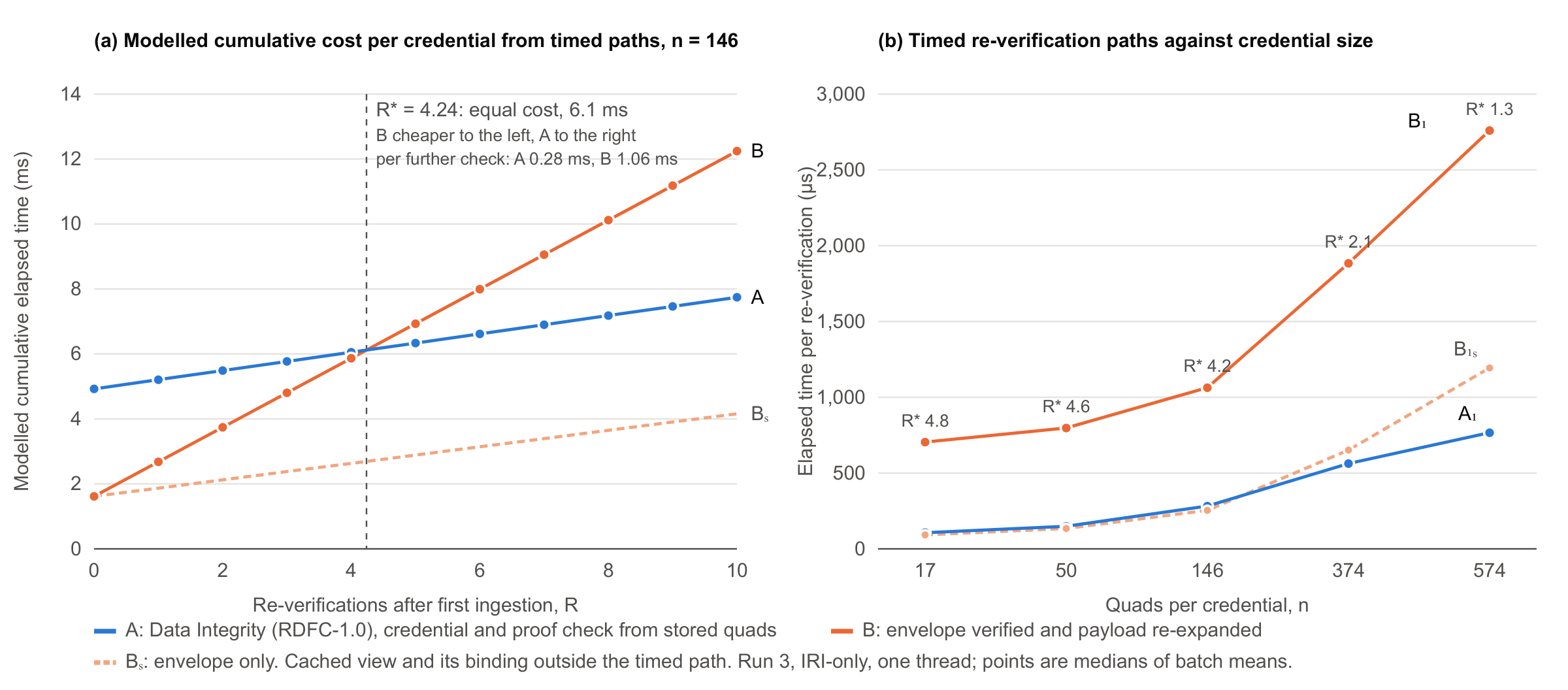
- The prototype cost advantage depends on repeated verification with refreshed envelope-to-graph mapping. Protected cached mappings and presentation workloads can favour other paths.
- The release supplies complete signed plain and nested examples, exact tokens, public verification material and passing positive and negative test reports.
Final publication downloads
This is the research overview for the final publication package, version 1.3, 9 November 2026. The PDFs are the authoritative full paper and executive brief.
- Full paper · PDF · 63 pages
- Executive brief · PDF · 20 pages
- Complete publication package · ZIP
- All figures · SVG, PNG and PDF
- File metadata and SHA-256 checksums · JSON
The ZIP contains both PDFs, editable LaTeX sources, vector figures, complete signed credential examples, exact tokens, public verification material, pinned dependencies, validation reports and checksums. Each document folder is self-contained. The executive brief introduces business-wallet and industrial requirements for readers who already understand credentials; its appendix gives the same complete verification examples as the full paper.
What must remain verifiable after evidence is merged?
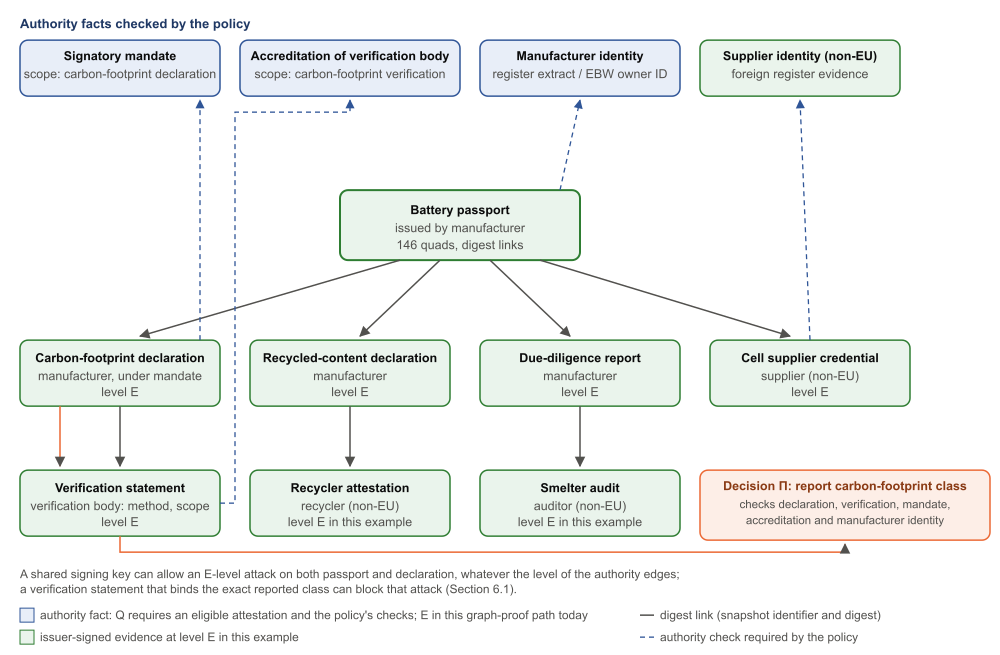
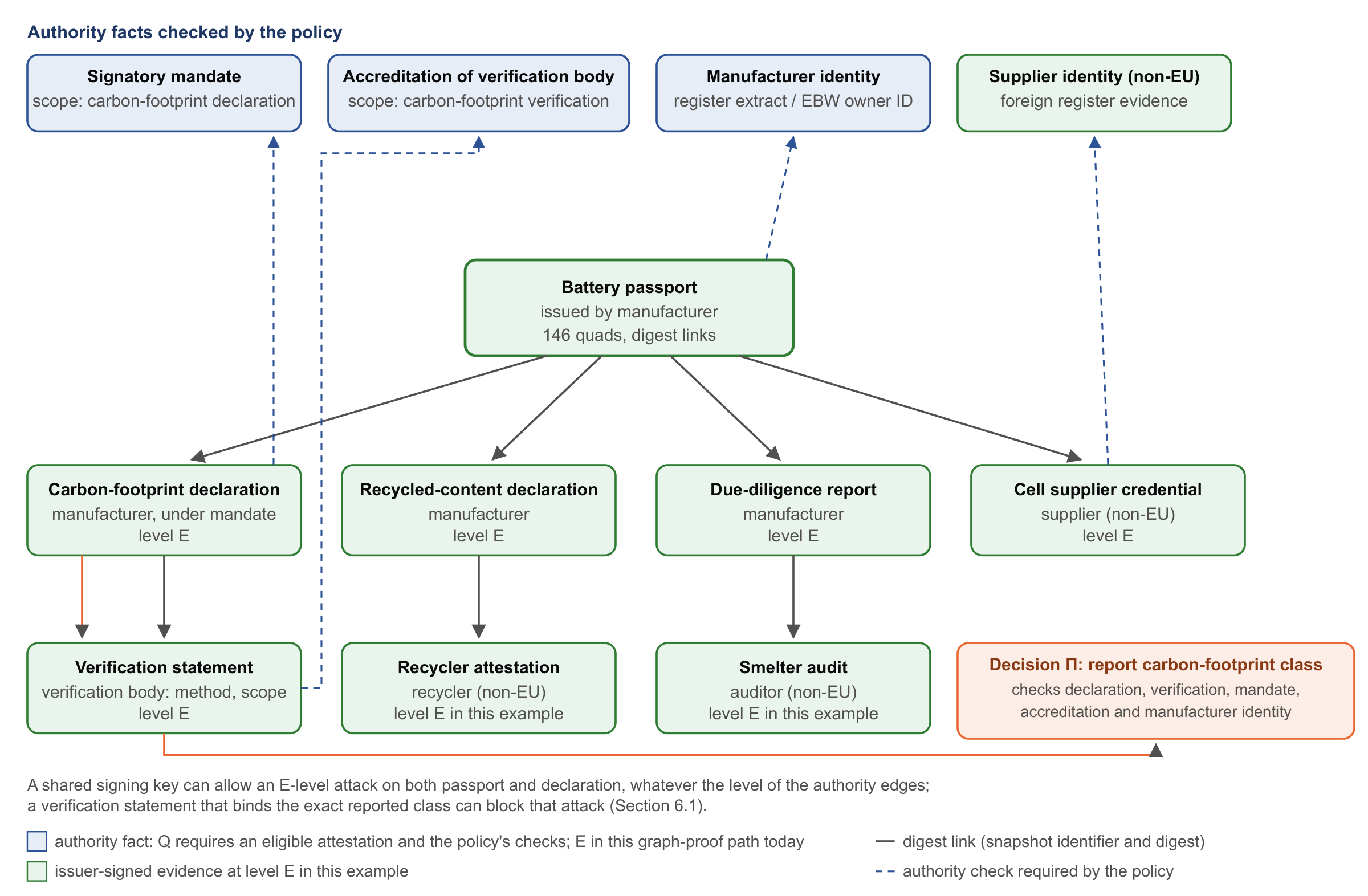
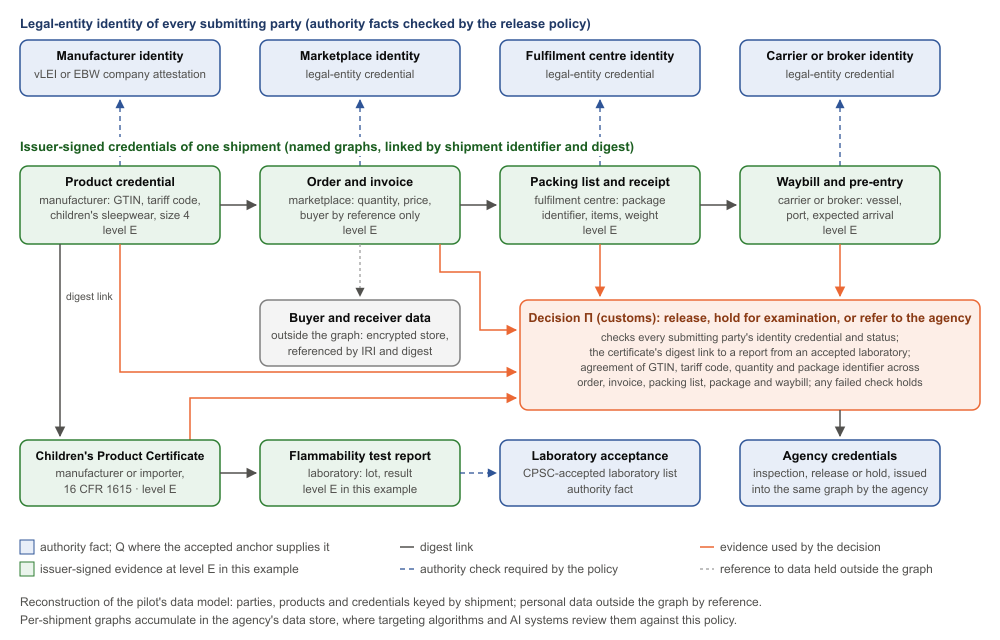
A citizen may present selected attributes to a verifier. An industrial workflow can retain and combine evidence from manufacturers, suppliers, laboratories, authorities and automated systems. Battery-passport analytics, customs review and an aerospace safety supervisor are the paper’s worked examples. These workflows need the meaning, issuer, source version and applicable authority of an assertion to remain inspectable after it becomes part of a larger graph.
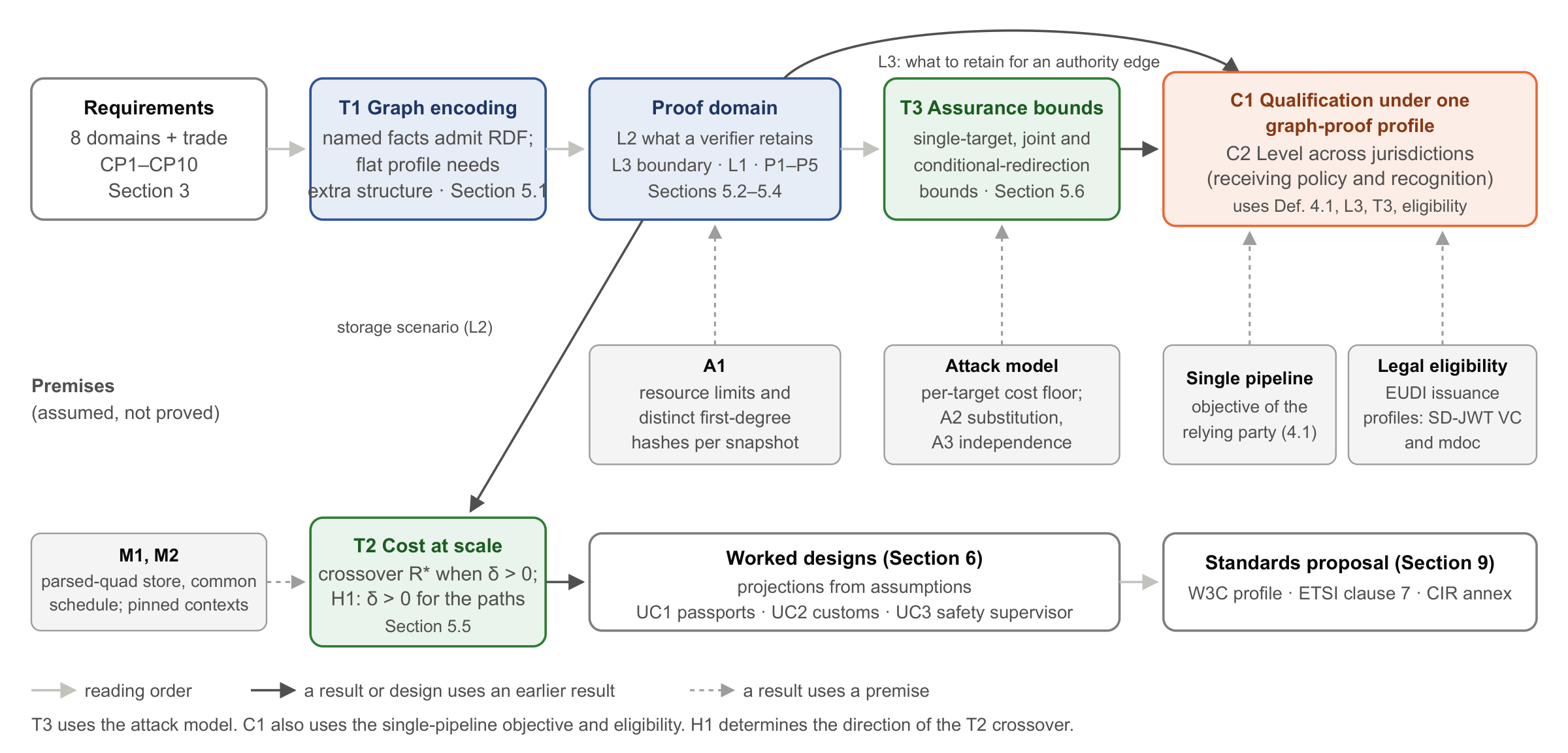
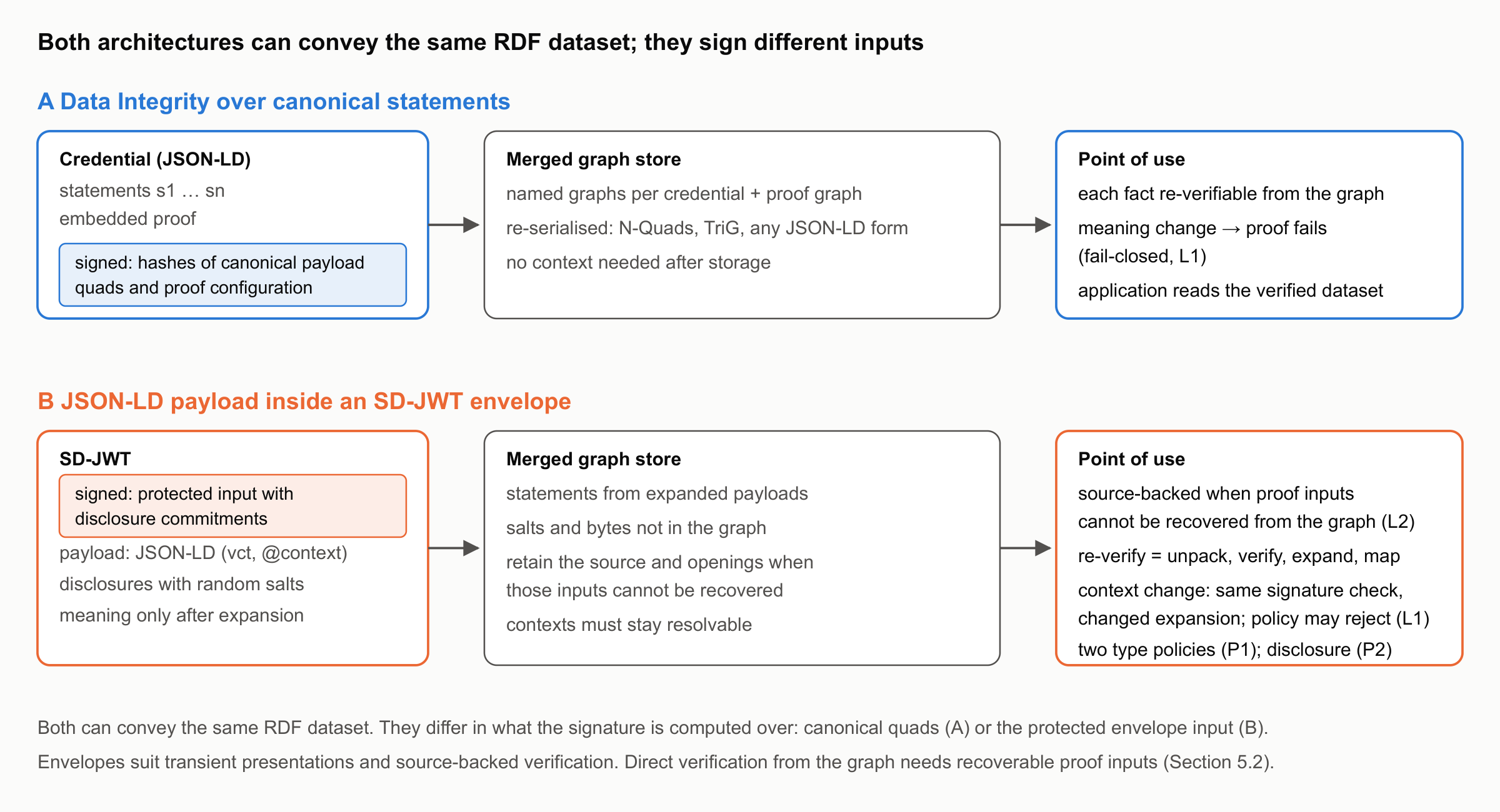
The architectural question is therefore not simply whether a credential contains JSON-LD. Both a graph-proof credential and a nested envelope can carry JSON-LD. The question is which inputs the issuer authenticated, what the relying party preserves, and how a machine binds the fact it uses to that authenticated evidence. Shared identifiers and RDF semantics help combine facts; credential proofs, source boundaries and decision policy address different parts of their use. The full paper develops these distinctions in Sections 4–5.
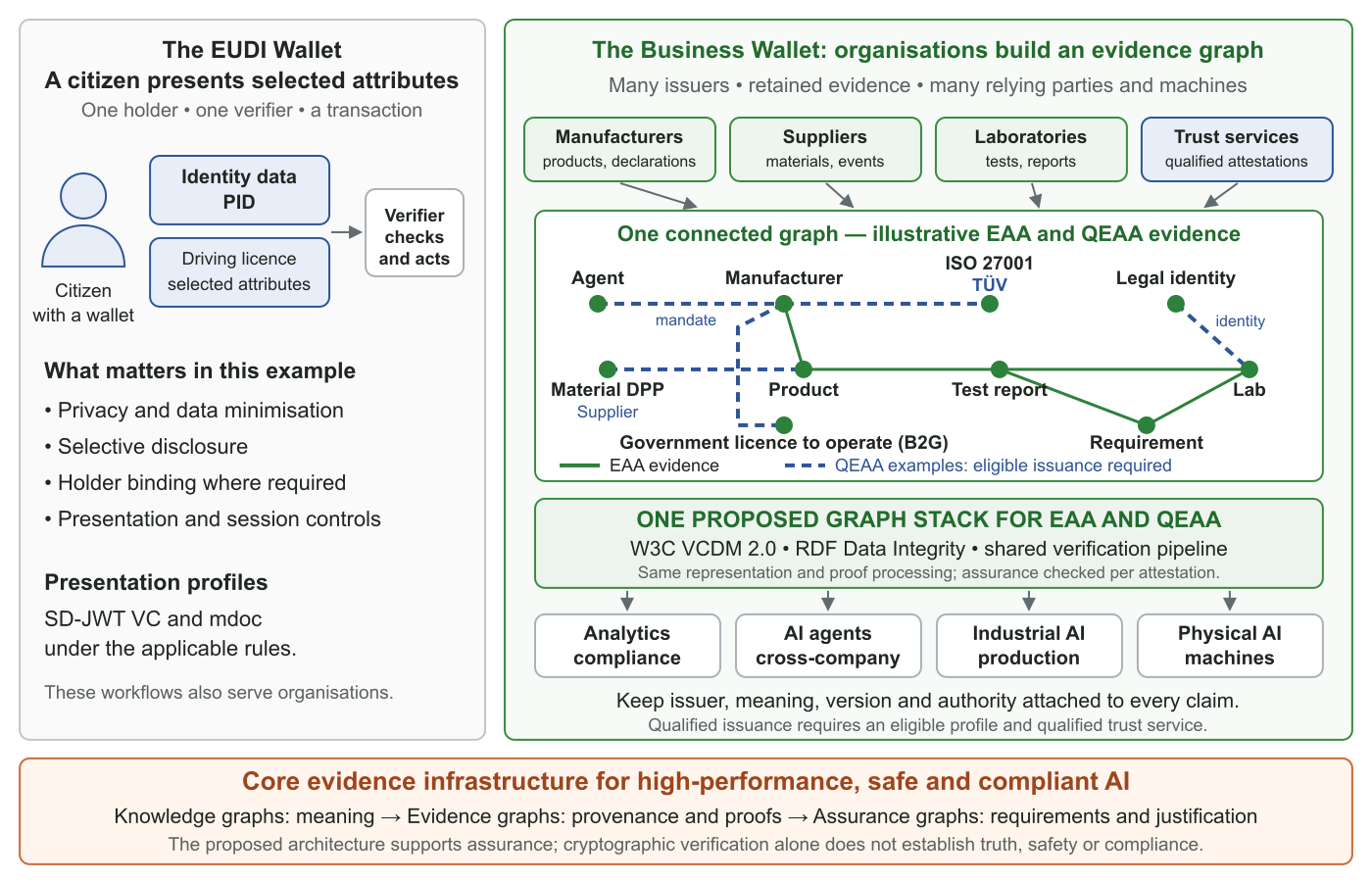
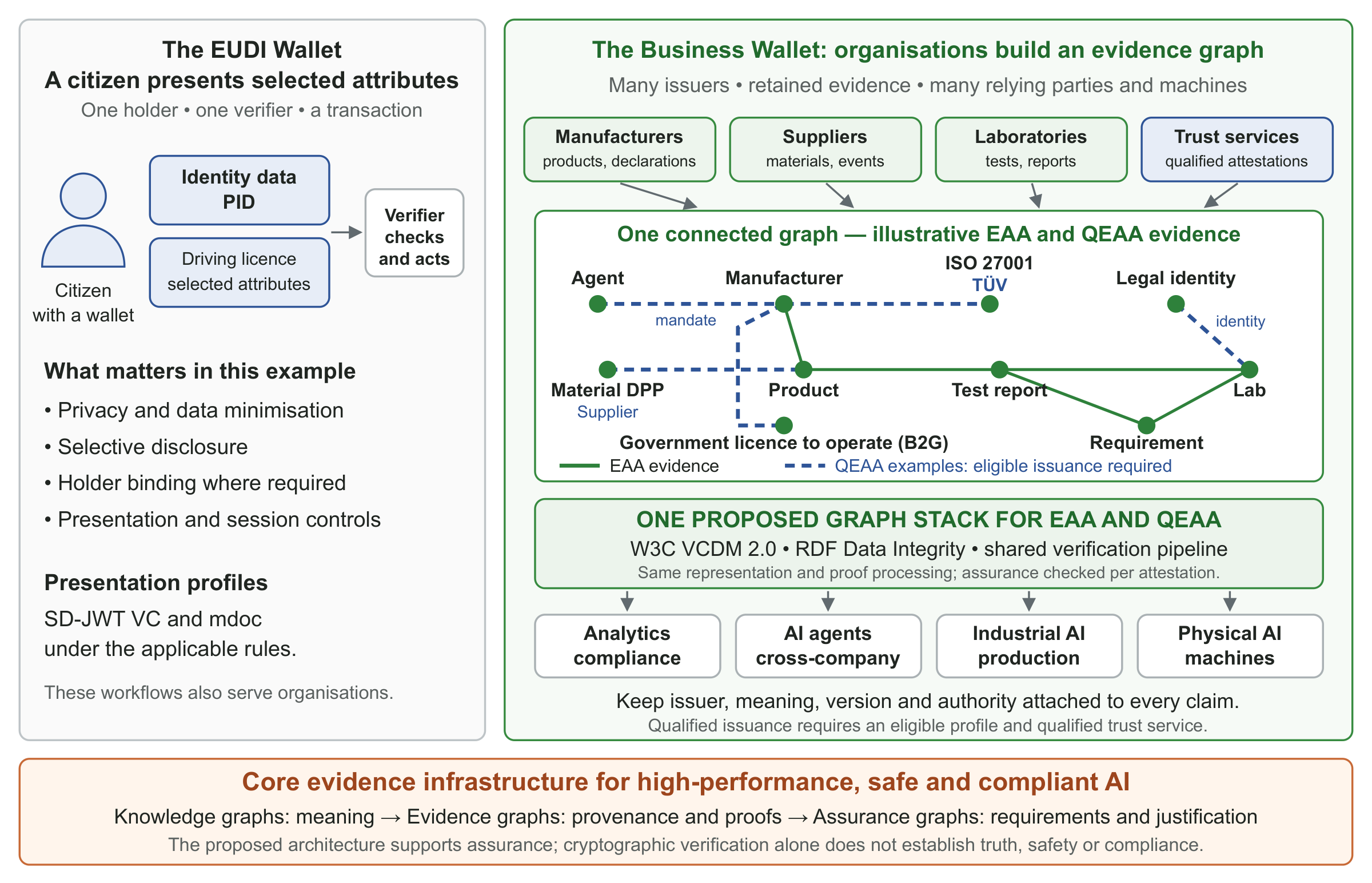
A common graph profile, with envelopes where they serve a purpose
The paper recommends W3C Verifiable Credentials Data Model 2.0 expressed in JSON-LD, secured with an RDF-based Data Integrity suite, as the persistent evidence format for the specified retained industrial graph workload. A profile is more than a serialization: it also fixes interpretation rules, admissible proof suites, source recovery, issuer/key binding, status handling and application validation. W3C VCDM 2.0 supplies the data model; Data Integrity supplies proof mechanisms.
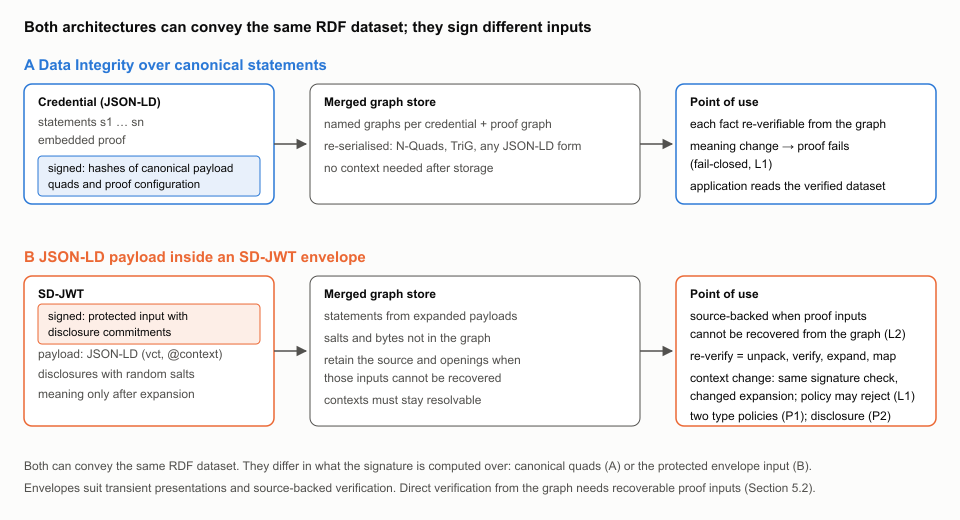
| Construction | What the verifier must establish | Consequence for retained graph evidence |
|---|---|---|
| A: RDF-based Data Integrity | The suite’s authenticated credential dataset and proof configuration, with authorised verification material and profile checks. | Recover the signed source snapshot, original graph positions and proof inputs. An arbitrary merged graph with source boundaries erased is insufficient. |
| B1: JSON-LD in an envelope, without an inner graph proof | The protected token input and disclosure commitments, plus the governed interpretation and binding to the graph view. | Keep the relevant source inputs available or reliably reconstructible. A protected cached mapping is a valid design when its binding, freshness and status are governed. |
| Dual-proof nesting in the complete examples | The outer ES256 signature and disclosure commitment, and the inner Ed25519 Data Integrity proof; both must pass under the example profile. | The inner graph-proof route is preserved, with additional obligations whenever policy relies on both layers. These are not the B1 benchmark timings. |
Use an envelope for a defined presentation, disclosure or interoperability requirement. A presentation-only wrapper can be checked at ingestion, followed by direct verification of the retained inner credential when policy permits. Its extra proof work need not recur on every graph read. Equally, selecting a graph format does not eliminate conflicting application schemas, unsafe processing, stale evidence or false statements by an authentic issuer.
What the cost and assurance results establish
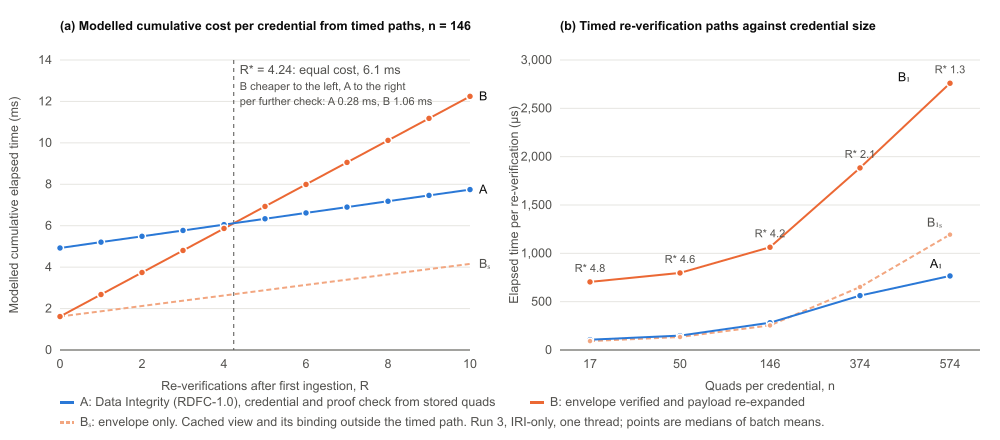
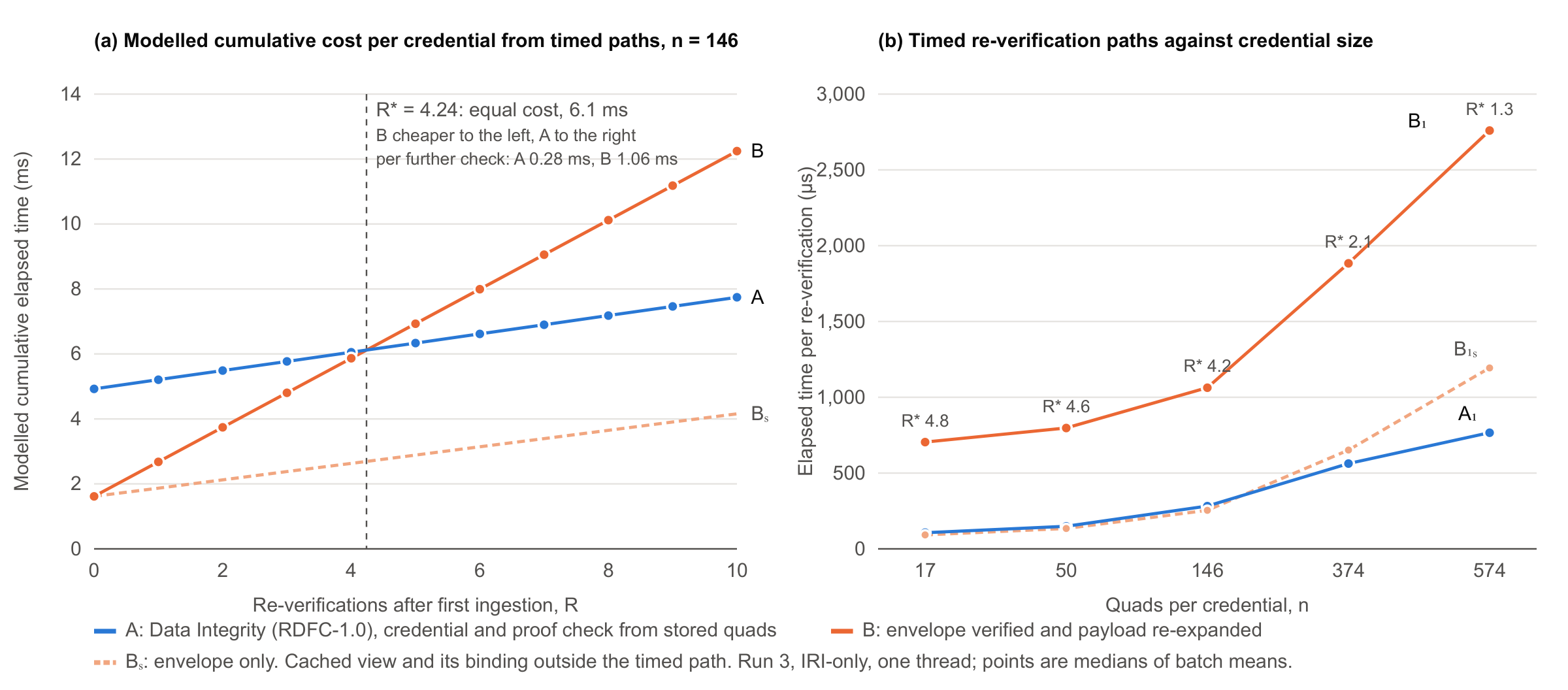
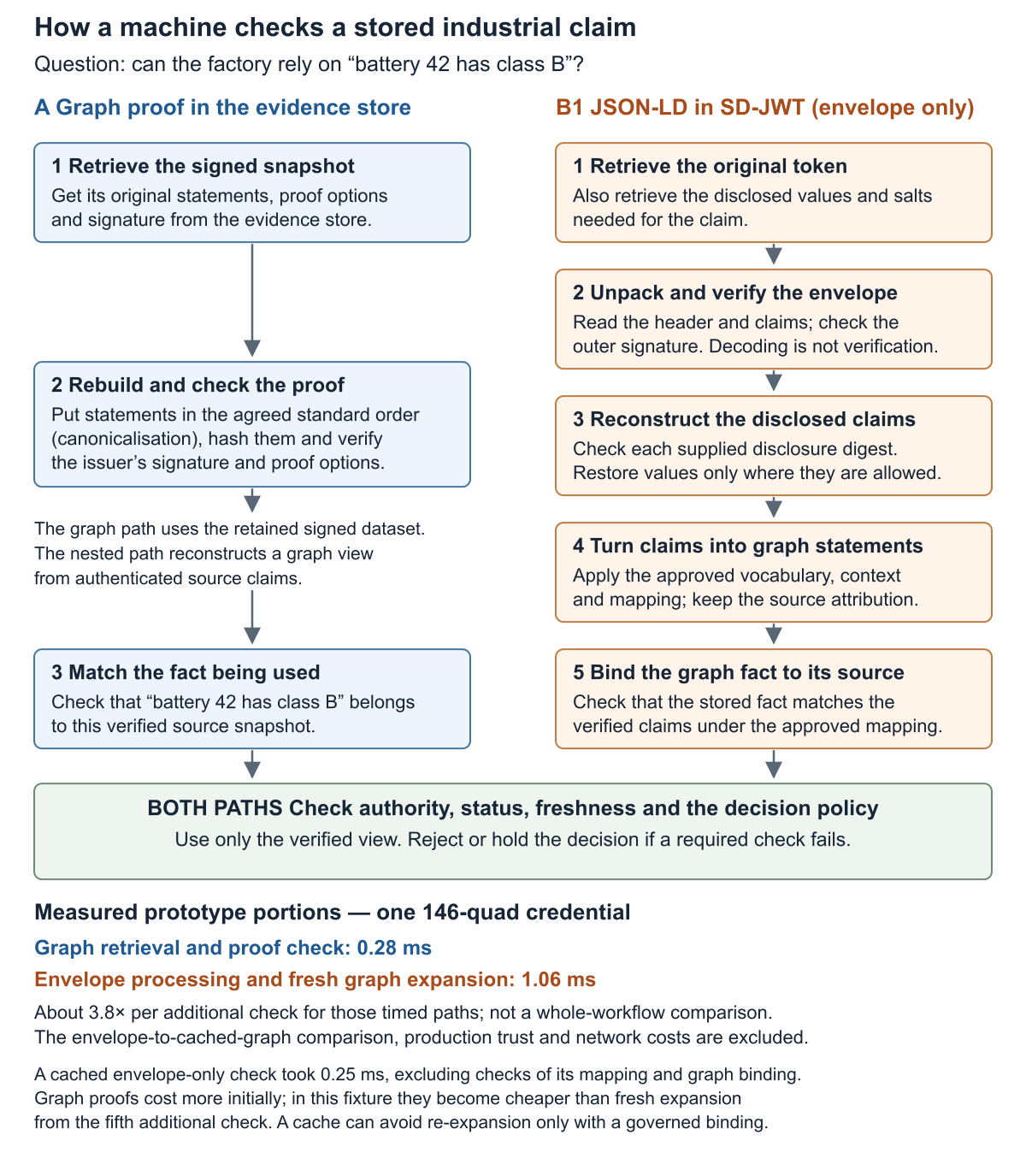
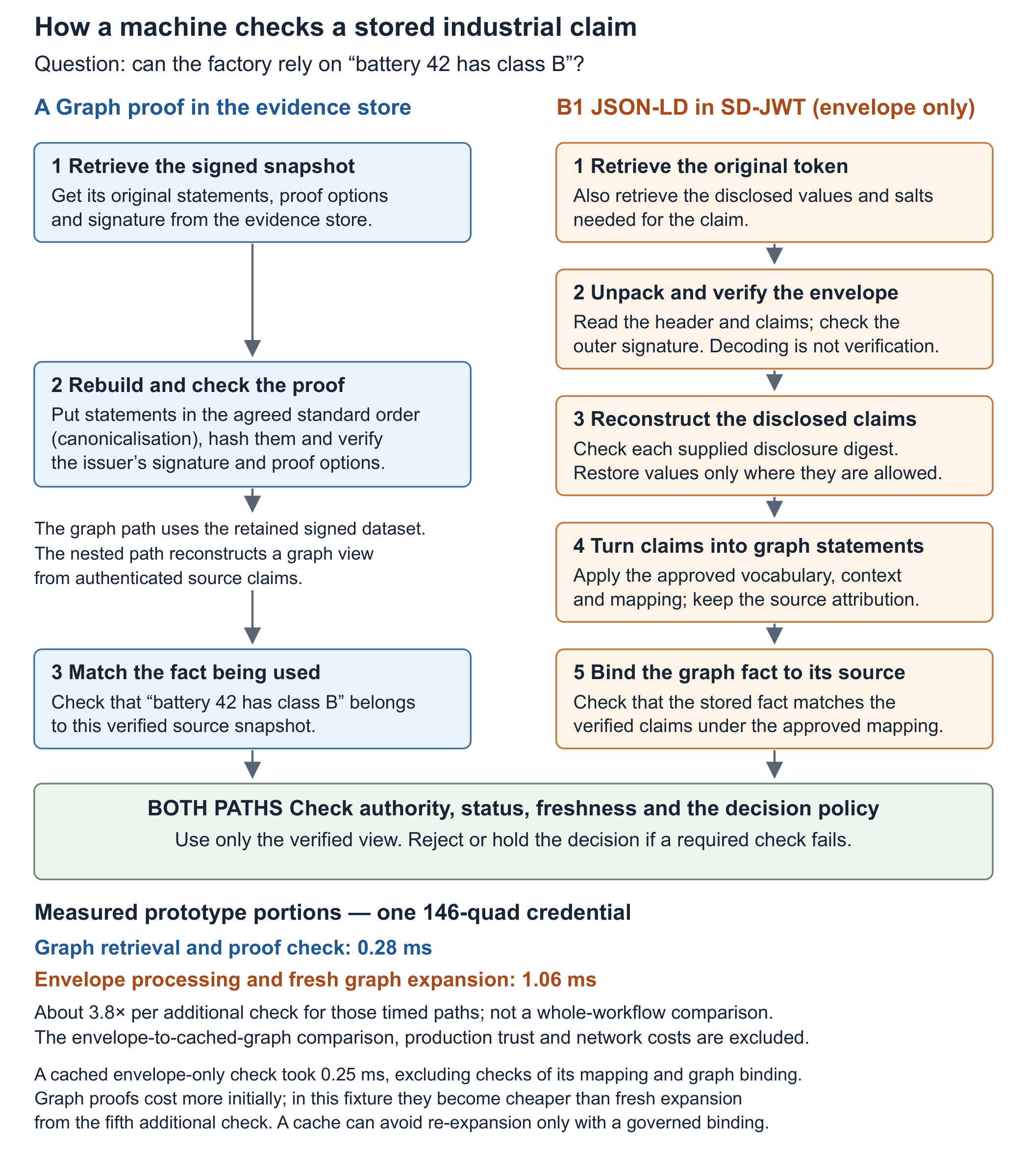
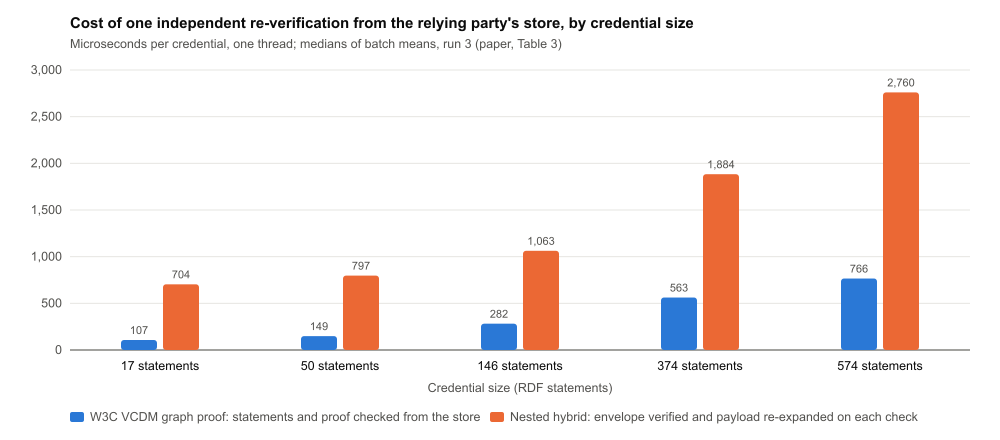
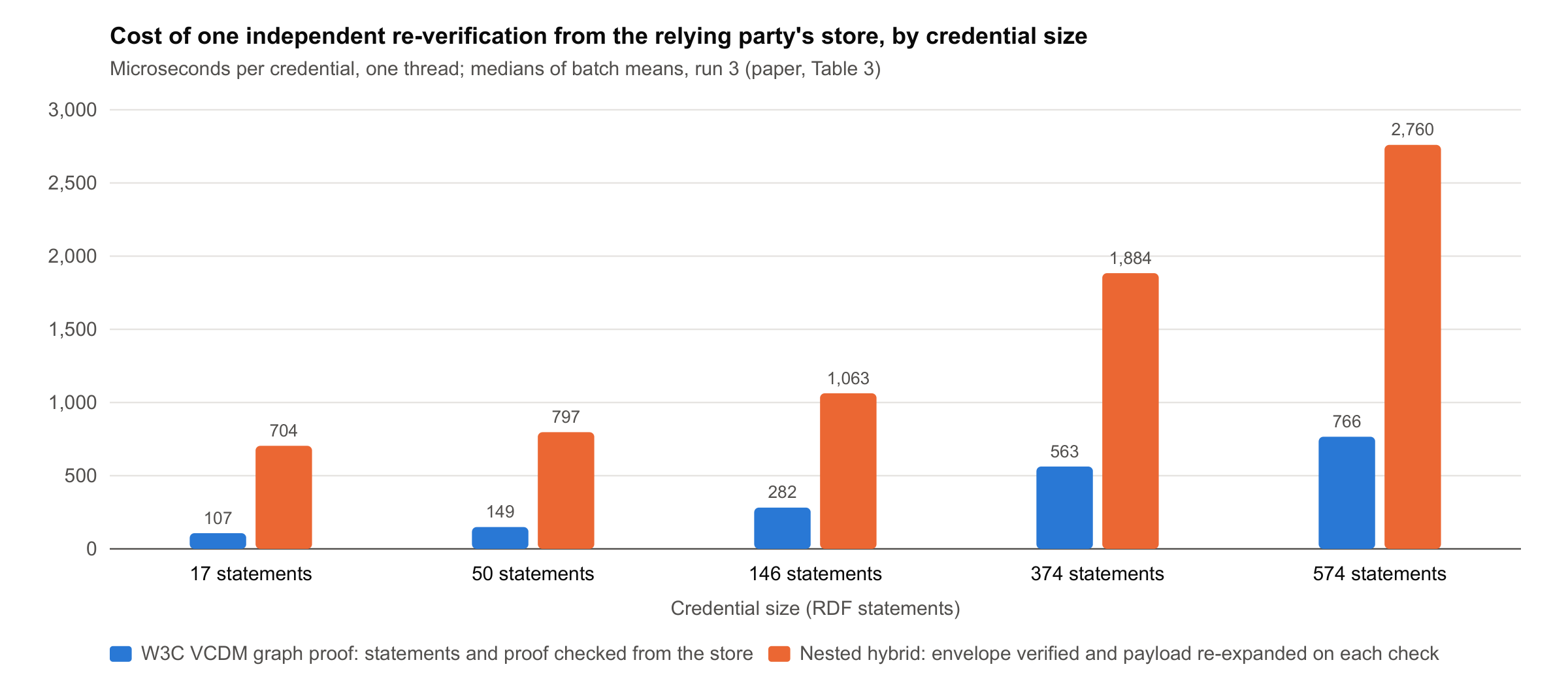
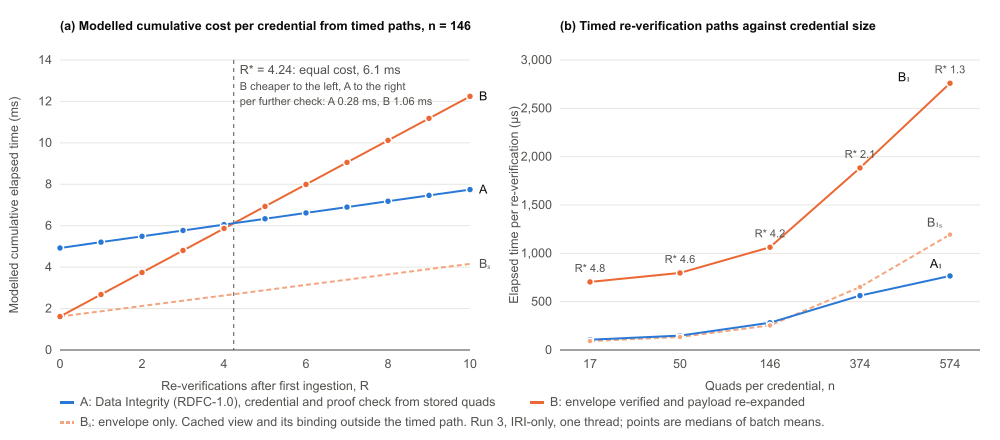
For the paper’s 146-quad synthetic fixture, the additional stored graph-proof check took about 0.28 ms, compared with 1.06 ms for envelope processing with fresh JSON-LD expansion. Including issuance and ingestion, the model favoured the graph path from the fifth additional verification. The separately measured envelope-only check took 0.25 ms, excluding validation of the cached graph view and its source binding. These are prototype processing paths, not full service latencies or universal format rankings. A separate presentation comparison favoured the tested SD-JWT implementation under its different proof procedure.
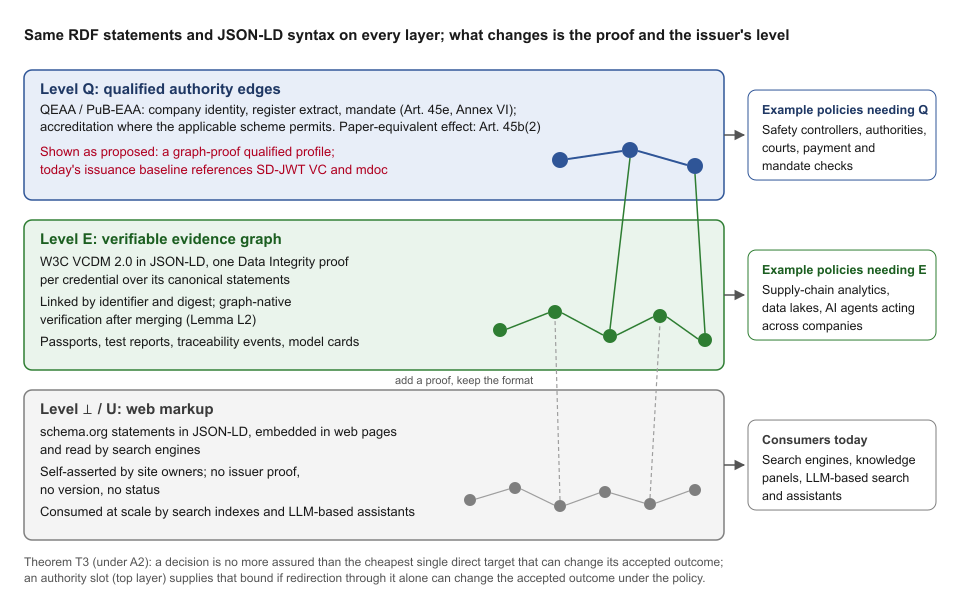
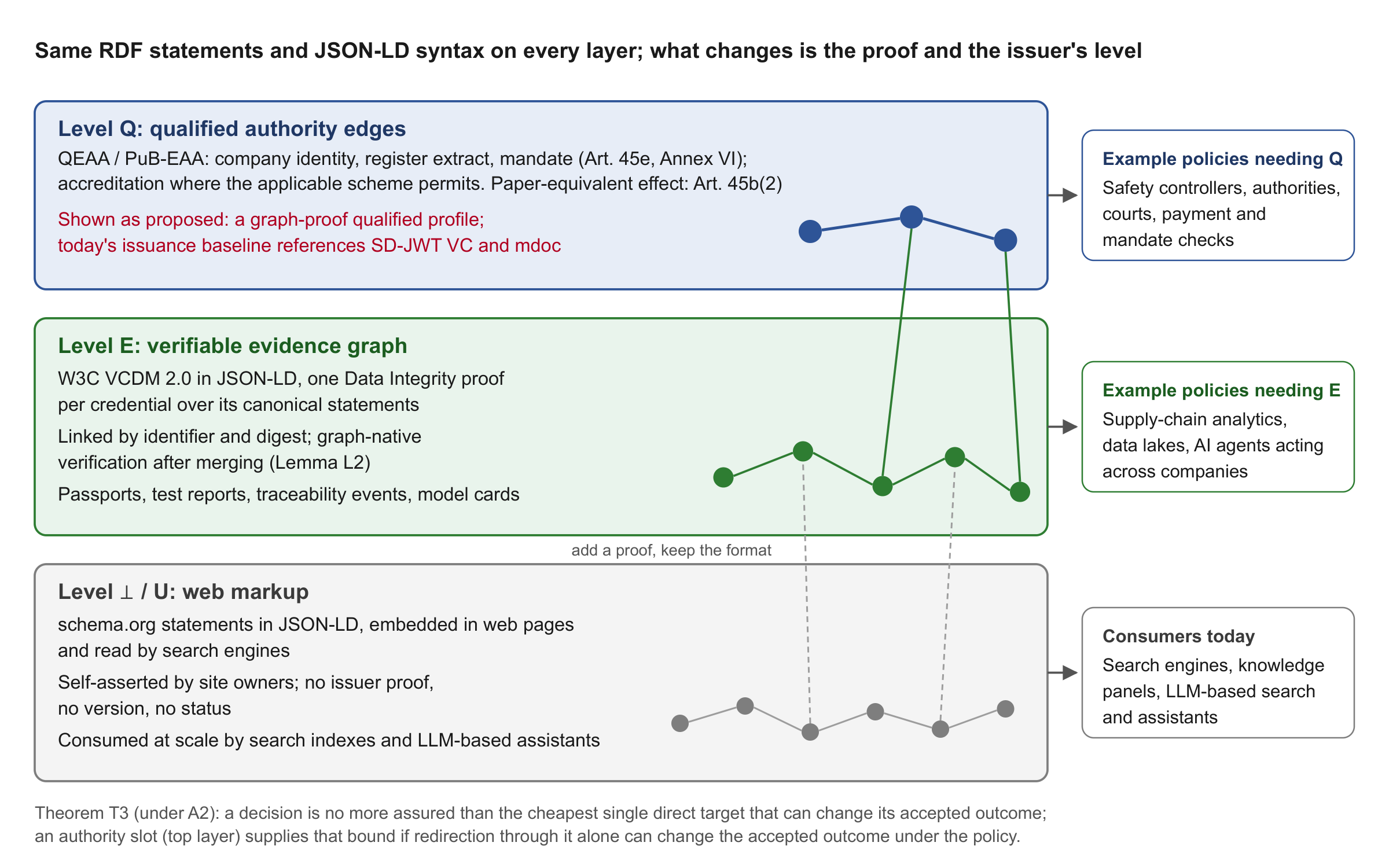
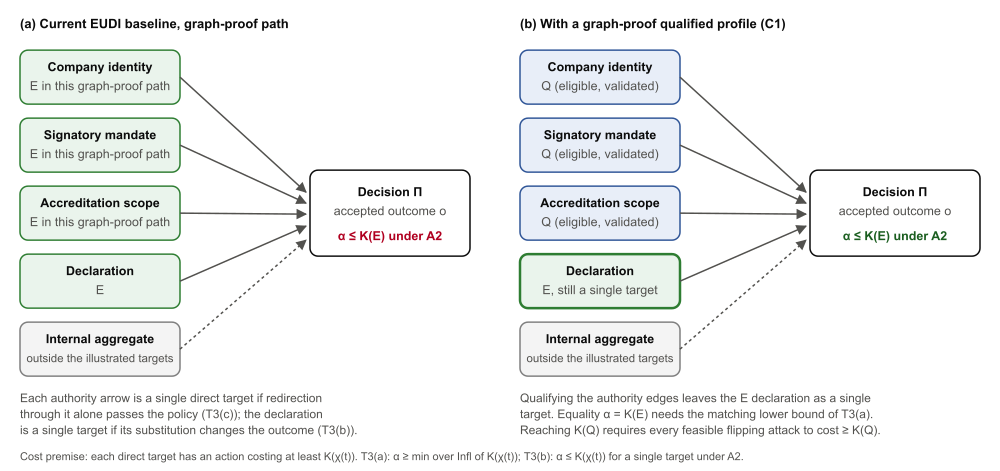
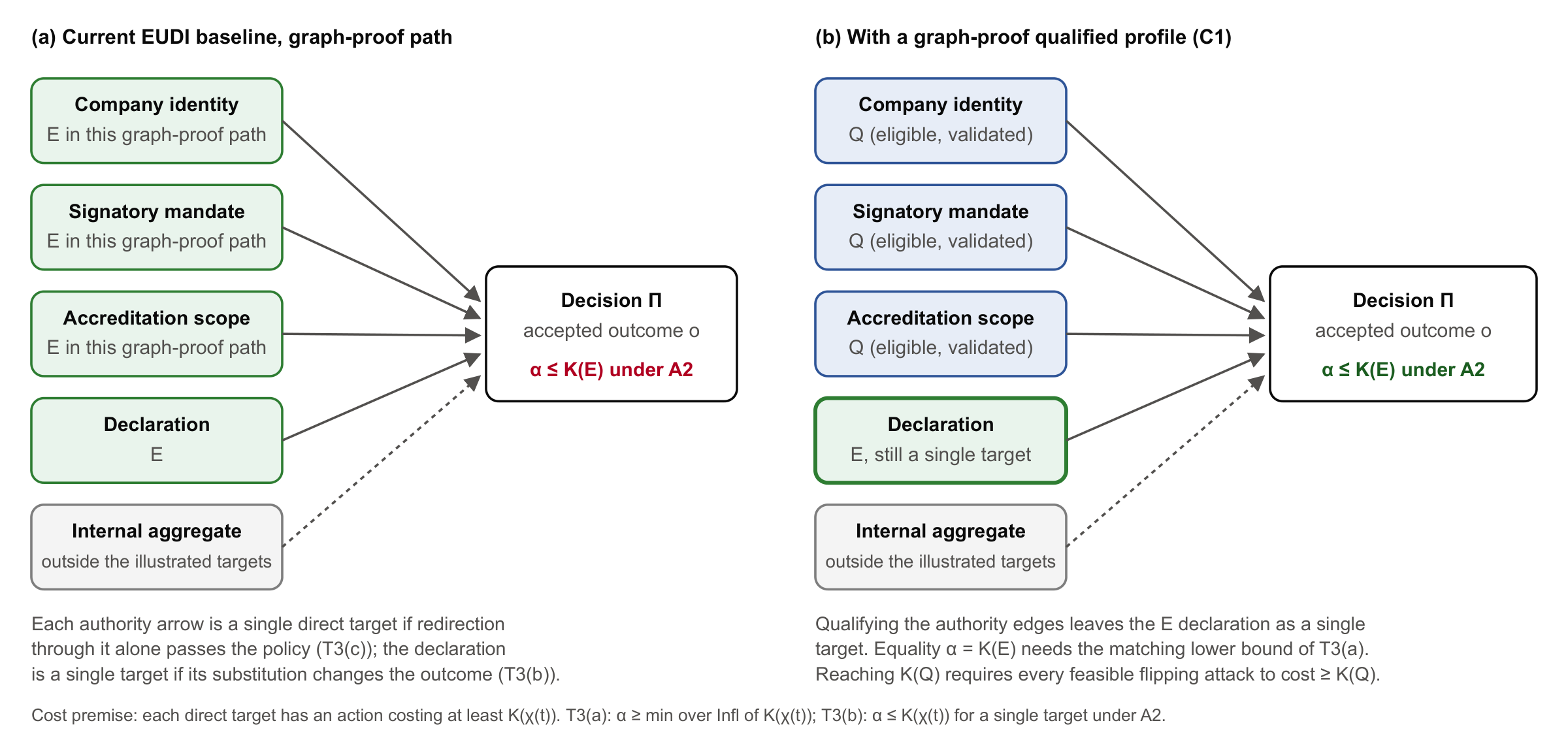
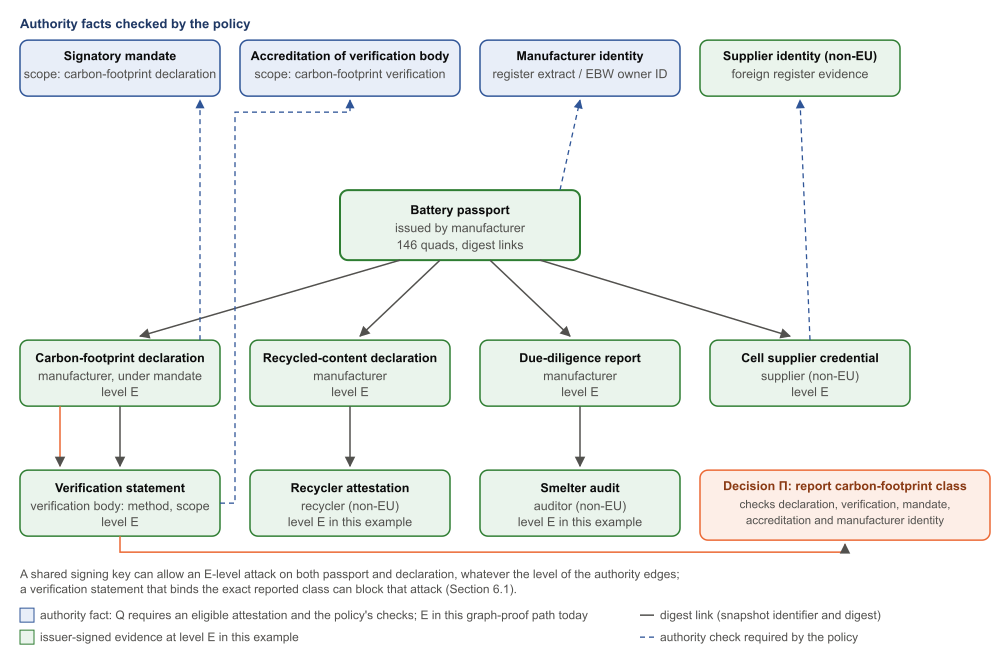
The policy may accept ordinary electronic attestations of attributes (EAAs) for product data, events and evaluations while requiring qualified electronic attestations of attributes (QEAAs) for selected foundational relationships. Sharing a credential profile does not erase their assurance differences. Qualification requires an eligible issuance profile and the applicable provider, scope and lifecycle conditions; it does not automatically qualify a neighbouring claim or AI output.
If a required QEAA is missing, the affected justification path cannot meet the target assurance. Another admissible path may still satisfy policy. If no such alternative exists, the decision lacks the required assurance, while independent evidence remains verifiable. The attack model additionally considers genuine-but-false content, changes to authority and joint attacks. The standards recommendation is to make an appropriate graph-proof profile eligible alongside existing options, rather than treating a wrapper as sufficient qualification. The paper discusses the European Business Wallet proposal as a proposal and distinguishes it from the adopted eIDAS amendment.
Complete signed examples and practical verification steps
Full-paper Appendix C and executive-brief Appendix A provide an actual signed VCDM credential and the same credential disclosed inside an SD-JWT. Both assert an illustrative battery’s recycled-cobalt share of 16 percentage points. Public keys, contexts, proof values, the complete wire token and validation scripts are included in the ZIP; no private signing key is needed.
- Signed plain credential · JSON
- Complete nested credential · SD-JWT
- Verification results · JSON
- Direct signature-path audit · JSON
- Verification instructions · TXT
- Verify the plain credential. Enforce its profile, resolve the pinned context and authorised issuer key, prepare the credential and proof-configuration inputs, canonicalise them, hash them and verify the Ed25519 signature. Expose only the verified view to the application.
- Unnest and verify the outer layer. For the nested example, first verify the ES256 issuer signature and allowed header/claims, match the disclosure hash, reconstruct the credential and enforce the inner/outer issuer binding. Decoding alone authenticates nothing.
- Verify the recovered inner credential. Apply all plain-credential checks. A saved negative fixture has a valid outer signature and disclosure commitment but an invalid inner proof; the combined verifier rejects it.
| Work or representation | Plain credential | Nested credential |
|---|---|---|
| Signature verification | One Ed25519 | One ES256 plus one Ed25519 |
| RDF canonicalisation | Two suite inputs | The same two inner inputs |
| Explicit SHA-256 work | Two inner hashes | Two inner hashes plus one disclosure hash |
| Disclosure reconstruction | None | One whole-credential disclosure |
| Serialized size | 797 bytes of compact UTF-8 JSON | 1,534 bytes of combined SD-JWT |
The size comparison excludes external key and context documents; the explicit hash count excludes hashing internal to signatures and canonicalisation. The whole credential is disclosed as one unit, so the inner eddsa-rdfc-2022 proof does not supply selective disclosure of individual battery attributes.
The main test runner passed four acceptance controls and 13 expected rejections. A second audit passed nine assertions and eight negative checks through direct Node/OpenSSL signature verification. It shares the RDF processing dependencies and is not an independent RDF implementation. These local tests establish the examples’ verification behaviour, not legal qualification, live revocation, wallet interoperability or the truth of the assertion.
Connections to Trusted AI, industrial AI, physical AI and PQC
Knowledge graphs express what entities and relationships mean. Verifiable evidence graphs preserve authenticated assertions, sources and versions. Assurance graphs connect system claims to evidence, requirements, assumptions and reasoning. The paper argues that these complementary views belong in the core evidence infrastructure for efficient, safe and compliant AI systems, alongside the engineering and governance needed to achieve those outcomes.
For Trusted AI, this makes the supporting evidence and authority behind a proposed action inspectable. For industrial AI, it links products, process conditions, tests and compliance requirements across organisations. For physical AI, such as robots and autonomous machines, it can connect permitted actions and operating limits to current evidence and authorised actors. Cryptographic attribution supports those decisions; it does not replace content validation, monitoring, runtime safeguards or a designed safe response when verification is unavailable.
Cryptographic hybrids and nested credential formats are different constructions. Data Integrity already supports proof sets and proof chains. Combining traditional and post-quantum signatures still requires validated suites, key and credential bindings, verification of mandatory components and downgrade protection. A common profile can reduce integration variation, but additional signatures do not elevate an EAA to a QEAA. The paper’s performance measurements do not include PQC overhead; its treatment follows the distinctions in Hybrid Signature Spectrums, RFC 9955.
Figures in SVG, PNG and PDF
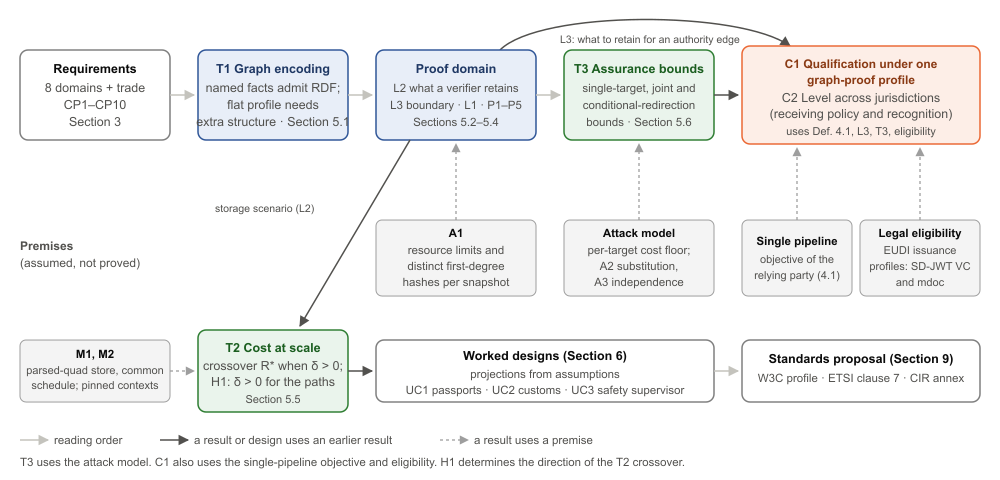
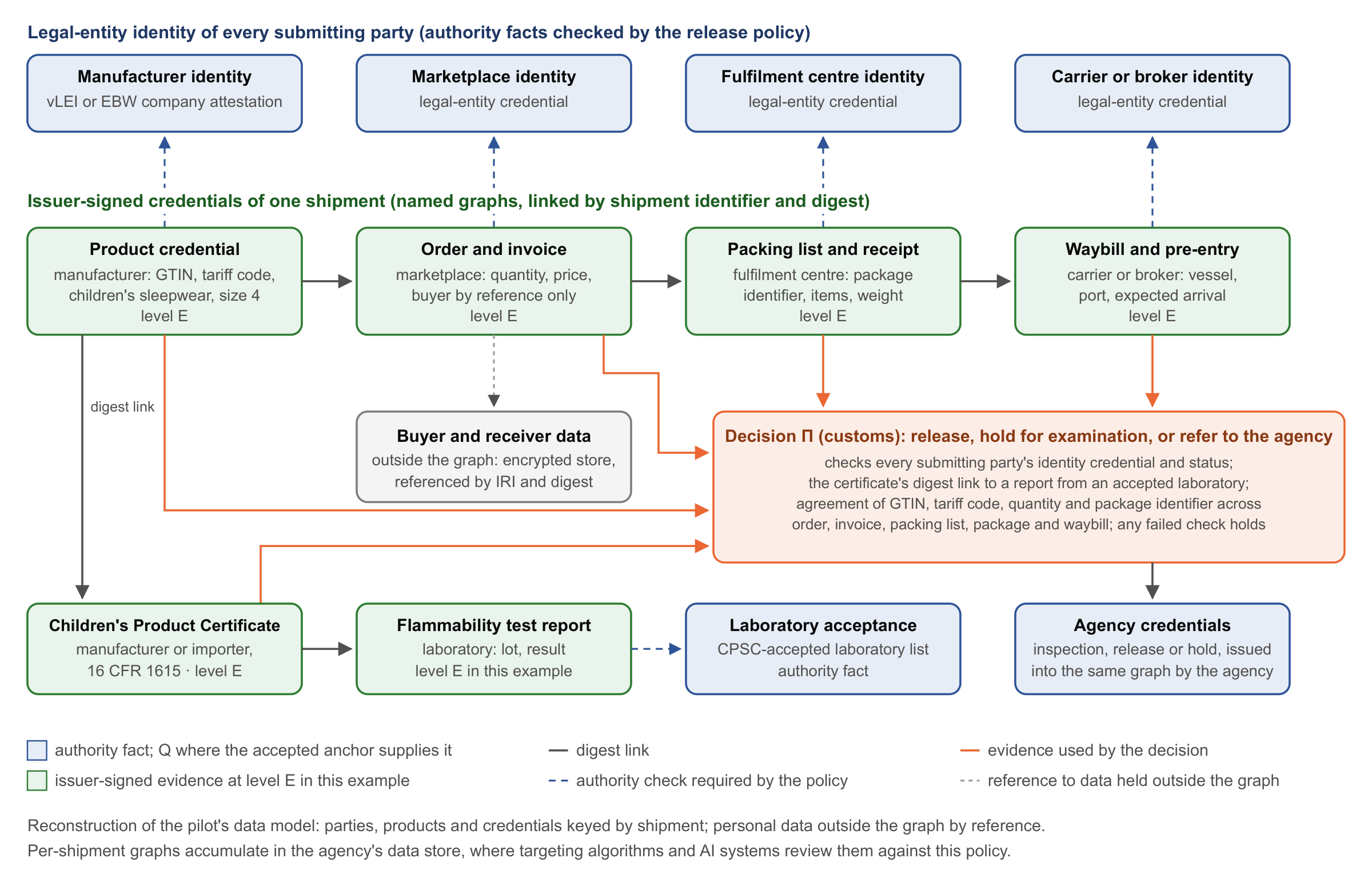
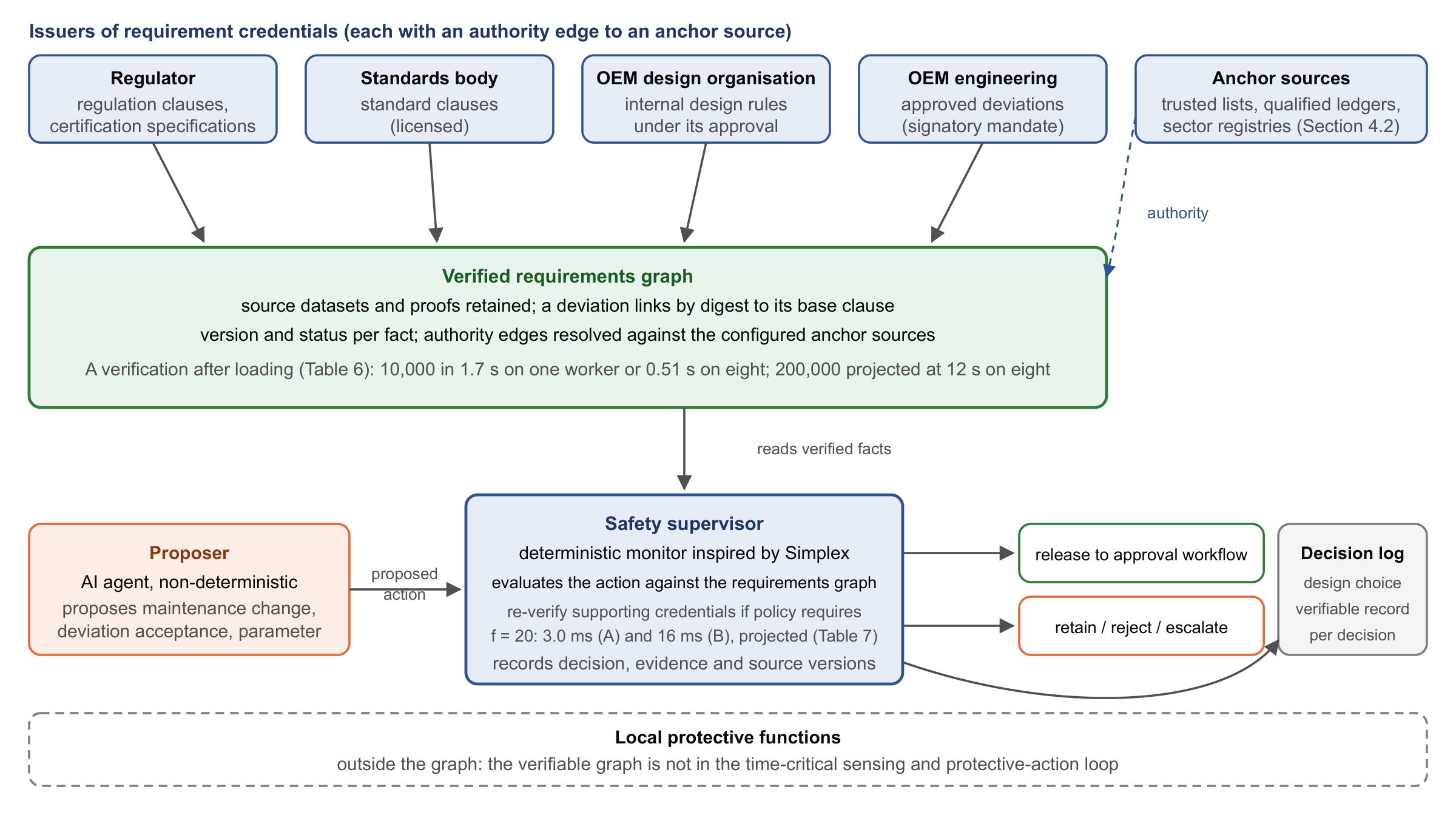
The gallery presents the figures from both final documents. Each caption identifies its source and the scope of the illustrated result. Download SVG for scalable vector artwork, PNG for presentations and web use, or PDF for publication-quality placement. Web SVG lettering is outlined for reliable display; the publication ZIP retains the original editable SVG sources. The introductory citizen-and-graph comparison above is Figure 1; the remaining figures follow below. Credit Carsten Stöcker, Spherity GmbH, link to this research page and CC BY 4.0, and indicate changes.
Evidence, reproducibility and limits
The full paper combines formal models, worked designs and prototype measurements on synthetic credentials. Its reported crossover values depend on the chosen verification schedule, retained data, implementation and interpretation checks. The arithmetic and internal consistency have been reviewed; the original benchmark code and raw run archive are not included, so the publication package does not independently reproduce those measurements. The supplied cryptographic example tests are a separate reproducible result.
Attestation-volume ratios are scenario assumptions rather than universal requirements. The battery example assumes one qualified credential per 1,000–10,000 ordinary credentials. The one QEAA per five ordinary EAAs ratio for higher-risk settings is an author-provided Spherity estimate; the supplied package contains no supporting dataset or methodology. Neither ratio establishes decision assurance.
The paper does not claim that RDF is the only possible representation, that every read requires fresh verification, or that a graph alone proves safety or compliance. Source-backed and mixed-format architectures remain valid when their mappings and verification rules are governed. The author is chief executive and founder of Spherity GmbH, which funded the work and develops credential and organisational-identity software. The full paper contains the complete declarations and reference list.
Publication and selected primary references
- Stöcker, C. (2026). Proofs over Statements in Verifiable Evidence Graphs for the European Business Wallet, version 1.3. Spherity GmbH, 9 November 2026. The full paper contains 130 references.
- Stöcker, C. (2026). Why business wallet evidence graphs need a qualified W3C VCDM profile — executive brief. Spherity GmbH.
- W3C. Verifiable Credentials Data Model v2.0 and Verifiable Credential Data Integrity 1.0, Recommendations, 15 May 2025.
- W3C. Data Integrity EdDSA Cryptosuites v1.0, Recommendation, 15 May 2025.
- IETF. RFC 9901: Selective Disclosure for JSON Web Tokens, November 2025.
- European Commission. Proposal for a Regulation on European Business Wallets, COM(2025) 838.
- European Union. Regulation (EU) 2024/1183 amending the eIDAS framework.
- IETF. RFC 9955: Hybrid Signature Spectrums, July 2026, Informational.

Open research
License and citation
The research content in this overview, both PDFs and the original figures is licensed by its named author under the Creative Commons Attribution 4.0 International License (CC BY 4.0), except for the third-party material identified below. Reuse must credit every named author, link to this canonical version and the license, and indicate whether changes were made.
Third-party rights: Third-party contexts and software dependencies retain the notices supplied in the publication package. The paper's CC BY 4.0 notice does not automatically assign a software licence to the verification scripts. Spherity names and logos are excluded from the research licence.
How to cite this work
Dr. Carsten Stöcker (2026-11-09). “Proofs over Statements in Verifiable Evidence Graphs for the European Business Wallet.” Spherity GmbH. https://spherity.github.io/spherity-research/proofs-over-statements-evidence-graphs.html. Licensed CC BY 4.0.
Direct answers
Questions this research answers
Why does this paper recommend JSON-LD credentials with RDF-based Data Integrity for industrial evidence graphs?
For retained evidence that many organisations repeatedly verify as graph data, a common W3C VCDM 2.0 JSON-LD profile with RDF-based Data Integrity aligns graph processing with the issuer-authenticated proof domain. It still requires governed vocabularies and contexts, compatible validation rules, source-snapshot recovery, issuer authority and status checks. JSON-LD syntax alone does not supply those guarantees.
Is a nested credential the same as a graph-proof credential?
No. Envelope-only B1 authenticates protected token inputs and disclosure commitments, then needs a governed binding to the graph interpretation. A nested credential that retains an inner Data Integrity proof can also authenticate that inner graph. When policy relies on both layers, both must be verified. A presentation-only wrapper need not be rechecked on every later use of independently verified inner evidence.
Are graph proofs always faster or more secure than SD-JWT VC?
No. The paper's cost advantage applies to specified repeated-verification paths with fresh envelope-to-graph expansion on synthetic fixtures. An envelope-only check under a trusted cached mapping can cost less, and a separate presentation test favours the tested SD-JWT implementation. Security depends on the complete profile, including interpretation, source binding, resource limits and application policy.
Does every edge in an industrial evidence graph need a QEAA?
No. Ordinary electronic attestations of attributes can support product, process, event and evaluation evidence where policy accepts them. Selected identity, mandate or other assurance-critical relationships may require qualified attestations under the applicable scheme. Qualification does not automatically propagate to neighbouring facts, derived conclusions or AI outputs.
What happens when a required qualified attestation is missing?
A justification path that requires that attestation cannot satisfy the target assurance level. Another admissible path may still satisfy the policy. If no admissible alternative exists, the decision cannot be justified at the required level; independent evidence elsewhere in the graph remains verifiable. A common credential format helps express and check dependencies but cannot repair missing assurance.
Are the plain and nested credential examples cryptographically validated?
Yes, under an explicit local demonstration profile. The plain credential has an Ed25519 Data Integrity proof; the nested version adds an ES256 SD-JWT signature and a disclosure commitment while retaining the inner proof. The main runner passed four acceptance controls and 13 expected rejection cases. A direct Node/OpenSSL audit passed nine assertions and eight negative checks, while sharing the RDF processing dependencies. These checks do not establish QEAA status or production conformance.
Does Data Integrity already support multiple signatures and post-quantum migration?
Data Integrity supports multiple proofs through proof sets and chains. A traditional/post-quantum hybrid still needs validated cryptosuites, key and credential bindings, mandatory-component verification and downgrade protection. Multiple proofs alone do not establish hybrid security, post-quantum assurance or qualified status. The paper's benchmarks do not measure PQC overhead.
How does this research support Trusted AI, industrial AI and physical AI?
Knowledge graphs express meaning, verifiable evidence graphs preserve authenticated sources and versions, and assurance graphs connect system claims to requirements, evidence and reasoning. Together they can help AI systems inspect the basis and authority for a proposed action. They complement safety engineering, monitoring, runtime controls and human oversight; cryptographic integrity does not prove factual truth or operational safety.