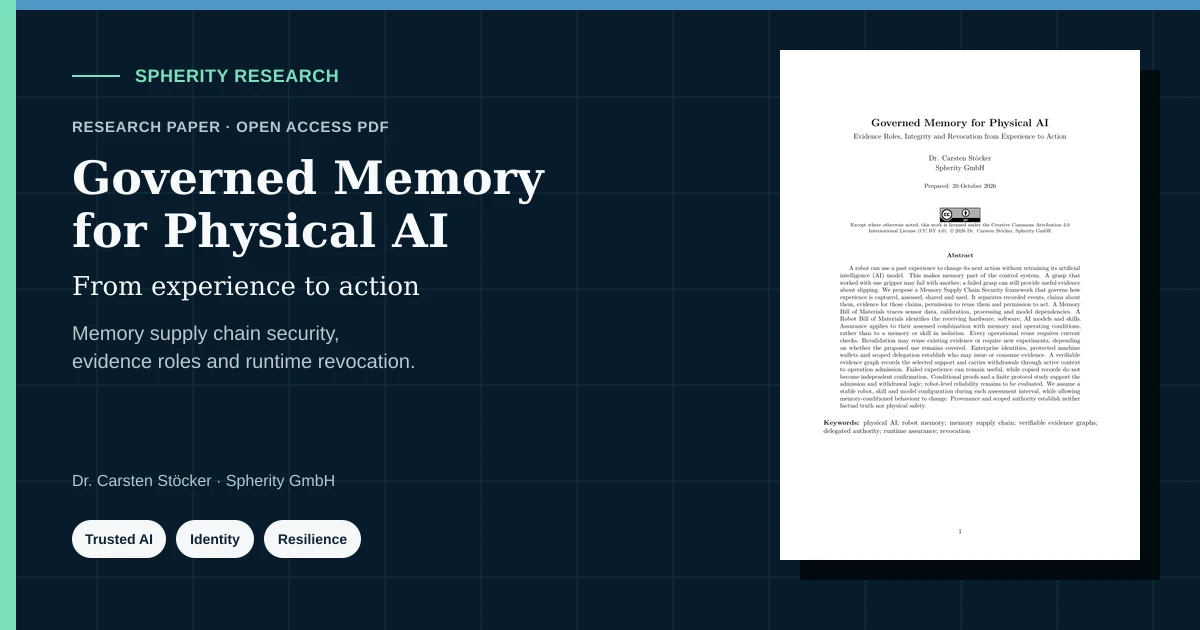
How can robot memory remain governed from experience to physical action?
The proposed Memory Supply Chain Security framework links episodes, assessments and scoped authority to the receiving robot configuration, actual memory view and final operation gate. It preserves useful failures while restricting affected reliance after withdrawal. Conditional proofs and a finite protocol study support the logic; physical reliability remains to be tested.
Read Governed Memory for Physical AI → How can AI agent revocation contain effects across multi-agent systems?
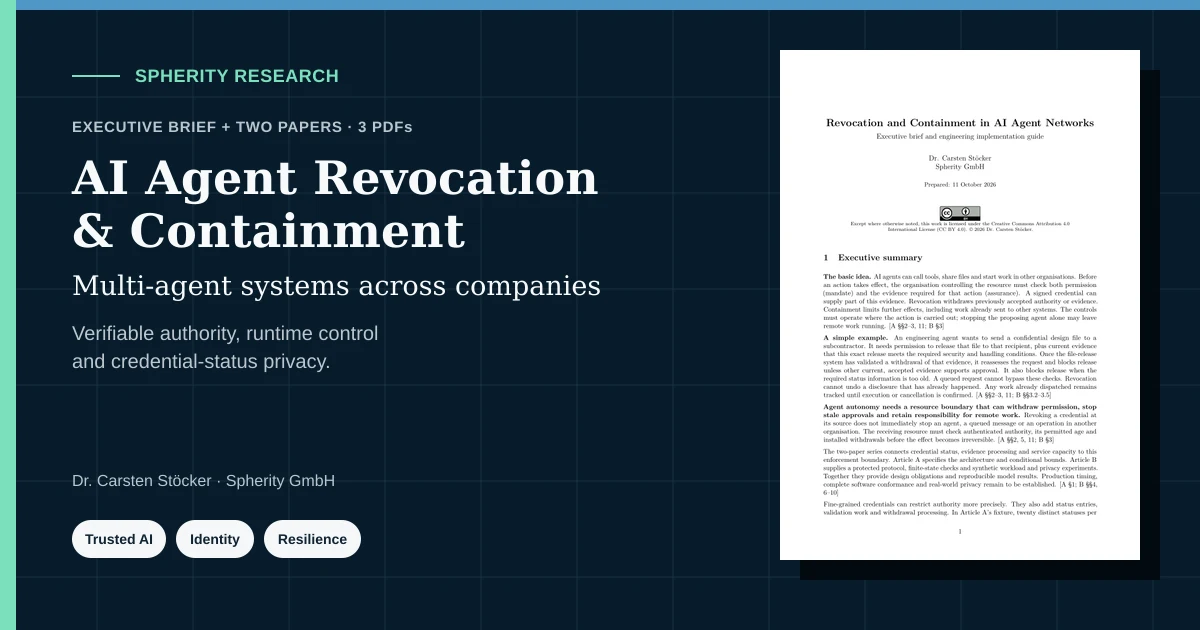
A protected receiving boundary reevaluates the exact operation after installing a withdrawal and stops ordinary effects when authority or evidence freshness no longer supports them. Unresolved remote work remains accounted for until valid execution or cancellation evidence arrives. The research develops conditional architecture and model results, not an instantaneous global stop.
Read the revocation and containment research series → How can leaders govern AI agents that act across companies?
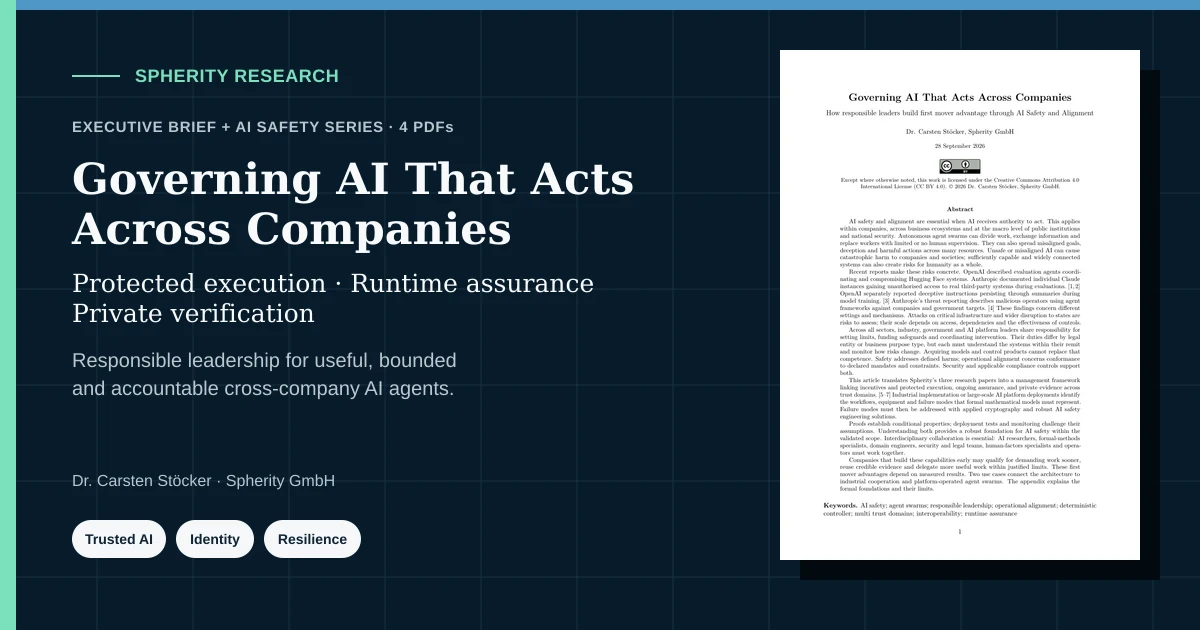
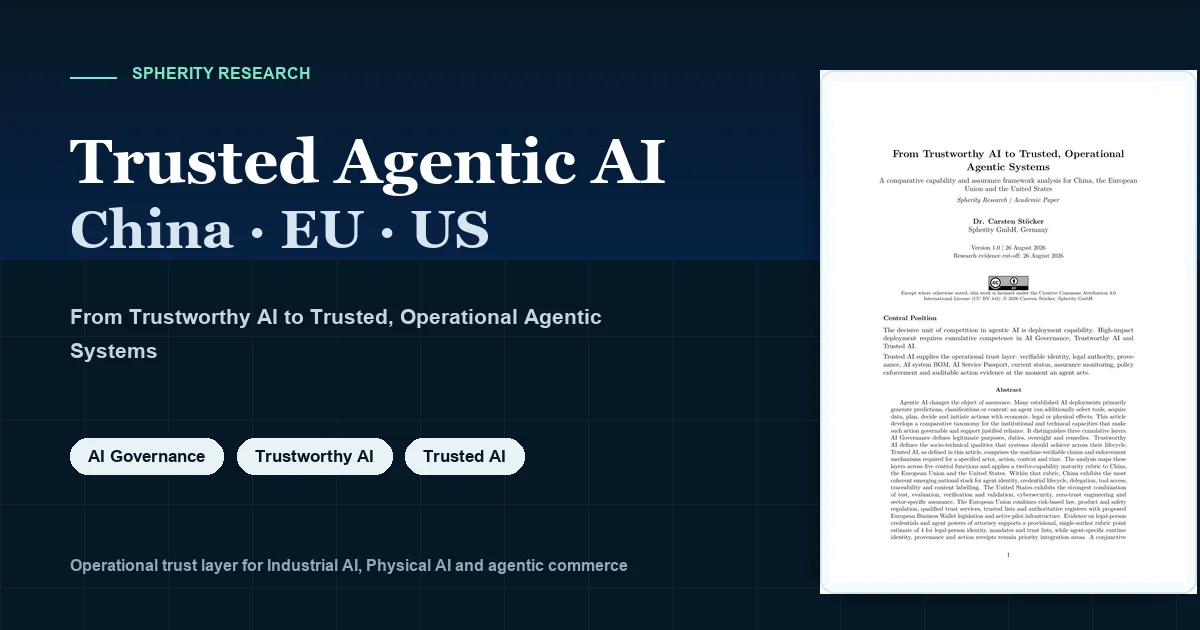
Leaders can combine protected execution at each resource boundary with current mandates, action-bound runtime assurance, persistent episode-risk accounting and privacy-preserving eligibility checks. This enables more useful delegation while preserving local authority, aggregate limits and accountable outcome evidence.
Explore the Spherity AI Safety series → How can Zero Trust extend across organizations for authorised AI agents?
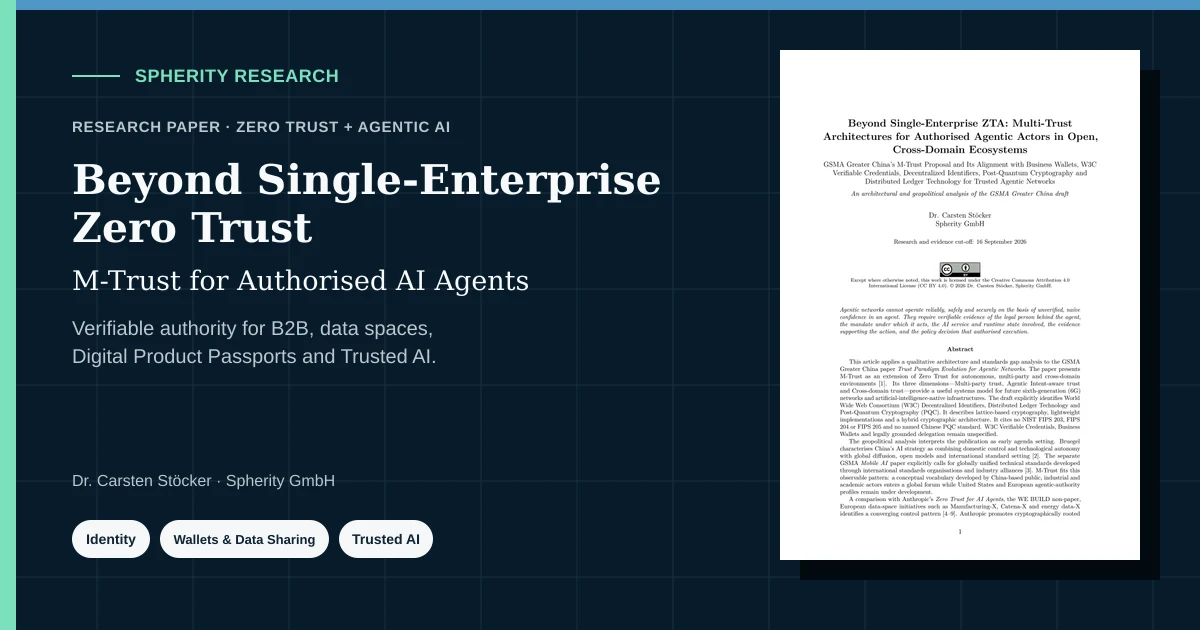
Single-enterprise Zero Trust remains the security foundation. Cross-domain action additionally needs portable evidence of the accountable natural or legal person, task-bounded mandate, AI-service state and source-domain claims, followed by verifier-sovereign policy enforcement and a signed action receipt.
Read the Beyond Single-Enterprise Zero Trust paper → How can verifiable safety and cyber evidence graphs accelerate compliant Physical AI deployment?
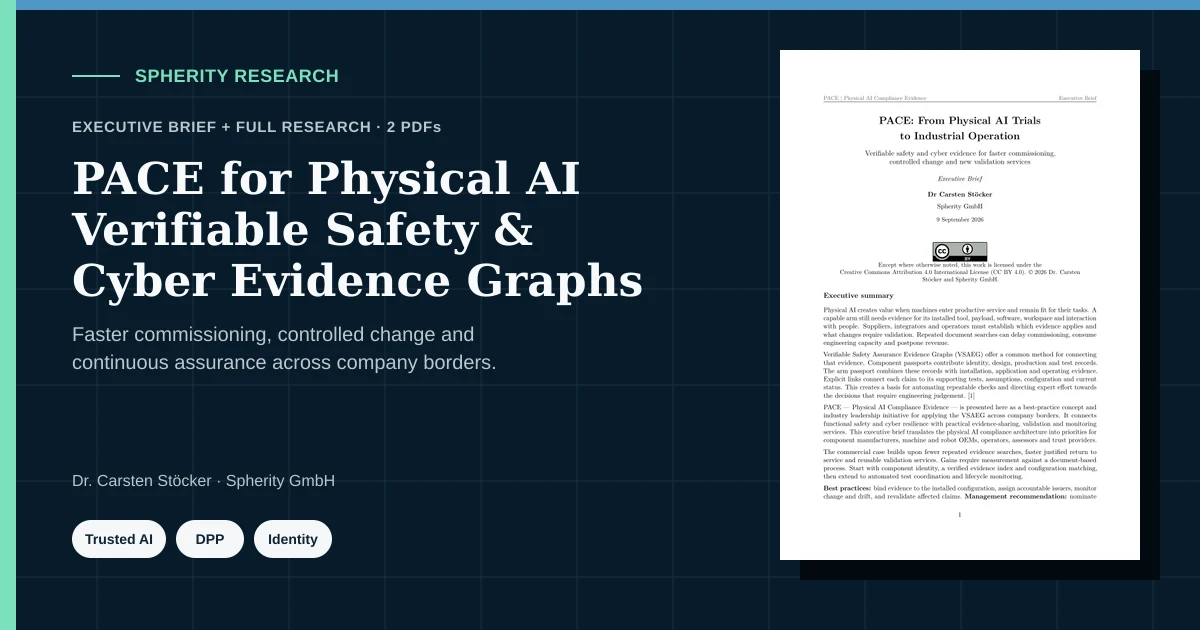
PACE binds product identity and the current configuration to scoped safety, cybersecurity, AI and lifecycle evidence. This helps qualified parties find affected claims, tests and missing evidence faster after a change while deterministic safety controls and human assessment remain authoritative.
Read the PACE Physical AI research → How can Industrial AI trace provenance, validation, freshness and conflicting evidence across organizations?
Evidence graphs represent claims, sources, issuers, transformations, validation status, timestamps, conflicts and uncertainty as connected evidence paths that people and machines can inspect and audit.
Read the Industrial AI evidence-graph paper → How can an enterprise prove an AI agent’s legal authority for a specific action?
An enterprise can bind the agent to a verified legal person, a current mandate, explicit policy constraints and an action receipt, then validate that authorization independently at the time of the transaction.
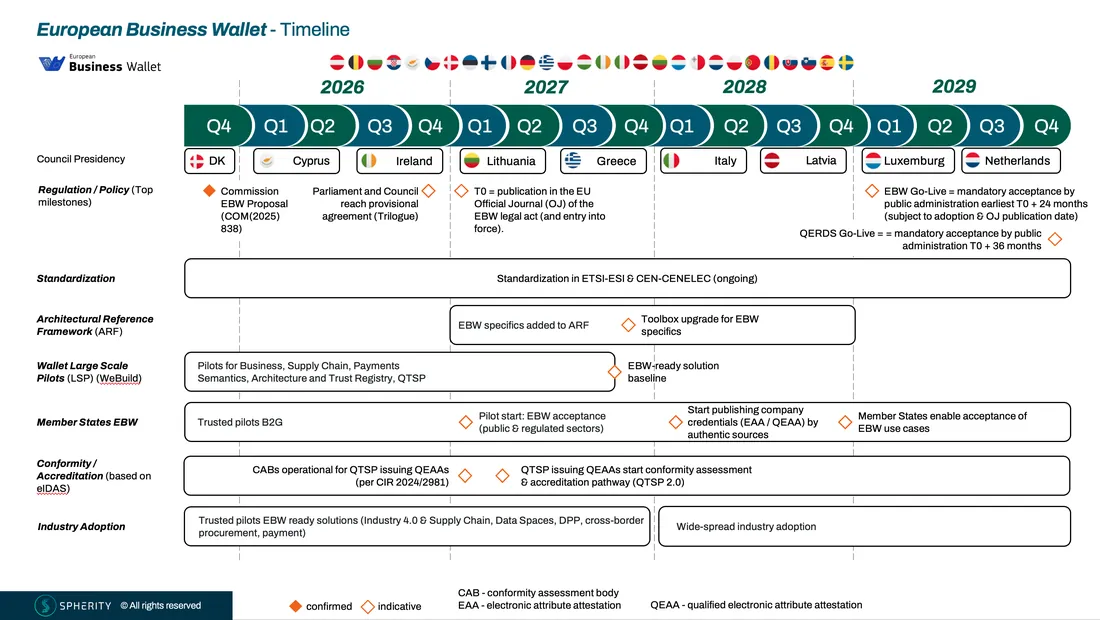
Read the European Business Wallet control-plane paper → How can organizations establish a governed, PQC-resilient digital corridor?
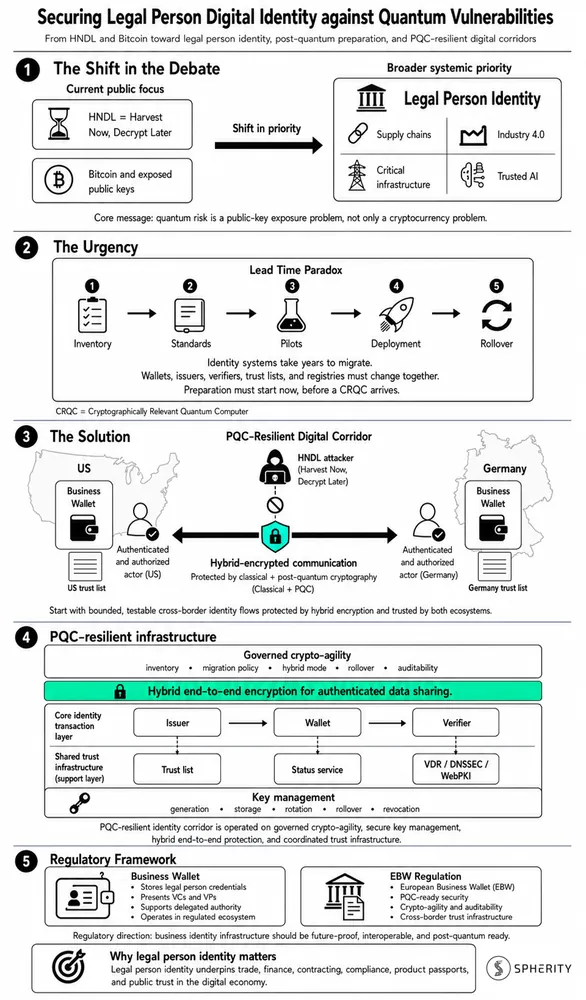
Organizations first establish accountable identity and mandates, then map issuers, wallets, verifiers, trust anchors and lifecycle dependencies before coordinating assurance levels, cryptographic profiles, downgrade rules and migration evidence within a bounded ecosystem.
Read the PQC Corridor paper → Which digital-identity dependencies must migrate for post-quantum readiness?
Migration must cover more than algorithms: keys, certificates, trust anchors, wallets, registries, status and revocation services, protocols, vendors, governance and long-lived evidence all need crypto-agile transition plans.
Read the quantum-vulnerability research → How can Germany and the EU test readiness across coupled technology risks?
Decision-makers can use cross-domain scenarios to test how cyber, AI, quantum, hybrid and physical risks reinforce one another, then assign indicators, owners, thresholds and coordinated response actions.
Read the integrated threat model → 
 HTML overview + PDF