
Spherity Research / Technology Outlook 2026
Top 10 German Technology Companies Building Industrial AI, Physical AI and Agentic Commerce
How Germany can combine AI agents, industrial software, manufacturing and IoT assets, autonomous machines, and European trust infrastructure
Browse this paper
In brief
What does this research establish?
The paper’s dated analytical selection comprises 1KOMMA5° / Heartbeat AI, Black Forest Labs, Celonis, Helsing, n8n, NEURA Robotics, Parloa, Quantum Systems, Sereact, and Spherity. Together with industrial anchors including Siemens, Bosch, SAP, Infineon, Deutsche Telekom, and Schwarz Digits, they supply complementary capabilities across AI, software, robotics, autonomous systems, energy, and cross-company trust infrastructure.
Key takeaways
- The Top 10 is an editorial selection based on six published criteria and presented alphabetically; it is not a valuation ranking or an independently certified league table.
- Germany already has strong technology components, but agentic industry also needs interoperable trust infrastructure for identity, authority, evidence, status, and accountability across organizations.
- Industrial AI, Physical AI, and agentic commerce require both a control plane for bounded authority and a data plane for provenance-bearing product, asset, software, and compliance evidence.
- Spherity is positioned as complementary infrastructure beneath transactions: current foundations cover organizational identity, wallets, verifiable credentials, regulated data exchange, product evidence, authorization, receipts, and crypto-agility.
- Hardware attestation, machine and software identity, runtime integrity, dynamic authorization, and continuous mission assurance are described as roadmap capabilities—not as replacements for certified safety or operational control systems.
- The coordinated opportunity is an open, model-agnostic, globally interoperable industrial stack rather than a closed national platform.
This page is an indexable research summary. The final PDF is the authoritative publication, including the German summary, complete company profiles, collaboration analysis, 2030 outlook, full FAQ, references, and investor-readable comparison table.
About the paper
Germany already has strong AI developers, workflow and process platforms, autonomous systems, robotics, energy orchestration, chips, cloud, enterprise software, and industrial automation. This paper asks what must connect those capabilities so that AI agents and machines can act across company and national borders with verifiable identity, bounded authority, reliable evidence, and clear accountability.
The analysis is intentionally systemic. The ten selected companies are not presented as interchangeable competitors or ranked by valuation. They occupy complementary positions in an emerging agentic cyber-physical economy and are assessed against a stated research cut-off of 2 August 2026.
10 German technology companies selected for the 2026 outlook
Direct answer. Presented in alphabetical order, the paper selects:
- 1KOMMA5° / Heartbeat AI — distributed energy orchestration.
- Black Forest Labs — frontier visual AI models.
- Celonis — process intelligence and enterprise context.
- Helsing — defence AI and autonomous mission systems.
- n8n — AI workflow and agent orchestration.
- NEURA Robotics — cognitive and humanoid robotics.
- Parloa — enterprise conversational AI agents.
- Quantum Systems — software-defined autonomous systems.
- Sereact — Physical AI for robotic manipulation.
- Spherity — organizational, product, and agent trust infrastructure.
| Company | Strategic role | Agentic-economy interface | Trust and evidence requirement |
|---|---|---|---|
| 1KOMMA5° / Heartbeat AI | Distributed energy orchestration | Asset agents trade energy and flexibility | Asset passports, installer credentials, grid permissions, and bounded mandates |
| Black Forest Labs | Visual foundation models | Visual inspection and commercial content agents | Model identity, AI-system evidence, provenance, and usage-policy receipts |
| Celonis | Process intelligence | Detects and orchestrates cross-company actions | External credentials, product evidence, mandate checks, and receipts |
| Helsing | Defence AI and mission autonomy | Secure supplier, maintenance, and mission-support processes | PQC-ready supplier identity, mission-data entitlements, runtime checks, and incident evidence |
| n8n | Workflow and agent orchestration | Coordinates discovery, verification, policy, and execution | Verifiable agent mandates, intent, counterparties, and evidence before tools run |
| NEURA Robotics | Cognitive and humanoid robotics | Robots procure service or parts within limits | Robot and software identity, configuration, safety-state evidence, and receipts |
| Parloa | Enterprise conversational AI | Orders, service changes, refunds, and negotiated outcomes | Representative and agent identity, intent declarations, policy limits, and receipts |
| Quantum Systems | Autonomous systems | Authenticated parts, maintenance, and logistics | Supplier and product credentials, mission entitlements, runtime checks, and PQC Corridors |
| Sereact | Physical AI for robotic handling | Replenishment, item verification, and service triggers | Robot identity, BOM evidence, safety-state attestations, integrity checks, and revocation |
| Spherity | Cross-company trust infrastructure | Identity, authority, evidence, and policy beneath transactions | Current trust foundations plus a hardware, Physical AI, and mission-assurance roadmap |
Selection method: strategic relevance, not a valuation ranking
The Top 10 is an editorial selection for the emerging agentic industrial economy. Companies were assessed across six dimensions:
- differentiated technology;
- strategic market importance;
- evidence of commercial scale or rapid adoption;
- relevance to Industrial AI, Physical AI, or agentic commerce;
- European sovereignty and resilience; and
- potential complementary value with organizational, product, and agent trust infrastructure.
Funding and valuation are treated as evidence of market confidence and capacity to execute, not as proxies for technology quality. Established corporations are discussed separately as industrial deployment anchors because they contribute factories, installed customer bases, infrastructure, standards influence, and global distribution.
The five-layer Industrial AI and Physical AI technology stack
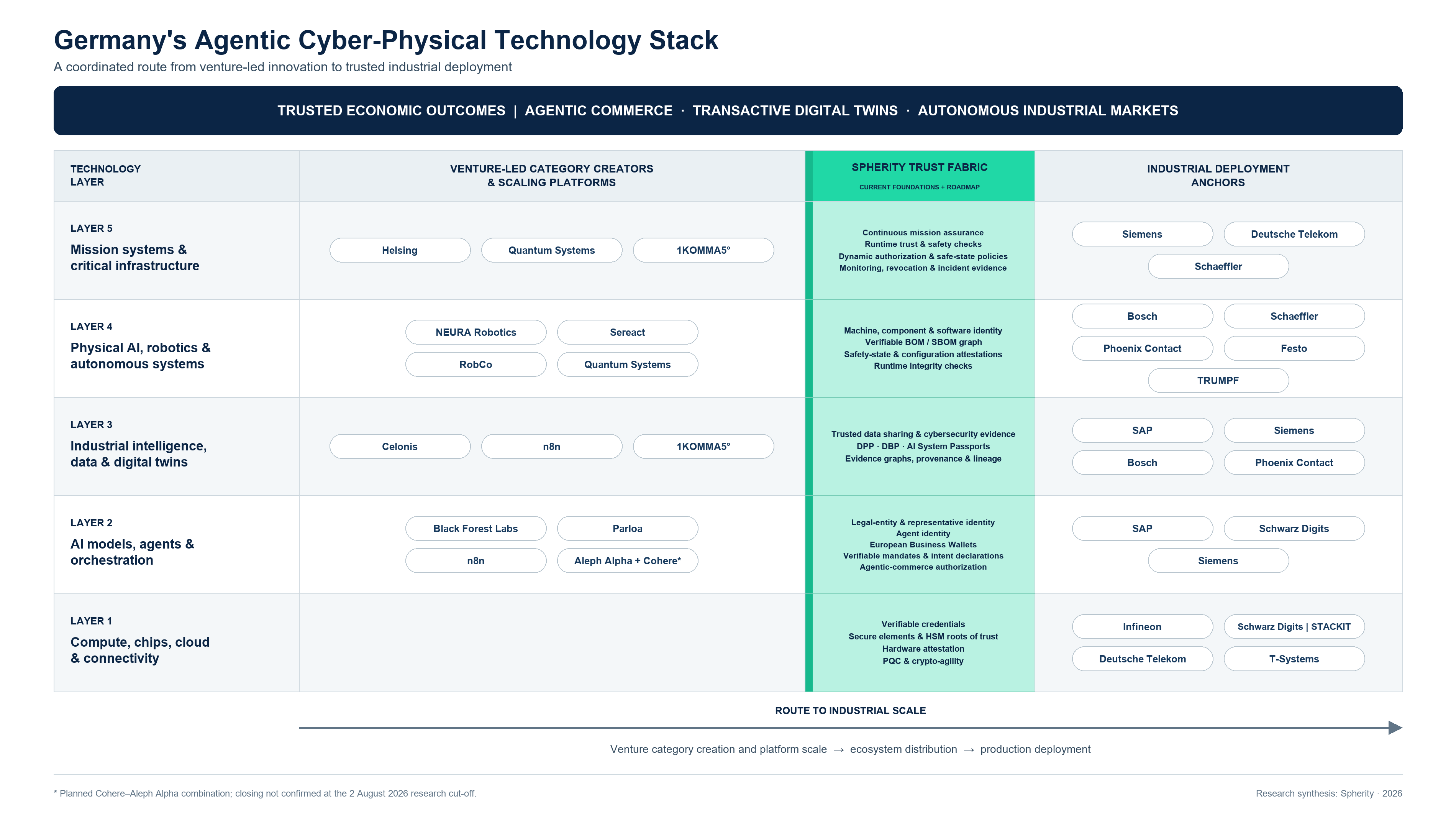
The five layers answer what the system can do. The vertical trust fabric answers how trust is anchored, who or what may act, which evidence can be relied upon, whether systems remain in an approved state, and how consequential actions can be controlled and audited.
- Layer 1 — compute, chips, cloud, and connectivity: Infineon, Schwarz Digits / STACKIT, Deutsche Telekom, and T-Systems anchor secure compute and connectivity.
- Layer 2 — AI models, agents, and orchestration: Black Forest Labs, Parloa, n8n, and the planned Cohere–Aleph Alpha combination turn goals into planned actions.
- Layer 3 — industrial intelligence, data, and digital twins: Celonis, SAP, Siemens, Bosch, and related platforms provide process and lifecycle context.
- Layer 4 — Physical AI, robotics, and autonomous systems: NEURA Robotics, Sereact, Quantum Systems, RobCo, and industrial automation companies act on the physical world.
- Layer 5 — mission systems and critical infrastructure: Helsing, Quantum Systems, 1KOMMA5°, and major industrial anchors operate where reliability and real-world consequences matter.
Why agentic commerce requires trust infrastructure
Definition and industrial example
Agentic commerce is commerce in which AI agents discover products and services, evaluate evidence, compare alternatives, negotiate terms, place orders, coordinate fulfilment, and document outcomes on behalf of people, organizations, machines, or public authorities.
Industrial example: a factory agent identifies a failing component, checks compatible replacements in Digital Product Passports, validates the supplier’s organizational credentials, orders within a delegated budget, and produces an action receipt showing which mandate and evidence supported the decision.
A payment can prove that funds moved. It does not prove that the agent represented the buyer, that its mandate covered the purchase, that the component met regulatory requirements, or that the evidence was current. Cross-company autonomy therefore requires verifiable principal and agent identity, bounded mandates, status and revocation checks, product or asset evidence, machine-enforceable policy, and durable receipts.
Two trust planes for governed Industrial AI
| Trust plane | Primary question | Evidence and controls |
|---|---|---|
| Control plane | Who is authorized to act, under which conditions, and what happens when those conditions change? | Legal-entity, representative, and agent identity; European Business Wallets; delegated mandates; signed intent; limits; policy decisions; credential status; revocation; escalation; and action receipts. |
| Data plane | What evidence supports the action and the current system state? | Provenance, validation, freshness, DPP and DBP evidence, future AI System Passports, BOM and SBOM relationships, configuration and safety-state attestations, conflicts, uncertainty, and issuer status. |
A valid mandate does not prove that an AI decision is factually supported or operationally safe. Reliable evidence does not prove that the agent was legally authorized to act. Regulated Industrial AI, Physical AI, and trusted agentic commerce require both planes.
Spherity: a complementary cross-layer trust fabric
The paper positions Spherity beneath the transaction layer, complementing AI, robotics, cloud, enterprise, semiconductor, automation, payment, and mission platforms. It separates current foundations from adjacent strategic roadmap capabilities:
| Capability horizon | Scope |
|---|---|
| Current foundations | Legal-entity and agent identity; European Business Wallets; Digital Product Passports and Digital Battery Passports; verifiable credentials; regulated data exchange; evidence provenance; bounded authorization; action receipts; and crypto-agility. |
| Partner-led expansion | Secure-element and HSM roots of trust; hardware attestation; machine, component, and software identity; verifiable BOM and SBOM graphs; configuration and safety-state attestations. |
| Strategic roadmap | Runtime integrity and policy checks; dynamic authorization; monitoring; revocation; incident evidence; safe-state policy inputs; and continuous mission assurance. |
These trust functions can provide verifiable inputs and preserve evidence, but they do not replace certified functional-safety controllers, operational technology, mission control, cybersecurity platforms, or accountable human authority.
Industrial anchors including Siemens, Bosch, SAP, Infineon, Deutsche Telekom, Schwarz Digits, Schaeffler, Phoenix Contact, Festo, and TRUMPF provide the route from specialized technology into factories, infrastructure, regulated markets, and global customer networks. The paper’s core strategy is cooperation across layers, not displacement of those platforms.
Implementation priorities for Germany and Europe
- Publish an open reference architecture for organizational, representative, agent, machine, product, and software identity across the control and data planes.
- Connect European Business Wallets with DPP and DBP ecosystems so reusable organizational credentials can authorize bounded product and asset workflows.
- Preserve evidence provenance through issuer-bound, status-aware evidence graphs instead of opaque aggregates.
- Pilot real production corridors in manufacturing, energy, health supply chains, critical infrastructure, and dual-use ecosystems.
- Define agent authorization and action-receipt profiles before agents receive cross-company transactional authority.
- Integrate hardware-rooted trust and crypto-agility with secure elements, HSMs, attestations, and controlled post-quantum migration.
- Measure outcomes such as onboarding time, repeated-check reduction, unauthorized-action rates, interoperability, and production transaction value—not the number of workshops or isolated pilots.
Evidence boundaries and claim discipline
The page and PDF distinguish reported facts, company statements, analysis, and forward-looking proposals. Company forecasts, funding announcements, and performance claims are attributed to their primary sources. The Cohere–Aleph Alpha combination is described as planned at the research cut-off, not completed. The European Business Wallet is described as a European Commission proposal at that date. Roadmap targets and the higher-layer Spherity capabilities are analytical proposals, not evidence of deployed certified systems.
The selection is time-sensitive. Company transactions, financing, product announcements, and regulatory status should be rechecked when the page is materially revised. The current research cut-off is 2 August 2026.
Selected primary and institutional sources
The final PDF contains the complete 41-item reference list. Key sources used for company and regulatory facts include:
- Helsing, “Helsing raises $1.8bn in Series E,” 13 July 2026
- Celonis, company information and Process Intelligence
- Quantum Systems, Series D announcement, 2 July 2026
- n8n, Series C announcement
- NEURA Robotics, Series C announcement
- Parloa, Series D announcement
- Black Forest Labs, Series B announcement
- Sereact, Series B and strategic investment announcement
- 1KOMMA5°, Heartbeat AI update
- European Commission, proposal for European Business Wallets
- EU Ecodesign for Sustainable Products Regulation
- NIST, first finalized post-quantum cryptography standards
The PDF contains the complete German and English analysis, all company profiles, seven trusted agentic-commerce examples, collaboration theses, international digital-corridor analysis, an aggressive implementation roadmap, the German Technology Outlook 2030, extended FAQ, and full references.

Open research
License and citation
Top 10 German Technology Companies Building Industrial AI, Physical AI and Agentic Commerce is licensed by its named author under the Creative Commons Attribution 4.0 International License (CC BY 4.0). Reuse must credit every named author, link to this canonical version and the license, and indicate whether changes were made.
How to cite this work
Dr. Carsten Stöcker (2026-08-03). “Top 10 German Technology Companies Building Industrial AI, Physical AI and Agentic Commerce: How Germany can combine AI agents, industrial software, manufacturing and IoT assets, autonomous machines, and European trust infrastructure.” Spherity GmbH. https://spherity.github.io/spherity-research/top-german-technology-companies-industrial-ai-agentic-commerce-2026.html. Licensed CC BY 4.0.
Direct answers
Questions this research answers
Which German technology companies does this 2026 outlook select?
The paper selects, in alphabetical order, 1KOMMA5° / Heartbeat AI, Black Forest Labs, Celonis, Helsing, n8n, NEURA Robotics, Parloa, Quantum Systems, Sereact, and Spherity. It is a dated editorial selection based on strategic relevance, not a valuation ranking.
How were the Top 10 companies selected?
The analysis uses six dimensions: differentiated technology; strategic market importance; evidence of commercial scale or rapid adoption; relevance to Industrial AI, Physical AI, or agentic commerce; European sovereignty and resilience; and potential complementary value with organizational, product, and agent trust infrastructure.
What is agentic commerce?
Agentic commerce is commerce in which AI agents discover, evaluate, negotiate, order, coordinate, and document transactions on behalf of people, organizations, machines, or public authorities. Trusted implementations verify the agent’s principal, bounded mandate, policy limits, relied-upon evidence, and accountability—not only payment.
What infrastructure do AI agents need before they transact across companies?
They need a control plane for buyer, supplier, representative, and agent identity; mandates, intent, policy, revocation, and action receipts; plus a data plane for current product, software, asset, and compliance evidence with verifiable provenance. Long-lived critical processes also require crypto-agility and post-quantum migration planning.
What role does Spherity play in trusted agentic commerce?
Spherity provides complementary, model- and platform-agnostic trust infrastructure across organizational and agent identity, European Business Wallets, Digital Product Passports, verifiable credentials, evidence provenance, authorization, action receipts, and crypto-agility. Roadmap capabilities extend toward hardware and runtime assurance without replacing certified control systems.