
Spherity Research · Visual paper overview + full PDF
EU DPP Registry, W3C Standards and DPP5.0
What the October 2026 Registry package delivers—and how verifiable evidence, legal-person identity and policy could converge
Abstract
The European Commission released its Digital Product Passport (DPP) Registry technical package on 30 October 2026, combining registration and authentication guidance with semantic assets for product data. This paper examines the division between a common EU Registry and distributed product-passport content, and explains how Resource Description Framework (RDF), JSON-LD, SKOS, SHACL and related standards contribute shared meaning, data validation and machine-readable discovery. It then introduces DPP4.0 and DPP5.0 as Spherity-defined maturity stages rather than adopted EU categories. DPP4.0 adds verifiable issuer-bound claims; DPP5.0 connects claims, sources, status and dependencies in access-controlled evidence graphs. A fictional product and robot-evidence example illustrates why provenance and claim status matter for industrial AI. The paper assesses current Registry functions against this model and proposes convergence with European Business Wallets, W3C Verifiable Credentials and machine-readable policy to support legal-person identity, representation, bounded mandates and controlled use. The proposed stack is an architectural recommendation. Its legal recognition, trust profiles, cross-company interoperability and operational assurance remain to be specified and tested.
Browse this paper
In brief
What does this research establish?
The European Commission’s October 2026 EU DPP Registry package provides common product-registration interfaces, semantic resources and access guidance built on open technologies such as JSON-LD, RDF, SKOS and SHACL. Spherity’s DPP4.0/DPP5.0 model describes proposed steps beyond semantic interoperability: issuer-bound evidence, current authority, governed access and connected evidence graphs. The proposed DPP + European Business Wallet convergence could supply organizational identity and mandates, but still requires accepted trust profiles, sector governance and local enforcement. This web edition also explains how the Registry’s catalogue-like role and semantic repository supply data-space building blocks, and proposes a lightweight B2G pattern with business wallets that can connect to a fuller Eclipse-based data space.
Key takeaways
- The Registry registers identifiers and related data; it does not need to centralize every product-passport document or evidence file.
- The Commission package introduces machine-readable semantic assets and APIs; validation against SHACL does not establish that a product claim is true or the issuer authorized.
- DPP4.0 / DPP 4.0 and DPP5.0 / DPP 5.0 are Spherity research stages, not EU regulatory or W3C maturity classifications.
- Verifiable Credentials can bind claims to issuers; verified legal-person identity, recognized roles, current status and policy remain separate conditions.
- A future European Business Wallet can help establish corporate identity and representation across borders, but the regulation is still a legislative proposal.
- Evidence graphs can make source changes and dependent claims traceable; revocation, interpretation and downstream action need explicit receiver-side rules.
- The Registry and semantic repository contribute discovery and shared meaning. Spherity’s proposed B2G pattern adds business-wallet authority, explicit policy decisions and enforcement, with a path to broader data-space exchange.
This HTML page is the canonical, indexable research overview. The PDF preserves the complete visual paper. The HTML page explains the core concepts, figures, evidence boundaries and current legal status in machine-readable text.
What the EU DPP Registry does—and does not do
The European Commission published a major technical package for the Digital Product Passport (DPP) Registry on 30 October 2026. The package includes the Semantic Data Guide, semantic artifacts, API specifications, service-account integration and self-hosted authentication guidance. It makes the semantic and technical shape of the Registry much more concrete.[1]
The Registry provides a common EU registration and indexing point for product identifiers and related metadata, while the accompanying semantic resources establish shared definitions and validation rules. The Digital Product Passport itself can be hosted by the responsible economic operator. A successful registration or schema check must not be read as independent proof that every underlying product claim is true. This visual paper addresses three questions:
- What semantic infrastructure has the EU actually implemented?
- Which trust and policy functions remain outside the current Registry package?
- How could Digital Product Passports and European Business Wallets converge into DPP5.0: access-controlled, verifiable evidence graphs for products, AI and physical AI?
The analysis separates EU law and technical implementation from Spherity’s proposed maturity model. DPP1.0–DPP5.0 is a Spherity framing. DPP4.0 / DPP 4.0 and DPP5.0 / DPP 5.0 are not official EU or W3C terms. The DPP + European Business Wallet (EBW) convergence described below is a target architecture and standards recommendation.
Why this matters for manufacturers, regulators and data users
For a DPP reader, the central distinction is simple: a common product-data model makes information comparable; an evidence and authority layer makes it possible to decide whether a specific claim may be relied upon for a specific task. These are complementary functions.
| Reader | Immediate benefit of the Registry package | Extra question for DPP4.0 / DPP5.0 |
|---|---|---|
| Manufacturer / economic operator | Register product-passport identifiers and work with common interfaces and semantic rules. | Which supplier, laboratory or representative was authorized to issue or update each material claim? |
| Market surveillance / customs | Locate registered DPPs and interpret defined fields consistently. | Can the source, authenticity, freshness and applicable status of a claim be verified independently? |
| Supplier / recycler | Reuse agreed identifiers and definitions for cross-company data exchange. | May a particular party access or reuse restricted evidence for its declared purpose? |
| Industrial AI / Physical AI developer | Use machine-readable product facts and validation rules. | How do invalid, changed or withdrawn premises reach dependent model decisions and machine configurations? |
None of these extra questions is answered by semantics alone. They require governance, issuer recognition, trusted identity, current status, evidence links and enforcement at the receiving system.
Key concepts and status
| Concept | Meaning on this page | Status at the 4 November 2026 evidence cut-off |
|---|---|---|
| EU DPP Registry | Commission infrastructure for registering and resolving DPP identifiers and related registry information. | EU implementation under Regulation (EU) 2024/1781 and Implementing Regulation (EU) 2026/1778. |
| EU DPP Register | Search synonym used on this page so readers using “register” can find the work. | Not the Commission's preferred English label; use DPP Registry in normative text. |
| W3C semantic stack | RDF, JSON-LD, SKOS, SHACL, SPARQL, OWL and DCAT, with XSD for XML support. | Established W3C standards/technologies used by the Commission's semantic implementation. |
| DPP5.0 | Access-controlled, verifiable evidence graphs for physical products, virtual products, AI and physical AI. | Spherity research framing, not an EU or W3C term. |
| European Business Wallet | Proposed EU framework for secure business identity, trusted documents, signatures/seals, communication and delegated authority. | Legislative proposal under the ordinary legislative procedure; not final law on the evidence cut-off.[15] [16] [17] |
| DPP + EBW convergence | Product semantics and evidence combined with legal-person identity, issuer authority, mandates and policy. | Spherity target architecture and standards recommendation. |
The EU DPP Registry package: what is now concrete
The legal framework is broader than ESPR product groups alone. Implementing Regulation (EU) 2026/1778 applies to products whose legislation requires a passport and Registry registration. Its Article 1 covers the relevant ESPR products, batteries, construction products, toys and detergents/end-user surfactants. This scope does not mean that all products in those categories must already carry a DPP today. The triggering sector-specific obligations and dates must be checked separately.[2]
The Commission’s resource page lists the following technical publications dated 30 October 2026.[1]
| Resource | Function |
|---|---|
| Semantic Data Guide | Explains taxonomies, validation schemas, SHACL shapes, JSON-LD contexts, versioning and semantic interoperability. |
| Semantic Data Artifacts | Provides machine-readable semantic resources needed to structure, interpret and validate DPP data. |
| API Integration Guide | Defines practical integration for authentication, DPP registration, API use and error handling. |
| OpenAPI Specifications | Defines public Registry API interfaces, operations, request/response structures and shared models. |
| Service Account Technical Integration Guide | Defines machine-to-machine authentication, including private_key_jwt, credentials, keys and access tokens. |
| Self-Hosted Authentication Guide | Defines JWT/JWKS validation, audience checks and authentication/authorization handling for operator-hosted DPP data. |
The architectural point is important: the Registry is a shared registration and control service, not necessarily the storage location for the full product passport. Economic operators can host the DPP payload and use common EU semantics, validation rules and access mechanisms. That separation supports distributed product-data hosting while preserving common registration, semantic validation and discovery. A schema-valid record is not automatically factually correct, compliant or authorized for a given action.
W3C standards inside the EU DPP semantic architecture
The Commission documents describe the implementation components rather than branding the package as a single “W3C architecture”. The underlying technologies are nevertheless standard W3C building blocks.
| Standard / technology | Role in the DPP | Operational value |
|---|---|---|
| RDF | Graph data model for subject–predicate–object statements. | Lets product facts share identifiers and join across sources. |
| JSON-LD | Maps JSON properties to RDF semantics through contexts. | Keeps JSON developer workflows while giving fields globally defined meaning. |
| SKOS | Vocabularies, concepts, codes, labels and hierarchies. | Gives DPP data points shared definitions and traceable semantic identifiers. |
| SHACL | Machine-checkable graph constraints. | Defines required properties, cardinality, datatypes, node kinds and controlled values. |
| SPARQL | Query language and advanced graph constraints. | Supports validation logic and queries beyond basic SHACL constraints. |
| OWL | Ontology semantics and version identifiers. | Supports explicit semantic identity and versioning. |
| XSD | XML datatypes and schemas. | Supports common datatypes and XML validation. |
| DCAT / DCAT-AP | Catalogue metadata for semantic releases. | Lets tools discover versions of vocabularies, contexts, shapes and schemas. |
The W3C standards have different jobs. RDF/JSON-LD express statements and their meaning; SKOS defines controlled values; SHACL checks whether data meets stated shapes; SPARQL queries graphs; OWL supports machine-interpretable ontology semantics. The EU DCAT-AP profile is based on the W3C DCAT vocabulary. These technologies do not, without a separate profile, make statements cryptographically verifiable or grant permission to perform an action.
The important implementation distinction is data format versus shared meaning. JSON remains the mandatory baseline registration format in the current implementation. JSON-LD and RDF preserve graph semantics directly. For DPPs that will later participate in signed evidence graphs, using the EU JSON-LD contexts can reduce mapping work between product data and a separately specified verifiable-claim profile. A JSON-LD representation does not supply a proof or trusted issuer by itself.
Worked example: a battery passport and a withdrawn test report
Consider an illustrative industrial battery. The manufacturer registers the relevant identifier and required information with the EU DPP Registry. Its DPP points to a materials declaration from a supplier and a laboratory report supporting a claimed property. A recycler later requests permitted information about the battery.
- Registration and meaning (current infrastructure): the product identity and applicable fields use the Registry model, and the documents can remain at their source systems.
- Evidence issuance (proposed DPP4.0 layer): the supplier and laboratory issue signed statements. A verifier checks their integrity and the recognized authority of each issuer separately.
- Evidence linking (proposed DPP5.0 layer): the product claim links to the test report, relevant configuration, validation method and current status. The recycler receives a view according to its role and purpose.
- Correction and withdrawal: if the laboratory withdraws the report, systems using that report can identify dependent product claims and reassess them. A HOLD or other response requires explicit rules and receiver-side enforcement; it does not happen automatically because a graph exists.
This is a conceptual example, not a reported EU Registry integration or tested battery deployment. It illustrates the division between semantics, source evidence, issuer authority, status and purpose-bound access.
From semantic product data to AI-ready evidence
AI systems need more than readable fields. They need to know what a statement means, who asserted it, which source and version support it, whether it remains current, and which downstream decisions depend on it. Physical AI adds a further requirement: a withdrawn test, calibration or conformity claim may have to propagate to affected machine configurations or release decisions.
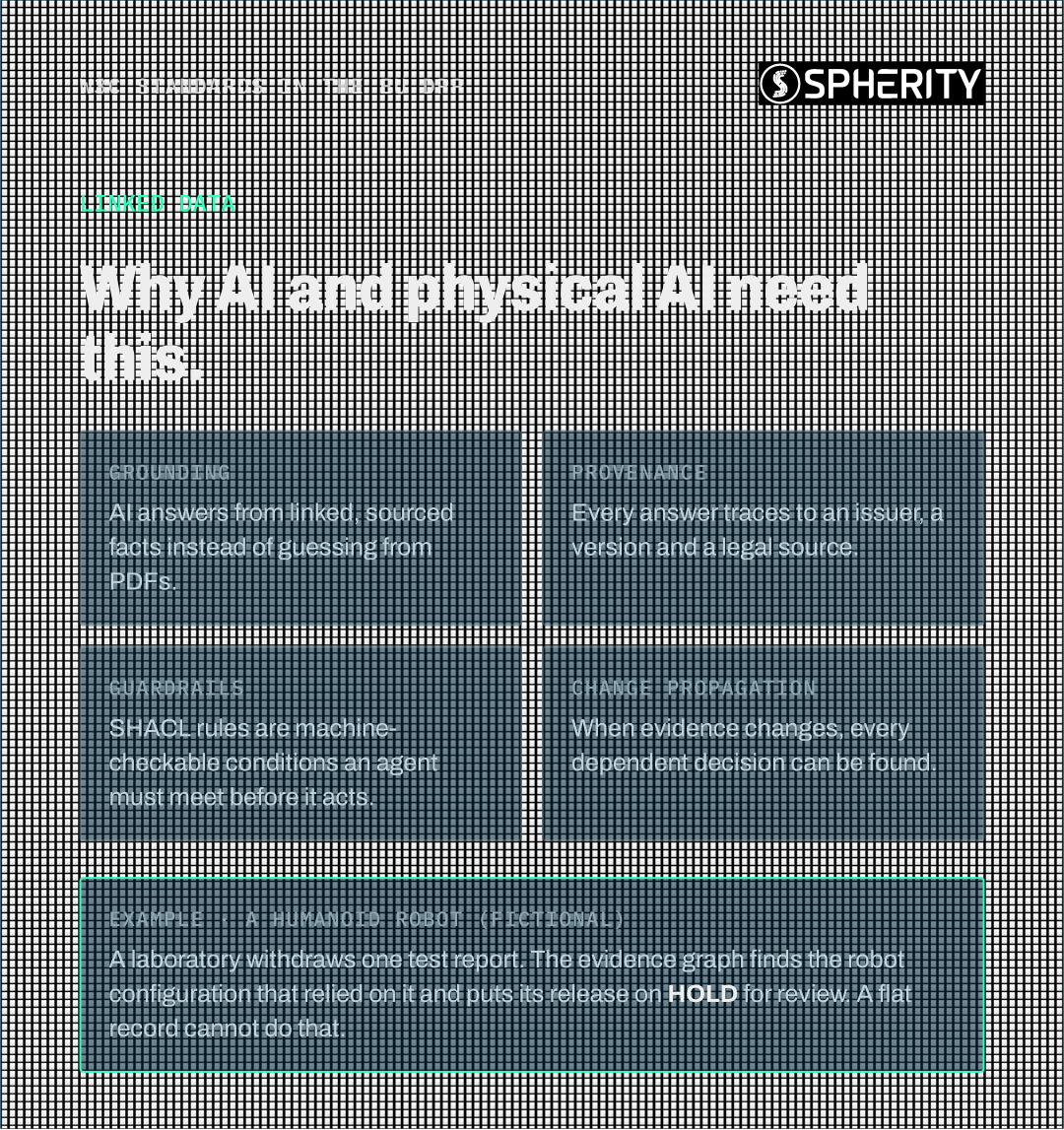
Download figure 1: SVG · vector PDF · PNG
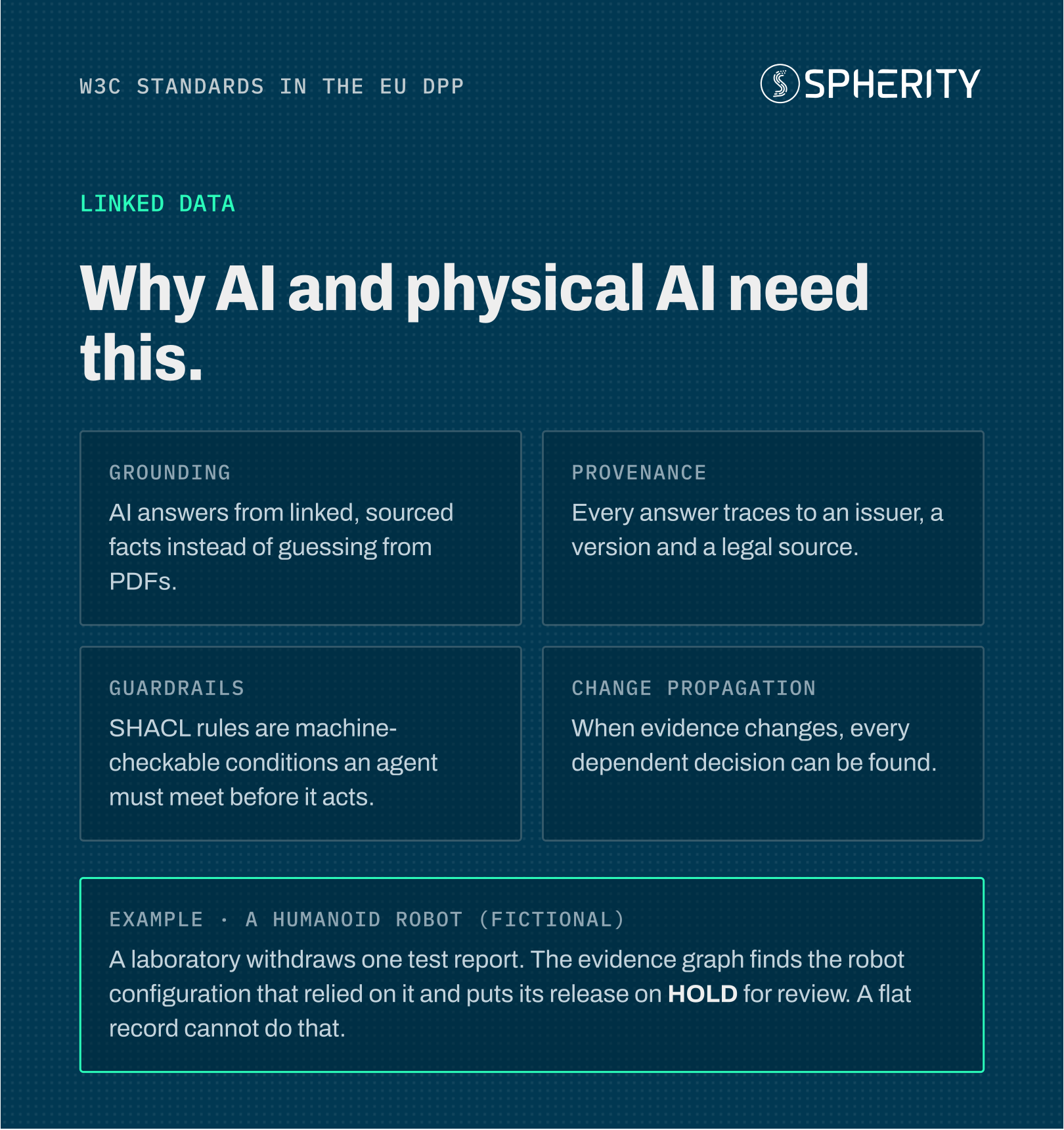
A verifiable evidence graph extends a graph of product facts with evidence about issuer, provenance, transformation, validation, version and status. Cryptographic proof can establish authorship and integrity; it does not by itself establish factual truth, legal authority or fitness for a specific decision. Those remain separate verification and policy questions.
DPP5.0: a maturity model from documents to evidence graphs
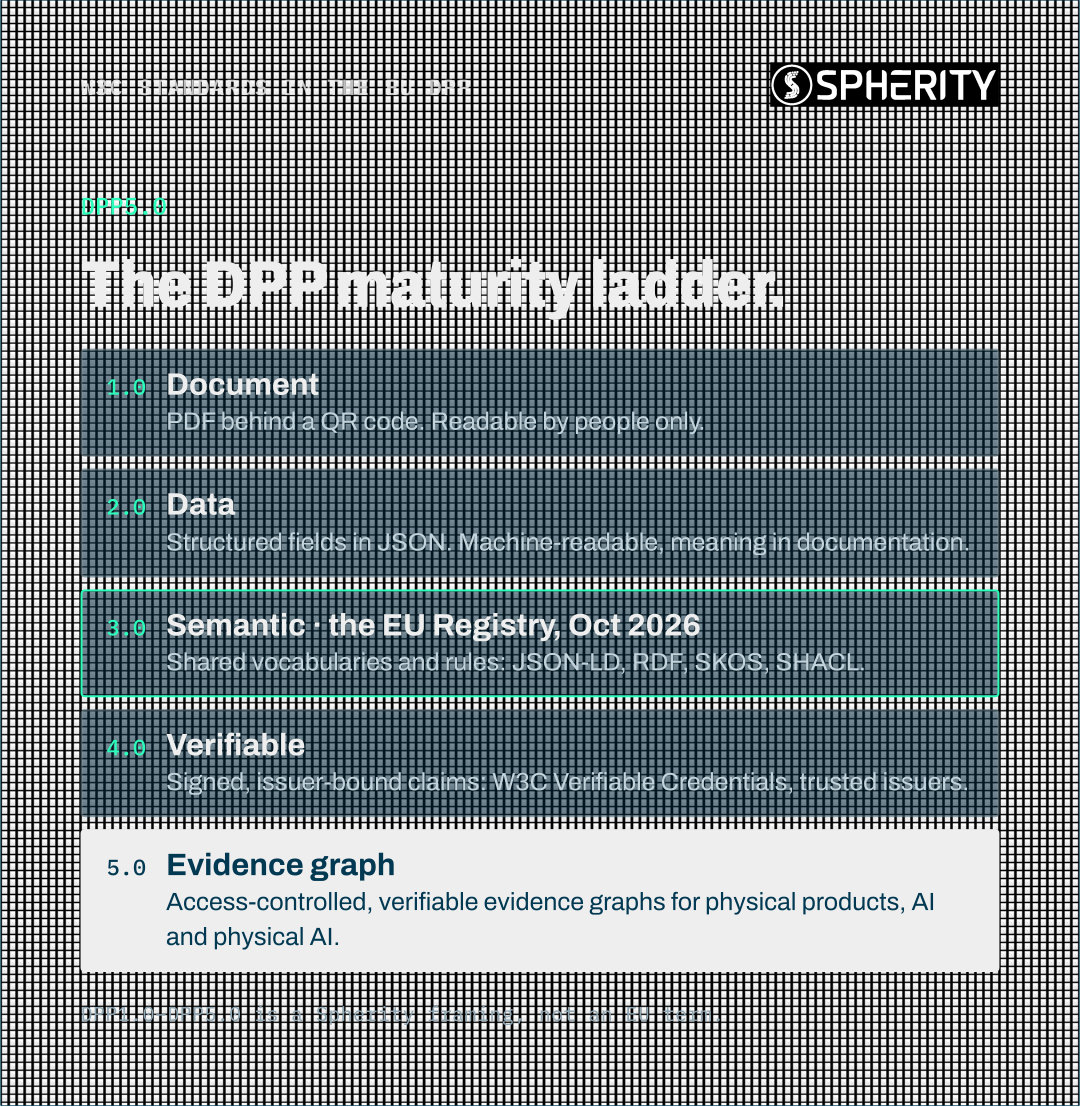
Download figure 2: SVG · vector PDF · PNG
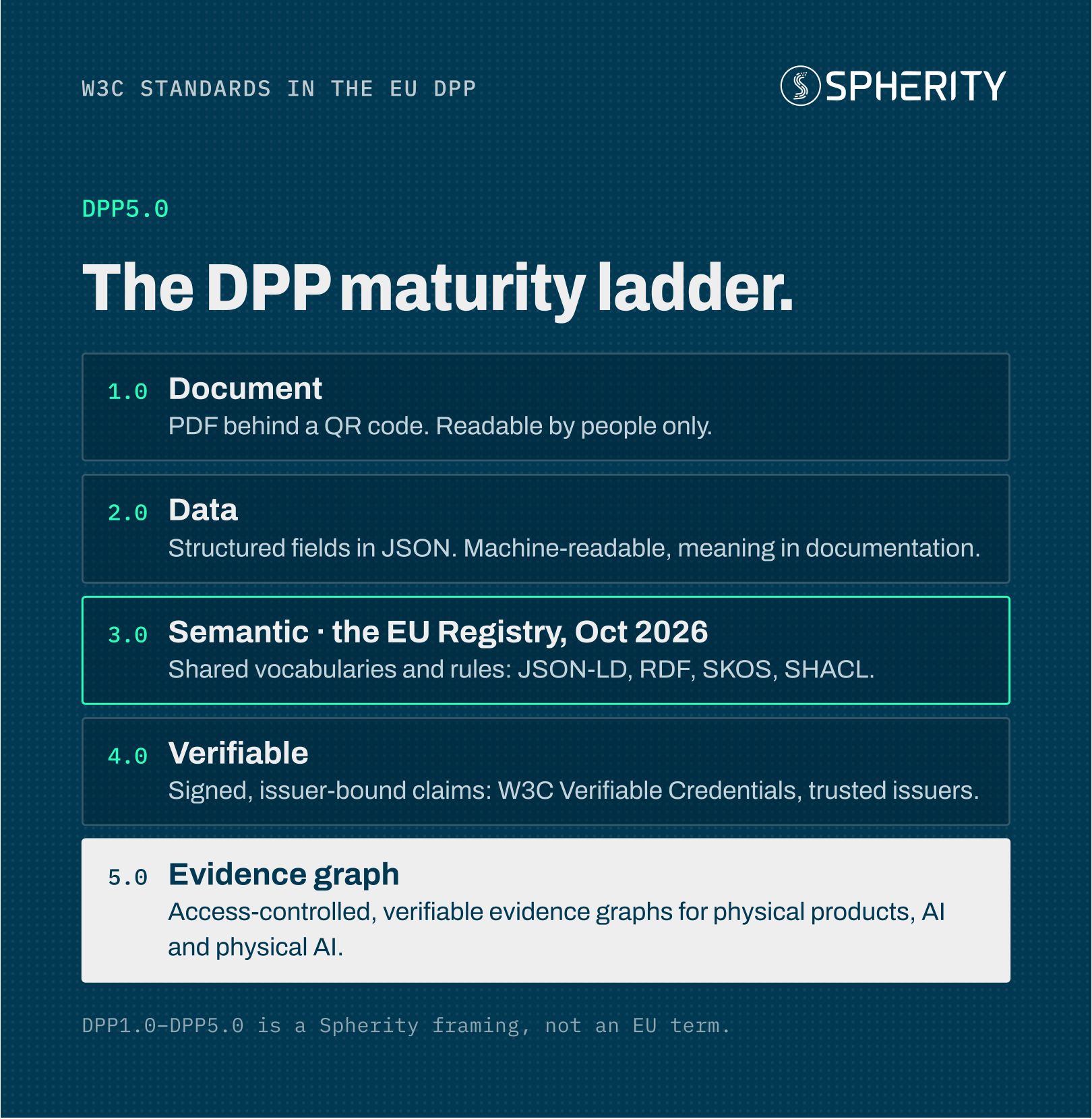
| Level | Core model | Machine capability | Main limitation before the next level |
|---|---|---|---|
| DPP1.0 — Document | PDF or document behind a QR code. | Human-readable access. | Meaning and fields are not reliably machine-actionable. |
| DPP2.0 — Data | Structured JSON or equivalent fields. | Machine-readable data. | Meaning still depends heavily on external documentation and local mappings. |
| DPP3.0 — Semantic | Shared vocabularies and validation: JSON-LD, RDF, SKOS, SHACL. | Common meaning and machine validation. | A fact is not automatically issuer-bound, status-aware evidence. |
| DPP4.0 / DPP 4.0 — Verifiable | Signed, issuer-bound claims with governed trust and status. | Machines can verify who asserted a claim and whether the credential remains valid. | Claims remain easier to use as isolated attestations than as connected dependency structures. |
| DPP5.0 / DPP 5.0 — Evidence graph | Access-controlled, verifiable evidence graph. | Machines can traverse claims, sources, versions, dependencies, authority and status across organizations. | Requires governance, interoperable profiles and policy enforcement across trust domains. |
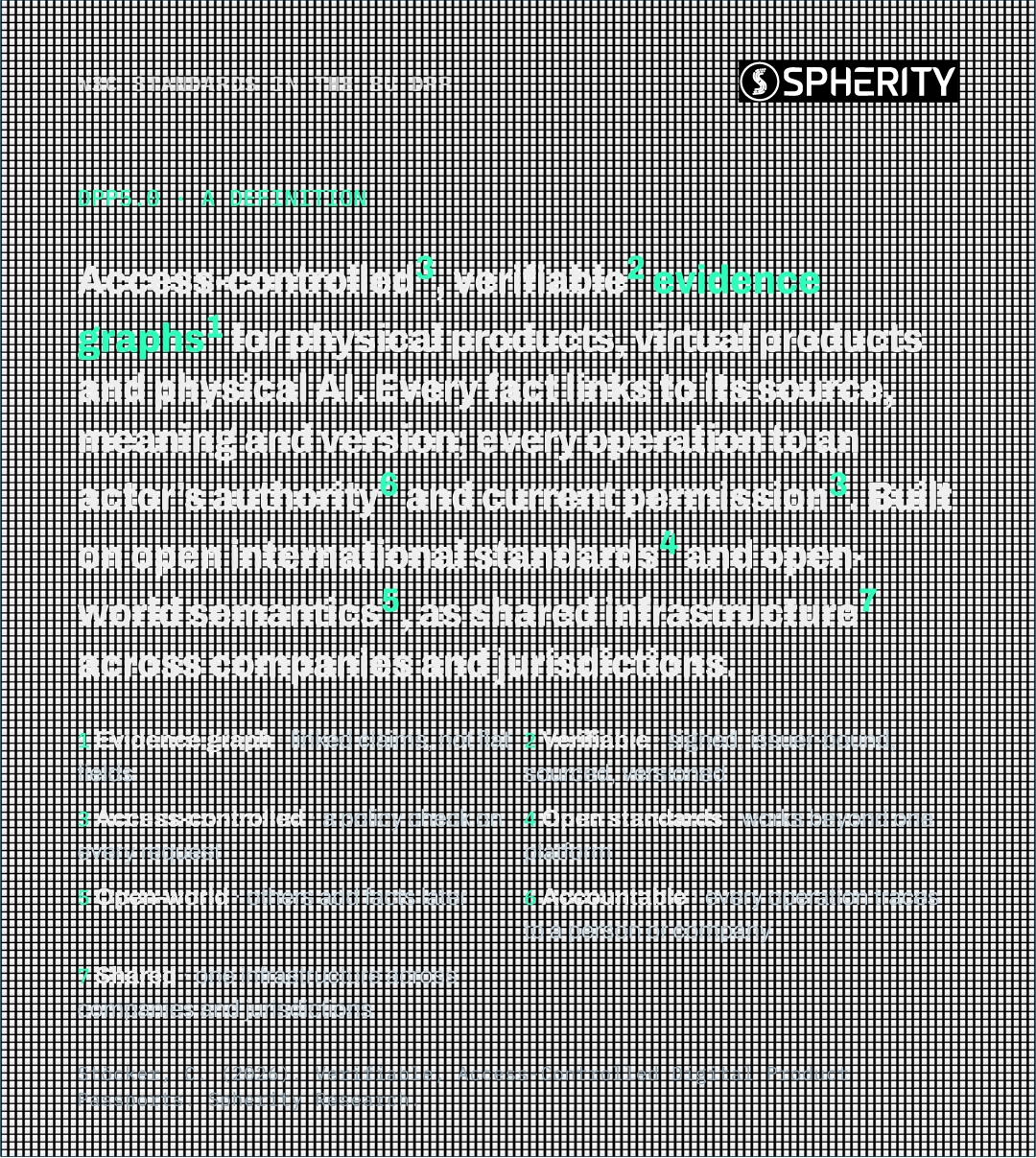
Download figure 3: SVG · vector PDF · PNG
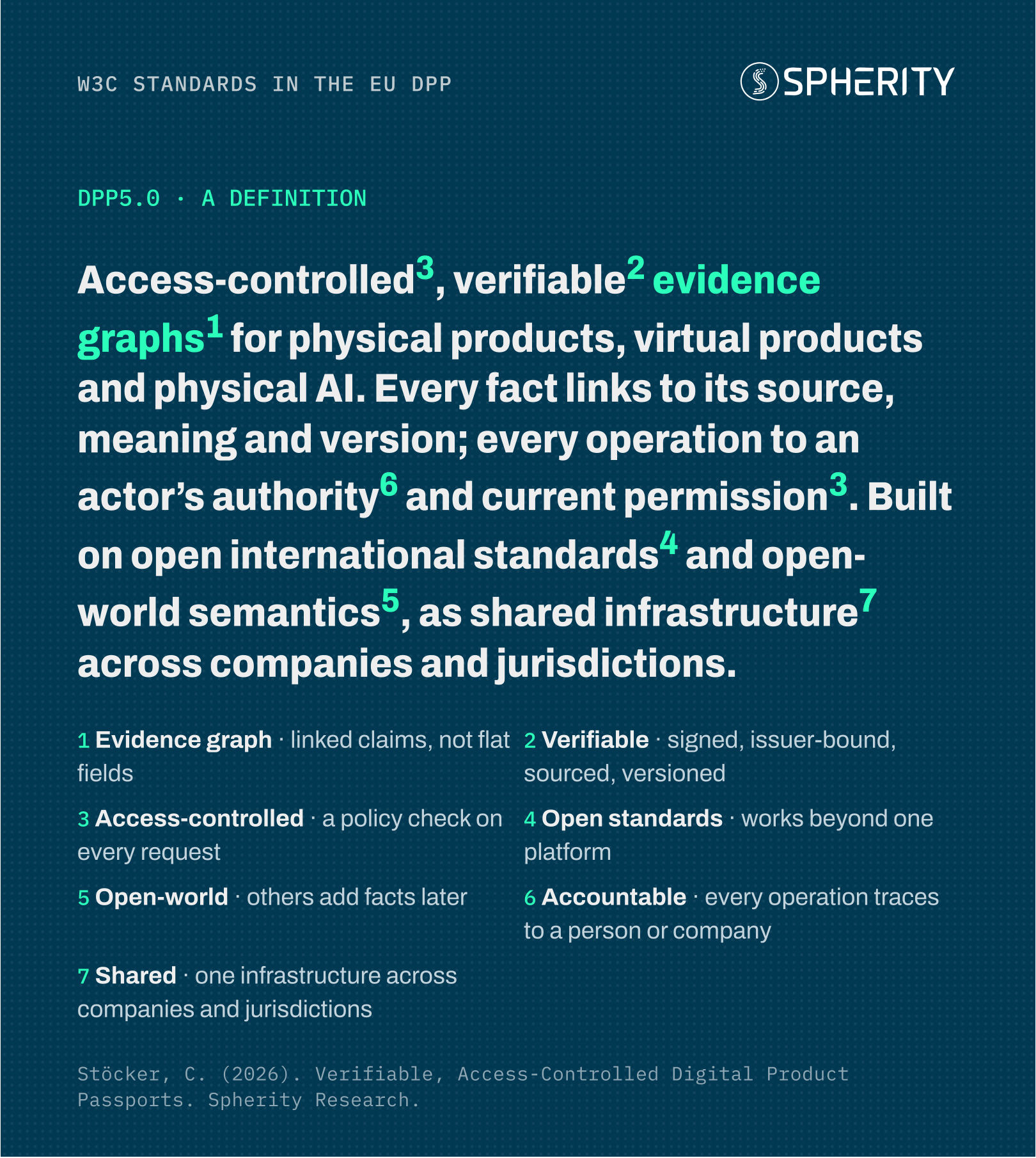
Reading the DPP5.0 definition. “Verifiable” means that a receiving party can check a claim’s issuer binding and integrity under a recognized trust profile. “Access-controlled” means that the requesting party’s role, purpose, mandate and current permission are evaluated before protected evidence is released or changed. “Evidence graph” means that claims remain linked to sources, evidence dependencies, transformations and status. “Open-world” allows further governed assertions without assuming that a single registry knows every fact. “Shared” means interoperable references and profiles across independently governed organisations, not a single central evidence store.
Where the Registry stands — and how DPP + EBW convergence addresses the gaps
The comparison below is Spherity’s assessment of the published technical package, not a Commission compliance grading. “Missing” means missing from the scope of this Registry package as a general product-claim mechanism. It does not mean that every sectoral system lacks trust or access controls.
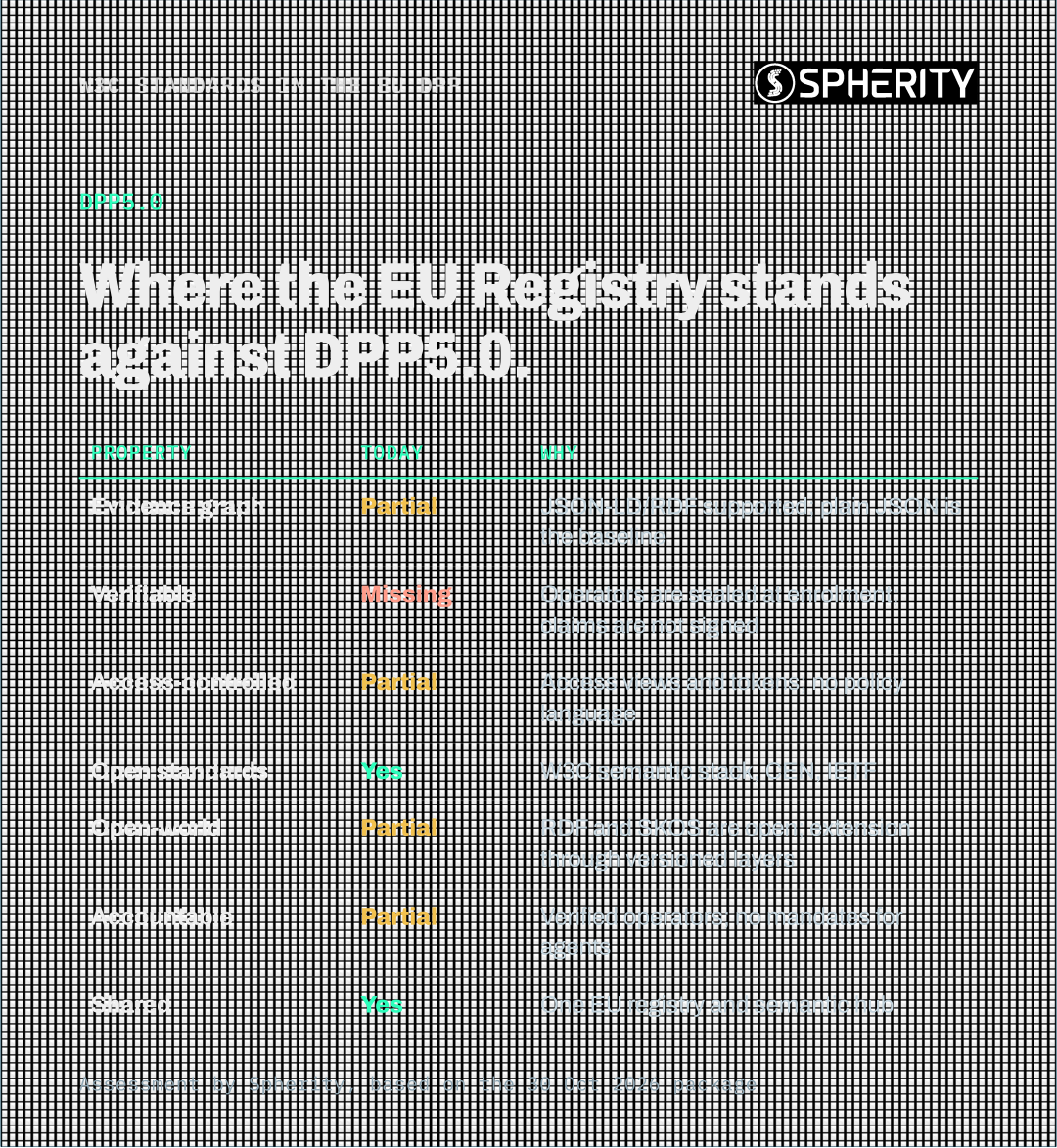
Download figure 4: SVG · vector PDF · PNG
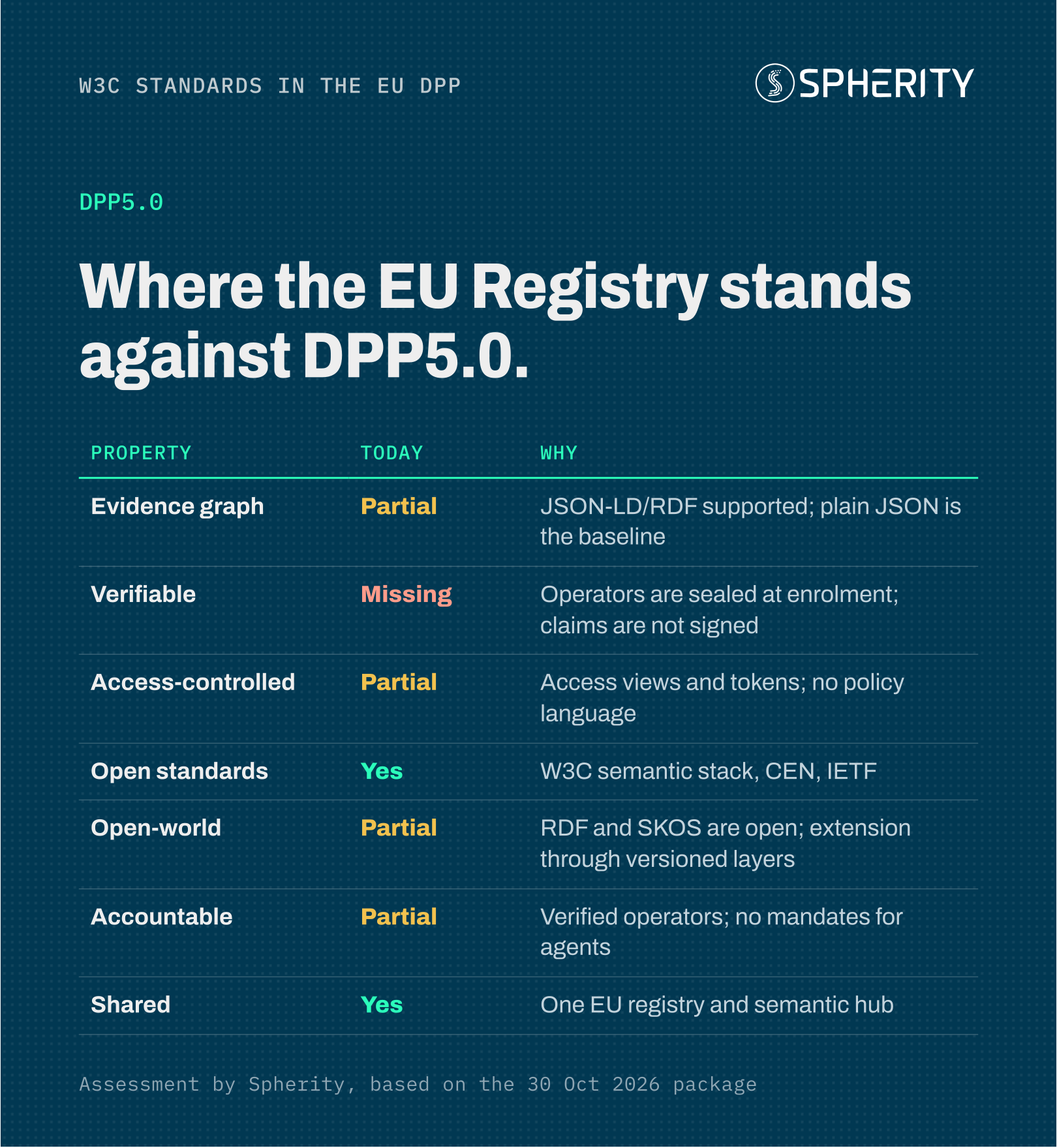
| DPP5.0 property | Registry package today | Convergence path proposed by Spherity |
|---|---|---|
| Evidence graph | Partial. JSON-LD/RDF and common IRIs support linked semantics; plain JSON remains the baseline. | Use JSON-LD/RDF operationally and link DPP claims to issuer, source, transformation, validation and status evidence. |
| Verifiable | Missing as a general claim layer. Operator enrolment can use trusted identity/signature mechanisms, but product claims are not generally W3C Verifiable Credentials. | Profile W3C Verifiable Credentials or equivalent signed evidence so material claims remain issuer-bound and status-aware. |
| Access-controlled | Partial. Access views, authentication and tokens are defined. | Add explicit machine-readable authorization and usage policy evaluated for purpose, role, resource and context. ODRL is one open standards candidate. |
| Open standards | Strong foundation. W3C semantics, CEN/CENELEC data-model work, IETF security protocols and OpenAPI. | Preserve open profiles for credentials, status and policy so no vendor owns the evidence semantics. |
| Open-world | Partial. RDF/SKOS support extensibility and versioned semantic layers. | Permit governed external claims while preserving EU core semantics, provenance and validation boundaries. |
| Accountable | Partial. Economic operators are identified for Registry participation. | Use a future EBW to prove the legal person, representation, issuer authority and bounded delegation—including for machine or AI-agent actions. |
| Shared | Yes at EU infrastructure level. Common Registry and semantic repository. | Extend interoperability across company and jurisdictional trust domains without centralizing all evidence. |
How DPP + EBW convergence divides responsibilities
The convergence model does not turn the Business Wallet into a product database. It separates responsibilities:
- DPP / DPP Registry: product identity, product semantics, registration, discovery, DPP validation and product-linked evidence.
- European Business Wallet: legal-person identity, representation, trusted organizational documents, signatures/seals and bounded delegation where the final legislation and profiles support them.
- Verifiable Credentials and current status: portable, issuer-bound evidence about identity, roles, permits, conformity, testing or other claims under governed profiles.
- Policy decision and enforcement: the relying party’s decision on whether a particular actor may obtain or change particular evidence for a stated purpose and context.
- Evidence graph: the machine-traversable connection between product facts and the authoritative evidence that supports them.
Together, these components could address the gap between “what is known about the product?” and “who is authorised to assert, access or act on that evidence now?” The gap is not automatically closed by connecting a wallet: recognized issuer roles, sector rules, revocation/status, interoperability profiles, policy decision points and enforcement still need to be implemented and tested.
The European Business Wallet is still legislation in progress. The Commission proposed COM(2025) 838 in November 2025. The Council adopted its negotiating position on 9 June 2026. The European Parliament’s responsible committee voted on 10 September 2026, and plenary confirmed the mandate to enter interinstitutional negotiations on 7 October 2026. As of the evidence cut-off, the procedure remains at first reading.[15] [16] [17]
The target: one open stack from catalogue to identity and policy
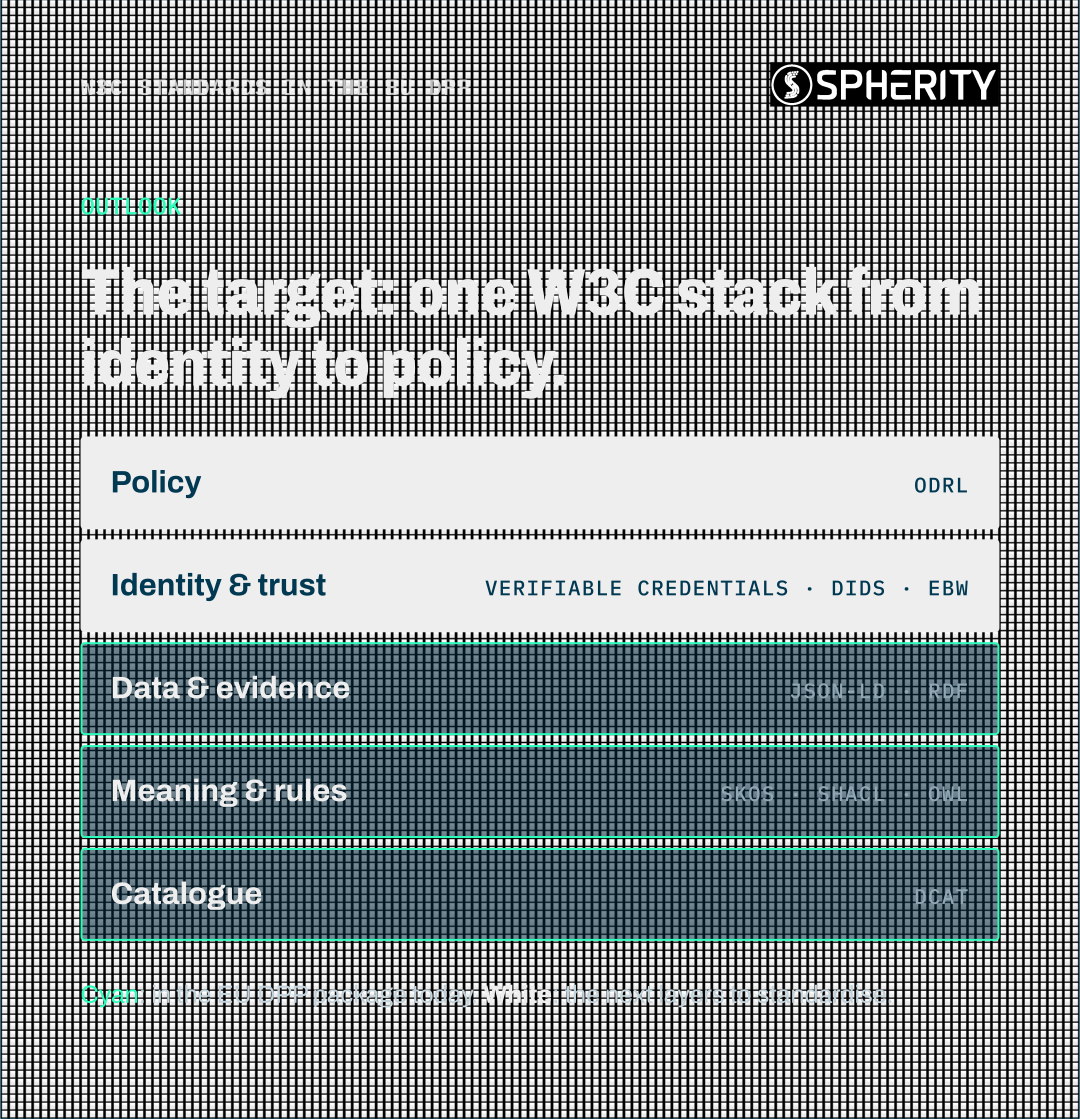
Download figure 5: SVG · vector PDF · PNG
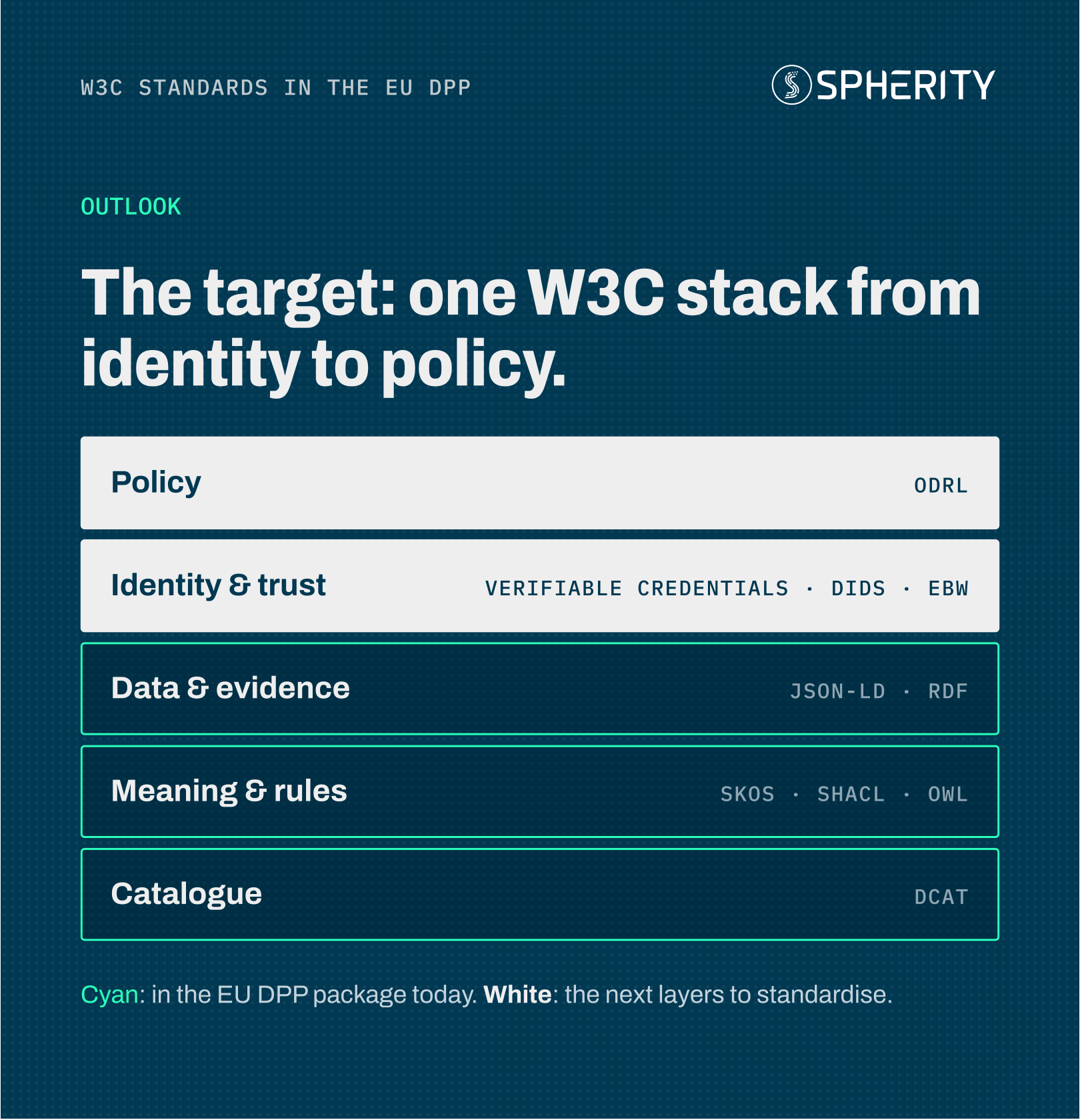
| Layer | Principal open-standard components | Core question |
|---|---|---|
| Catalogue | DCAT / DCAT-AP | Which semantic and data resources exist, and which version applies? |
| Meaning & rules | SKOS, SHACL, OWL | What does each field mean, and which constraints apply? |
| Data & evidence | JSON-LD, RDF | How are product facts linked across sources and transformed into a graph? |
| Identity & trust | Verifiable Credentials, DIDs, EBW profiles | Who issued the claim, which legal person stands behind it, and which authority applies? |
| Policy | ODRL or equivalent machine-readable policy profiles | May this party perform this action, for this purpose, on this evidence now? |
The stack should remain modular. The European Business Wallet is a proposed EU legal/business instrument, not a W3C specification. W3C credentials do not establish legal authority by themselves; an EBW does not prove a product claim is true; and ODRL does not determine policy governance. The relying party must combine trusted issuers, current status, sector rules and local authorization.
From DPP Registry to data space: Spherity’s B2G implementation pattern
The EU DPP Registry and its semantic repository provide elements of a data space: a common point of discovery, shared meaning and governed participation around distributed product data. Spherity is working on a lightweight business-to-government (B2G) implementation pattern that combines a Government Register, a Semantics Register and authentication and authorization supported by business wallets and a policy engine. The same foundations can connect statutory registration and reporting to a fuller data space spanning public authorities and commercial participants.
Web edition extension, 4 November 2026. This section develops Spherity’s architecture proposal beyond the original 36-page PDF; it does not describe an adopted EU data-space profile or a deployed Spherity service.
The Registry as a catalogue; the semantic repository as a focused semantic hub
The Commission describes the Registry as an EU-wide index connecting product-passport identifiers and registration information to a decentralized DPP system. Product data remains the responsibility of economic operators or their service providers. This supplies a catalogue-like discovery function: identify a passport and connect it to the relevant registration context. It does not establish that the Registry exposes a general-purpose catalogue of negotiable data offers or implements the Dataspace Protocol.[21]
The associated semantic repository supplies common models, definitions and validation resources. It can therefore be understood as a special-purpose semantic hub for regulated Digital Product Passport (DPP) and Digital Battery Passport (DBP) data. Shared identifiers, vocabularies, JSON-LD contexts and versioned constraints help independent systems interpret and validate the same regulated fields.[1] [2] “Semantic hub” is our architectural interpretation: it does not imply one universal industrial ontology, ownership of every product fact, or verification of factual truth. Sector and company extensions need governed mappings to the applicable core version.
Together, these functions address where to find data and how to understand it. A functioning data space also needs an agreed operating framework: who may participate, which identities and issuers are trusted, which rights apply, how exchanges are enforced, and who handles failures and disputes. A catalogue plus semantics is a substantial foundation; completeness depends on the use case and governance, rather than on the number of installed components.
A lightweight B2G data space with business wallets
Spherity’s implementation pattern separates three responsibilities, with business wallets providing reusable identity and authority evidence across them:
- Government Register — the regulated record. Maintain required identifiers, registration state and submission receipts; link to responsible operators and permitted data endpoints. For reporting use cases, record the report’s purpose, period and applicable submission rules. Store the payload only where the governing process requires it.
- Semantics Register — the interpretation and validation contract. Publish the applicable model, vocabulary, context and validation-profile versions. A submission must identify the version against which it was checked; later mappings must preserve meaning, units and provenance. Successful validation establishes conformance to those rules, not product conformity or factual accuracy.
- Policy engine and enforcement — the decision on each action. Authentication verifies the requesting party and its control of the relevant credential or key. Business wallets can supply legal-person identity, representation, roles and bounded mandates. Authorization then evaluates those verified inputs against the requested action, resource, purpose, legal basis, validity and current status. The register API and data host must enforce the decision and retain an auditable result.
A wallet presentation is an input to authorization, not an access grant. Recognized issuers, delegation chains, credential status, service-account binding and failure handling need explicit profiles. The proposed European Business Wallet could provide an EU framework for some of these functions, subject to final legislation and interoperability rules; the architecture must not assume that any wallet credential already has that legal effect.[15] [16]
For example, a battery manufacturer could submit a registration through a service acting under a bounded business-wallet mandate. The service authenticates, the policy engine checks its permission to register that product, and the submission is validated against a named semantic profile. The register returns an attributable receipt. A market-surveillance request and a recycler’s request subsequently receive distinct policy decisions and data views. The receipt proves what the registration process accepted; it does not certify every underlying battery claim. This is an illustrative target flow, not a claim about current Registry wallet integration.
Connecting registration and reporting to a fuller data space
The opportunity is to reuse compliance infrastructure as a governed entry point for wider data sharing. Preserve the government record and its statutory purpose. Publish permitted discovery metadata and endpoint references into the wider catalogue, with explicit provenance, freshness and access conditions. Keep protected product evidence at its authoritative source where appropriate. Link identifiers and semantic versions across systems instead of silently copying records into a second source of truth.
Mandatory B2G submissions and authority access must retain their applicable legal basis. Optional B2B exchanges can add agreed usage conditions and commercial terms; those terms must not replace statutory duties or access rights. A registration receipt, a participant credential and a contract agreement answer different questions and should remain distinguishable in the evidence graph.
This transition requires adapters for register APIs, semantic mappings, trust recognition and policy enforcement. It also needs operational governance for onboarding, changes, revocation, catalogue-cache freshness, audit, retention and disputes. A practical acceptance test is whether a withdrawn mandate, changed semantic version or revoked evidence item produces the correct decision across both the B2G process and the connected data exchange.
Eclipse Dataspace Components: one fuller implementation pattern
Eclipse Dataspace Components (EDC) is one modular framework for implementing this broader exchange architecture. It supplies reusable software building blocks that must be assembled with domain semantics, trust rules, governance and operational services.[22] An EDC-based pattern could map the responsibilities as follows:
| Responsibility | EDC-based implementation option | Integration boundary |
|---|---|---|
| Discover data | Participant catalogues and the Federated Catalog, which crawls and caches catalogue metadata. | Project permitted register metadata into data offerings; a product registration is not automatically a contractual offer. |
| Establish participant trust | Identity Hub manages and presents credentials using the Decentralized Claims Protocol (DCP). | Define trusted issuers and mappings to business-wallet identity and mandates; wallet interoperability is not automatic. |
| Agree and control exchanges | Connector control plane for contract negotiation and transfer lifecycle; policy functions evaluate configured conditions. | Keep statutory B2G rights distinct from optional B2B agreements and bind rules to the relevant decision stages. |
| Deliver protected data | A compatible data plane integrated with the chosen source systems and transfer technology. | Enforce access at the source and delivery boundary; catalogue visibility is not permission to receive every field. |
| Preserve regulated meaning | The Semantics Register remains a domain service alongside the exchange components. | Maintain approved profiles, mappings and validation evidence; installing a connector does not supply DPP/DBP semantics. |
The component roles follow the EDC adopter documentation and Identity Hub implementation; policy evaluation requires configured functions and correct scope bindings.[23] [24] [25] The Dataspace Protocol (DSP) specifies interoperable catalogue, agreement and access exchanges. It does not by itself define the regulated product semantics or the legal basis of a government submission.[26]
Participant onboarding and endpoint discovery in a data space serve a different purpose from a government product register. Likewise, an Identity Hub is not automatically a legally recognized European Business Wallet. The proposed bridge needs explicit protocol versions, identity and trust profiles, API adapters and conformance tests. Nothing in this comparison establishes that the EU DPP Registry currently runs EDC or implements DSP/DCP.
Spherity’s strategic direction is a continuous architecture from regulated registration to governed evidence exchange: start with the smallest complete B2G process, then add federation and cross-company exchange where the use case warrants them. Shared semantics and reusable business identity can reduce repeated integration work while preserving the government’s role, the operator’s data responsibilities and each recipient’s access limits.
Engineering recommendations
Implement what is required now; profile and test the proposed trust layer separately. The current Commission semantic and API documentation should be the technical baseline. Future wallet, credential and policy integration should be treated as a controlled interoperability programme, not as an already-required feature of the Registry.
- Industry: implement the required registration format first; use JSON-LD for richer operational evidence where practical. The Commission’s contexts map JSON fields to defined semantics. Adopt them where suitable, and verify that any transformation preserves the required registry payload and validation rules.
- DPP and EBW standards work: align product evidence with open credential profiles. Legal-person identity, representation, role, mandate and product evidence should interoperate without proprietary translation layers.
- Policy layer: make protected access machine-readable. Define purpose, role, resource, action, context, validity and status as explicit policy inputs; evaluate them on every material request.
- Keep current EU capabilities and target architecture separate. Label DPP5.0, evidence-graph profiles and DPP + EBW convergence as research proposals until adopted profiles exist.
- Test the whole verification path. Conformance work should cover semantic versions, claim signatures, issuer recognition, credential status, delegation, policy decisions, cross-company linking, withdrawal and failure cases.
- Preserve source authority. The Registry, a wallet or an evidence graph should not turn derived or copied data into a new authoritative source without explicit issuer governance.
Key references
- European Commission — Digital Product Passport resources and documentation (including the 30 October 2026 technical package). https://single-market-economy.ec.europa.eu/single-market/digital-product-passport/resources-documentation_en
- Commission Implementing Regulation (EU) 2026/1778 — DPP Registry implementation rules, in force. https://eur-lex.europa.eu/eli/reg_impl/2026/1778/oj/eng
- Regulation (EU) 2024/1781 — Ecodesign for Sustainable Products Regulation (ESPR). https://eur-lex.europa.eu/eli/reg/2024/1781/oj/eng
- Regulation (EU) 2023/1542 — Batteries and waste batteries. https://eur-lex.europa.eu/eli/reg/2023/1542/oj/eng
- W3C — JSON-LD 1.1. https://www.w3.org/TR/json-ld/
- W3C — RDF 1.1 Concepts and Abstract Syntax. https://www.w3.org/TR/rdf11-concepts/
- W3C — SKOS Reference. https://www.w3.org/TR/skos-reference/
- W3C — SHACL. https://www.w3.org/TR/shacl/
- W3C — SPARQL 1.1 Query Language. https://www.w3.org/TR/sparql11-query/
- W3C — OWL 2 Overview. https://www.w3.org/TR/owl2-overview/
- W3C — Data Catalog Vocabulary (DCAT) version 3. https://www.w3.org/TR/vocab-dcat-3/
- W3C — Verifiable Credentials Data Model 2.0. https://www.w3.org/TR/vc-data-model-2.0/
- W3C — Decentralized Identifiers (DIDs) 1.0. https://www.w3.org/TR/did-core/
- W3C — ODRL Information Model 2.2. https://www.w3.org/TR/odrl-model/
- European Commission — Proposal for European Business Wallets, COM(2025)838. https://eur-lex.europa.eu/legal-content/EN/TXT/?uri=CELEX:52025PC0838
- European Parliament — EBW legislative procedure 2025/0358(COD). https://oeil.europarl.europa.eu/oeil/en/procedure-file?reference=2025/0358(COD)
- Council of the EU — EBW negotiating position, 9 June 2026. https://www.consilium.europa.eu/en/press/press-releases/2026/06/09/european-business-wallets-council-adopts-negotiating-position/
- W3C — Verifiable Credential Data Integrity 1.0. https://www.w3.org/TR/vc-data-integrity/
- W3C — Bitstring Status List v1.0. https://www.w3.org/TR/vc-bitstring-status-list/
- W3C — PROV-O: The PROV Ontology. https://www.w3.org/TR/prov-o/
- European Commission — Digital Product Passport Registry: purpose and decentralized architecture. https://single-market-economy.ec.europa.eu/single-market/digital-product-passport/dpp-registry_en
- Eclipse Foundation — Eclipse Dataspace Components project. https://projects.eclipse.org/projects/technology.edc
- Eclipse Dataspace Components — Adopters Manual, component roles and integration responsibilities. https://eclipse-edc.github.io/documentation/for-adopters/
- Eclipse EDC — Identity Hub and Decentralized Claims Protocol implementation. https://github.com/eclipse-edc/IdentityHub
- Eclipse Dataspace Components — Policy Engine, functions and scope bindings. https://eclipse-edc.github.io/documentation/for-adopters/control-plane/policy-engine/
- Eclipse Dataspace Protocol — stable release 2025-1. https://eclipse-dataspace-protocol-base.github.io/DataspaceProtocol/2025-1/
Evidence boundary: DPP1.0–DPP5.0 and DPP + EBW convergence are Spherity research framings. They are not adopted EU or W3C profiles. Current software and legal provisions should be checked against their official sources.

Open research
License and citation
The original research text, 36-page visual paper, this overview and the author-created standalone figures is licensed by its named author under the Creative Commons Attribution 4.0 International License (CC BY 4.0), except for the third-party material identified below. Reuse must credit every named author, link to this canonical version and the license, and indicate whether changes were made.
Third-party rights: Spherity names, logos and trademarks are not licensed. Underlying EU/W3C legal texts, standards, third-party materials and source websites retain their own rights; figures include Spherity branding that is excluded from CC BY reuse.
How to cite this work
Dr. Carsten Stöcker (2026-11-03). “EU DPP Registry, W3C Standards and DPP5.0: From Semantic Product Data to Verifiable Evidence Graphs and European Business Wallet Convergence.” Spherity GmbH. https://spherity.github.io/spherity-research/eu-dpp-registry-w3c-dpp5.html. Licensed CC BY 4.0.
Direct answers
Questions this research answers
What does the EU DPP Registry actually store?
The Registry stores product-passport identifiers and required registration information under applicable EU rules. The product-passport payload can remain at the responsible economic operator or another permitted host. Registration alone does not prove every claim is true.
What is new in the 30 October 2026 DPP technical package?
The package includes the Semantic Data Guide, machine-readable semantic artifacts, API Integration Guide, OpenAPI specifications, Service Account Integration Guide, and guidance for self-hosted authentication and authorization.
Which W3C technologies underpin the DPP semantic model?
RDF provides graph semantics; JSON-LD binds JSON properties to global meanings; SKOS defines controlled concepts; SHACL validates graph constraints; SPARQL queries graphs; OWL supports ontology semantics; and DCAT supports catalogues. XSD supplies relevant datatypes and XML definitions.
What do DPP4.0 and DPP5.0 mean?
DPP4.0 (DPP 4.0) and DPP5.0 (DPP 5.0) are Spherity research labels. DPP4.0 adds attributable, verifiable claims; DPP5.0 connects current product evidence, provenance, authority and purpose-specific policy across companies. They are not EU maturity classes.
Does SHACL verification prove a product claim is true?
No. SHACL tests conformance to declared data shapes and constraints. Factual reliability requires competent sources, evidence checks and potentially independent assessment; authorized use requires a separate policy decision.
Does the DPP Registry require W3C Verifiable Credentials?
The October 2026 technical package does not establish W3C Verifiable Credentials as a general requirement for all product claims. Signed credentials can be a complementary evidence format under future or sector-specific profiles.
How can European Business Wallets support DPP transactions?
A future European Business Wallet may supply reusable business identity, representation credentials and bounded mandates. Verifiable evidence, credential status and relying-party authorization can then be linked to the DPP, subject to final law, accepted trust frameworks and local enforcement.
What remains to be tested for DPP5.0?
Interoperable issuance and verification profiles, authority recognition, policy decisions, evidence status and revocation, cross-company graph links, provenance completeness, latency, failure handling and auditability need implementation tests.
Is the EU DPP Registry a data space?
The Registry provides catalogue-like discovery and a semantic repository for regulated product data: important data-space building blocks. These functions alone do not establish a complete data space. Participation rules, trusted identities, authorization, enforcement and operating governance must be defined for the intended exchanges.
How does the DPP semantic repository act as a semantic hub?
Its shared models, definitions, contexts and validation resources provide a focused semantic hub for regulated Digital Product Passport and Digital Battery Passport data. This is an architectural interpretation, not a claim that it contains all industrial knowledge or verifies factual truth. Extensions need mappings to the applicable core version.
What is Spherity’s lightweight B2G data-space pattern?
Spherity is working on a pattern combining a Government Register, a versioned Semantics Register, and business-wallet-supported authentication and authorization. Wallet evidence identifies the business and its mandate; a policy engine decides whether a specific action is allowed, and APIs and data hosts enforce the result. This is a proposed implementation pattern, not an adopted EU profile.
How can Eclipse Dataspace Components connect B2G infrastructure to a fuller data space?
An EDC-based implementation can add federated catalogue discovery, credential exchange through Identity Hub, contract negotiation and transfer management, with a compatible data plane. Register adapters, semantic profiles, business-wallet trust mappings and enforcement remain necessary. Statutory registration and authority access retain their legal basis separately from optional B2B agreements.