
Spherity Research Whitepaper · Version 1.0
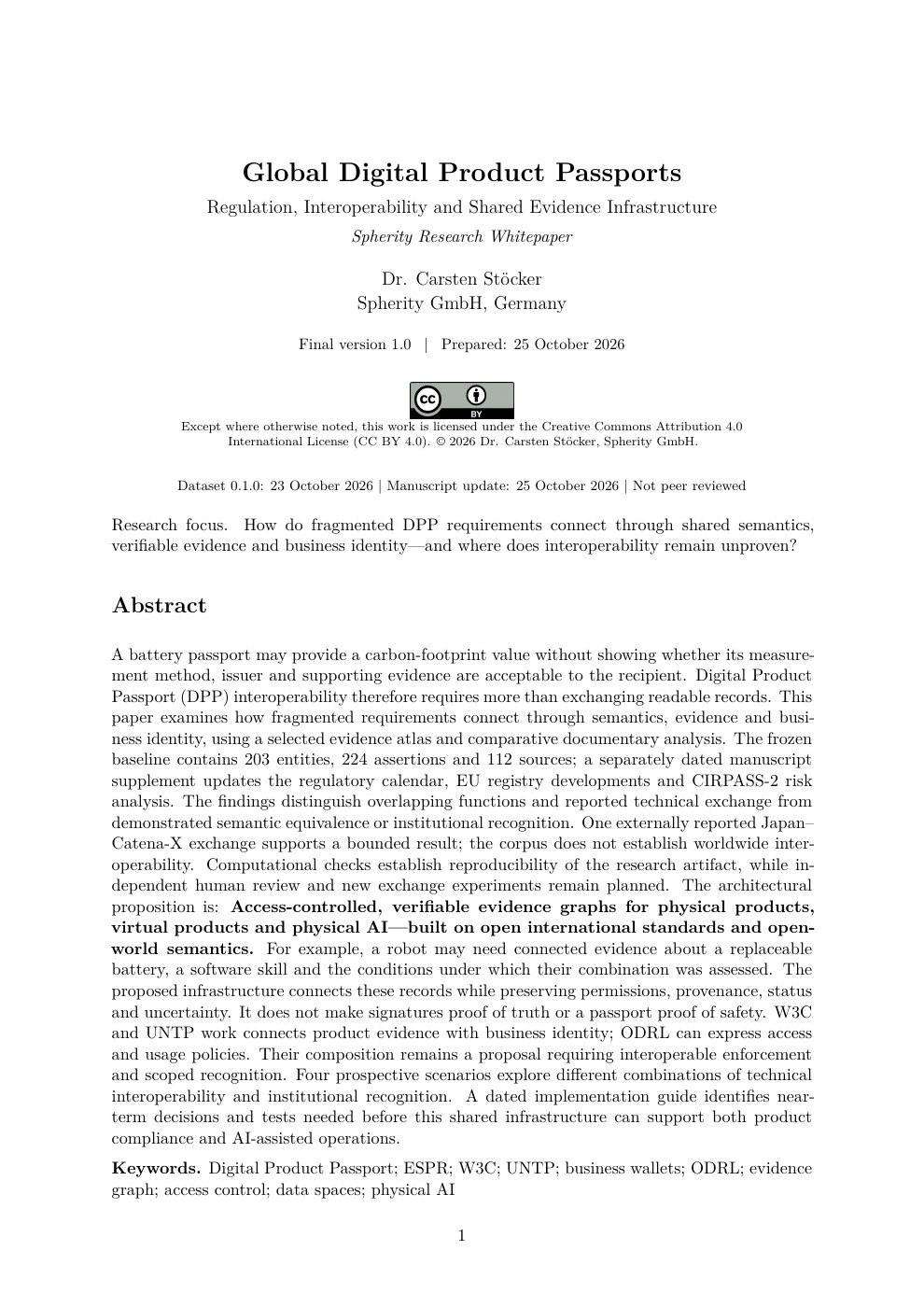
Global Digital Product Passports
Regulation, Interoperability and Shared Evidence Infrastructure
The paper and its living research companion
Understand the rules. Follow the evidence.
Explore how regulation, standards and shared evidence infrastructure connect—and where interoperability remains unproven.
Global DPP Atlas · Research release 0.2.0
Explore global DPP regulation
Select a country to inspect regulatory phase, scope, dates and sources. Then follow the standards and the evidence behind each connection.
25 October 2026
Research record and version details
Browse this paper page
In brief
What this research establishes
DPP requirements are developing through different legal, standards and implementation pathways. Shared semantics, verifiable evidence and business identity can connect them, but data transfer does not by itself establish equivalent meaning, authority or legal acceptance. This paper combines a source-linked evidence atlas with a proposed infrastructure for physical products, virtual products and physical AI.
Key takeaways
- Distinguish a legal obligation, a published specification, a pilot and an independently demonstrated exchange. Each answers a different question.
- Separate fixed application dates from planned adoption windows and conditional requirements. A registry launch does not establish every operational capability.
- The proposed evidence infrastructure combines product claims, actor authority and enforced permission. Its integrated benefits require bounded tests and independent review.
The paper’s architectural proposition
A shared evidence infrastructure for DPPs and AI
Access-controlled, verifiable evidence graphs for physical products, virtual products and physical AI—built on open international standards and open-world semantics.
Connect evidence about a product to its source, meaning and version, and connect each requested operation to an actor’s authority and current permission. This is a proposition for shared infrastructure.
The EU calendar: different dates mean different things
A deadline for a registry, an application date for a defined product group and a target for adopting a future measure answer different questions. Keep the event type visible when planning a product, implementation or investment.
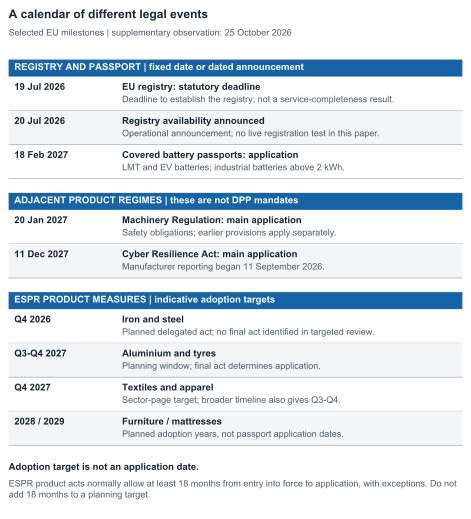
Download the original calendar as a vector PDF ↓
Read the calendar as accessible text
Registry establishment deadline
Statutory deadline in ESPR Article 13(1). EU; applicable product and actor scope only.
Does not establish that every registry function was operational.
ESPR Articles 4(4) and 13 — observation 25 October 2026 ↗Registry availability announced
Commission announced registry and testing-environment availability. EU; applicable product and actor scope only.
No live registration or semantic-validation test performed.
The Digital Product Passport Registry is now live — 20 July 2026 ↗Covered batteries
Article 77 passport application. LMT batteries; EV batteries; industrial batteries with capacity greater than 2 kWh, placed on the market or put into service.
Threshold applies only to industrial batteries; individual information requirements can have separate conditions.
Battery Regulation Article 77 — observation 25 October 2026 ↗Iron and steel
Indicative adoption target; final act determines requirements. EU; applicable product and actor scope only.
Adoption is not application. Normal ESPR transition is at least 18 months from entry into force, with exceptions.
Ecodesign and Energy Labelling Working Plan 2025–2030 ↗
Digital Product Passport — iron and steel ↗Textiles and apparel
Indicative adoption target; final act determines requirements. EU; applicable product and actor scope only.
Adoption is not application. Normal ESPR transition is at least 18 months from entry into force, with exceptions.
Ecodesign and Energy Labelling Working Plan 2025–2030 ↗
Digital Product Passport — textiles and apparel ↗
Commission DPP indicative timeline — observation 25 October 2026 ↗Aluminium
Indicative adoption target; final act determines requirements. EU; applicable product and actor scope only.
Adoption is not application. Normal ESPR transition is at least 18 months from entry into force, with exceptions.
Ecodesign and Energy Labelling Working Plan 2025–2030 ↗
Commission DPP indicative timeline — observation 25 October 2026 ↗Tyres
Indicative adoption target; final act determines requirements. EU; applicable product and actor scope only.
Adoption is not application. Normal ESPR transition is at least 18 months from entry into force, with exceptions.
Ecodesign and Energy Labelling Working Plan 2025–2030 ↗
Commission DPP indicative timeline — observation 25 October 2026 ↗Furniture
Indicative adoption target; final act determines requirements. EU; applicable product and actor scope only.
Adoption is not application. Normal ESPR transition is at least 18 months from entry into force, with exceptions.
Ecodesign and Energy Labelling Working Plan 2025–2030 ↗Mattresses
Indicative adoption target; final act determines requirements. EU; applicable product and actor scope only.
Adoption is not application. Normal ESPR transition is at least 18 months from entry into force, with exceptions.
The 2029 adoption target lies outside the paper’s 24-month review horizon.
Ecodesign and Energy Labelling Working Plan 2025–2030 ↗Machinery
Adjacent safety regime; earlier provisions apply separately. EU; applicable product and actor scope only.
Not a DPP mandate.
Machinery Regulation — corrected Article 54 date ↗CRA manufacturer reporting
Article 14 reporting starts for covered manufacturers. Manufacturers of covered products with digital elements.
Stewards have a different reporting start; not a DPP mandate.
Cyber Resilience Act — Article 71 application dates ↗
Cyber Resilience Act — reporting obligations ↗Products with digital elements
Main cybersecurity obligations; manufacturer reporting began 11 September 2026. EU; applicable product and actor scope only.
Actor-specific exceptions matter; not a DPP mandate.
Cyber Resilience Act — Article 71 application dates ↗
Cyber Resilience Act — implementation timeline ↗
Product measures and regulatory milestones
Table 3 from the whitepaper, in an accessible web format. The thirteen rows preserve the paper’s 25 October 2026 observation and its qualifications. In particular, planned adoption of an ESPR measure is not the date on which every product must carry a passport. Open a linked Atlas record to inspect the current research release’s evidence.
| Product or measure | Date or planning window | Instrument and event | Meaning, scope and qualification |
|---|---|---|---|
| Covered batteries | Passport application | Regulation (EU) 2023/1542, Article 77Primary source ↗ | Article 77 passport application. LMT batteries; EV batteries; industrial batteries with capacity greater than 2 kWh, placed on the market or put into service. Threshold applies only to industrial batteries; individual information requirements can have separate conditions. |
| Iron and steel | Indicative adoption target | ESPR product delegated actPrimary source ↗ · Additional source ↗ | Indicative adoption target; final act determines requirements. EU; applicable product and actor scope only. Adoption is not application. Normal ESPR transition is at least 18 months from entry into force, with exceptions. |
| Textiles and apparel | Indicative adoption target | ESPR product delegated actPrimary source ↗ · Additional source ↗ · Additional source ↗ | Indicative adoption target; final act determines requirements. EU; applicable product and actor scope only. Adoption is not application. Normal ESPR transition is at least 18 months from entry into force, with exceptions. |
| Aluminium | Indicative adoption target | ESPR product delegated actPrimary source ↗ · Additional source ↗ | Indicative adoption target; final act determines requirements. EU; applicable product and actor scope only. Adoption is not application. Normal ESPR transition is at least 18 months from entry into force, with exceptions. |
| Tyres | Indicative adoption target | ESPR product delegated actPrimary source ↗ · Additional source ↗ | Indicative adoption target; final act determines requirements. EU; applicable product and actor scope only. Adoption is not application. Normal ESPR transition is at least 18 months from entry into force, with exceptions. |
| Furniture | Indicative adoption target | ESPR product delegated actPrimary source ↗ | Indicative adoption target; final act determines requirements. EU; applicable product and actor scope only. Adoption is not application. Normal ESPR transition is at least 18 months from entry into force, with exceptions. |
| Mattresses | Indicative adoption target | ESPR product delegated actPrimary source ↗ | Indicative adoption target; final act determines requirements. EU; applicable product and actor scope only. Adoption is not application. Normal ESPR transition is at least 18 months from entry into force, with exceptions. The 2029 adoption target lies outside the paper’s 24-month review horizon. |
| Horizontal repairability | Indicative adoption target | ESPR horizontal measurePrimary source ↗ | Indicative adoption target; final act determines requirements. EU; applicable product and actor scope only. Adoption is not application. Normal ESPR transition is at least 18 months from entry into force, with exceptions. Includes repairability scoring; product scope and requirements depend on the measure. |
| EEE recycled content and recyclability | Indicative adoption target | ESPR horizontal measurePrimary source ↗ | Indicative adoption target; final act determines requirements. EU; applicable product and actor scope only. Adoption is not application. Normal ESPR transition is at least 18 months from entry into force, with exceptions. Distinct from individual energy-related-product measures and their transitional routes. |
| Construction products | Indicative adoption target | Regulation (EU) 2024/3110; passport-system delegated actPrimary source ↗ · Additional source ↗ | Commission target for the passport-system delegated act. EU; applicable product and actor scope only. System operation follows six months and mandatory provision eighteen months after the relevant act enters into force; product-family transitions matter. |
| DPP service providers | Indicative adoption target | ESPR service-provider delegated-act planningPrimary source ↗ | Planning year retained; quarter unresolved. EU; applicable product and actor scope only. Conflicting planning indications are not a verified act or application date. |
| Machinery | Main application | Regulation (EU) 2023/1230, Article 54Primary source ↗ | Adjacent safety regime; earlier provisions apply separately. EU; applicable product and actor scope only. Not a DPP mandate. |
| Products with digital elements | Main application | Cyber Resilience Act, Article 71Primary source ↗ · Additional source ↗ | Main cybersecurity obligations; manufacturer reporting began 11 September 2026. EU; applicable product and actor scope only. Actor-specific exceptions matter; not a DPP mandate. |
Download the paper’s original Table 3 (CSV) ↓ · Download the sourced calendar (JSON) ↓
The service-provider planning quarter remains unresolved where Commission materials give Q2 and Q3. The normal ESPR transition is measured from a delegated act’s entry into force, with exceptions; do not add eighteen months mechanically to a planning quarter. Sources and later observations remain distinguishable from the fixed manuscript.
Use the knowledge graph to ask better questions
A knowledge graph represents things as nodes and explicit relationships as connections. Here, those things include laws, requirements, committees, specifications, programmes and research reports. Each sourced connection carries a claim and qualifications, so readers can follow an explanation back to its evidence.
Separate different kinds of progress
Follow regulation, technical specifications and ecosystem activity without treating them as interchangeable. Check whether a record concerns a proposal, a published edition or a reported operation.
Inspect the actual claim
Hover to highlight neighbours; select a node or connector to inspect sources, versions and limitations. A committee liaison is useful context, but it is not proof of technical conformance.
Identify the missing evidence
Look for mappings, access arrangements, tested exchanges and unreviewed dependencies. An unconnected node may reflect a local initiative or incomplete extraction; it does not prove incompatibility.
The paper’s frozen evidence map
The interactive map above shows Atlas research release 0.2.0 and regulatory phases. The research figure below retains the paper’s original 0.1.0 snapshot dated 23 October 2026. Its colours describe geographic evidence coverage. They are not a regulatory ranking, and they should not be compared with the interactive map as if they used the same categories.
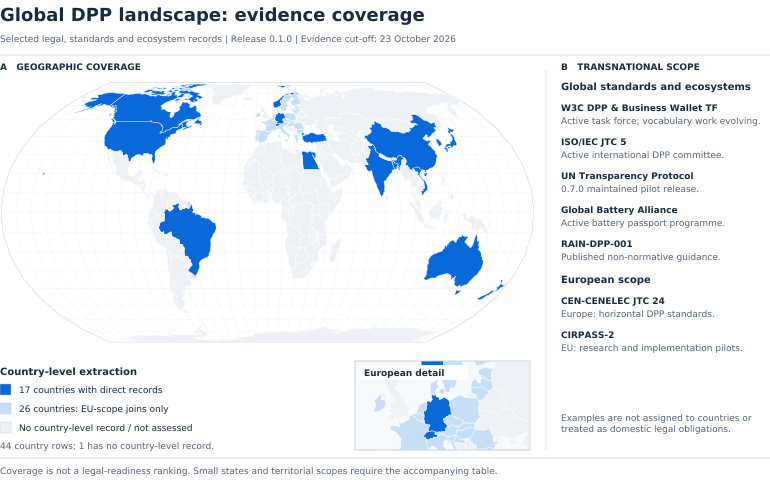
Download Figure 1 as a vector PDF ↓ · Accessible geographic coverage table →
Registration is one part of the evidence infrastructure
The EU registry’s statutory functions include registration information and a semantic repository. These are distinct from a discovery catalogue, a federated semantic hub and the systems hosting detailed product evidence. A registration proof does not establish that every underlying claim is correct.
The paper separates the registry’s legal deadline and launch announcement from the capabilities documented in its September 2026 user guide. It did not perform an authenticated registration or API test. The lower part of this figure is the author’s proposed architecture, rather than an observed common deployment.
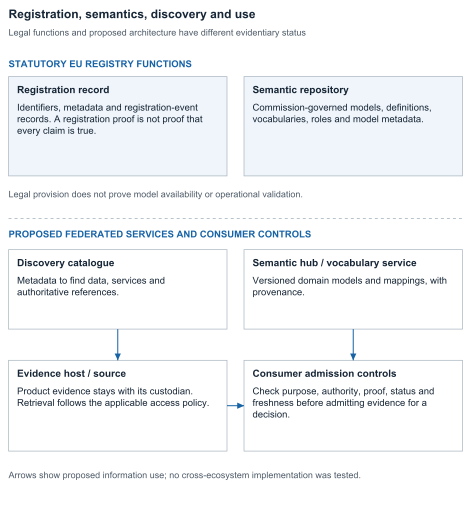
Download Figure 3 as a vector PDF ↓ · Inspect the registry evidence →
Connect evidence, authority and permitted operations
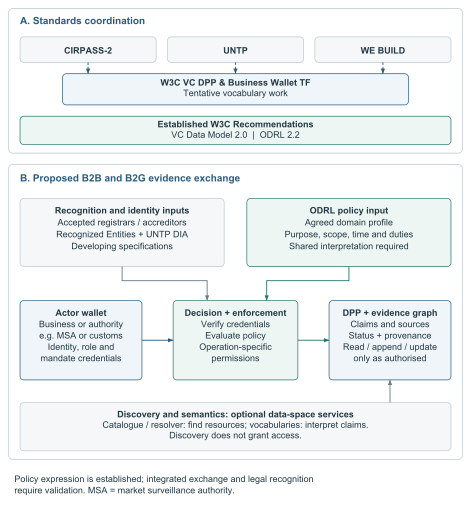
Product evidence concerns an object; business identity and mandates concern the actor requesting an operation. The proposed architecture combines these with scoped recognition, an agreed policy vocabulary and enforcement at the point of access and use.
W3C Recommendations, experimental Working Drafts, UNTP pilot editions and rolling guidance have different status. Wallet use is not universal across UNTP implementations. ODRL expresses permissions and constraints; it does not enforce them by itself. A supplier’s policy cannot override lawful statutory access, and an authority credential does not confer unlimited access to every record.
Download Figure 4 as a vector PDF ↓
A reported exchange has a specific boundary
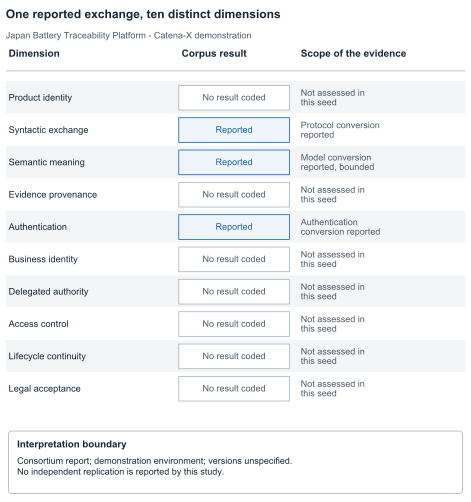
The frozen corpus contains one qualified, externally reported Japan–Catena-X exchange. It supports bounded statements about protocol, model and authentication conversion. It does not establish worldwide semantic equivalence, business authority, lifecycle continuity or legal acceptance.
Download Figure 5 as a vector PDF ↓
“No result coded” is not a failed test. It identifies a dimension that this selected corpus did not assess. The reported demonstration was not independently reproduced for the paper.
Physical products, virtual products and physical AI
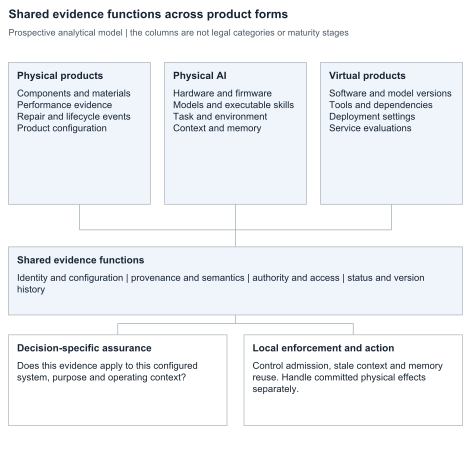
Product claims, software versions, robot configurations and evaluated skills can share evidence functions: identity, provenance, semantics, authority, access and change history. Their legal duties, safety assessments and operating controls remain different.
Download Figure 6 as a vector PDF ↓
Convergence is a set of scenarios to test
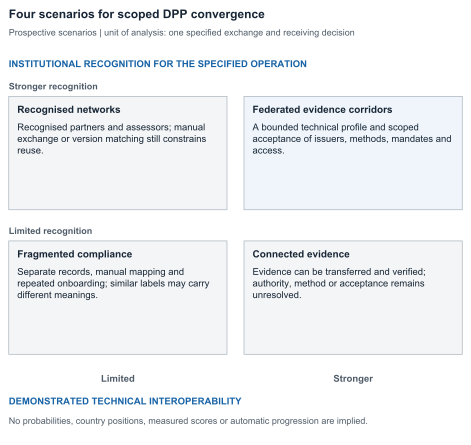
The paper separates demonstrated technical interoperability from institutional recognition for a particular operation. Better data exchange can coexist with unresolved authority or acceptance. Recognition arrangements can also exist where exchange still requires manual work.
Download Figure 7 as a vector PDF ↓
What this means for AAS
AAS is an international standard with national adoption, standards projects, industrial programmes and prototypes in different jurisdictions. Those are distinct adoption signals. It may remain a useful industrial source model, connect through explicit mappings, or be displaced in particular applications. The research does not establish inevitable disappearance or nationwide rejection.
AI may increase demand for portable semantics and attributable evidence. Its effect should be measured against competent AAS, graph and API implementations using the same information, tasks and decision policies.
What to watch over six, twelve and twenty-four months
Table 9’s checkpoints start from 25 October 2026. These are proposed review and implementation horizons, not forecasts of universal adoption or promises that developing standards will be final by then.
Watch and verify
Recheck battery-passport application and adjacent machinery duties.
Verify outcome of the steel target and registry semantic availability.
Implementer action
Prioritise covered products, correct evidence and permissions.
Exercise registration and recovery in the relevant environment; retain test evidence.
Boundary: Proposed activities; no future outcome or successful test assumed.
Watch and verify
Review construction/service-provider acts and 2027 product-measure targets.
Track European Product Act negotiations.
Implementer action
Pin profiles and standards versions.
Test two implementations, delegation and status; retain conditionality until final acts establish application.
Boundary: This checkpoint does not cover the whole fourth quarter of 2027.
Watch and verify
Review CRA main application, furniture developments and international standards outputs.
Look for measured portability and scoped recognition arrangements.
Implementer action
Reassess adapters and evidence reuse; test provider exit and changes.
Measure operational value and retain adverse results.
Boundary: Furniture adoption could fall later in 2028; mattresses and the 2029 EEE measure are outside this horizon.
Boundary: Standards publication alone does not establish mutual recognition.
Download the paper’s original Table 9 (CSV) ↓
The question behind the research
How do fragmented DPP requirements connect through shared semantics, verifiable evidence and business identity—and where does interoperability remain unproven?
The practical approach begins with one product and one consequential decision. Identify the applicable requirement, actor, scope, event date and recipient’s evidence needs. Preserve useful source systems and explicit mappings. Then test legitimate and adverse cases with a second implementation, keeping legal recognition and operational benefit as separate questions.
Methods, versions and research downloads
Whitepaper 1.0
63 pages · prepared 25 October 2026 · seven figures · ten tables · 116 cited references. Final author version, not peer reviewed.
Download the supplied PDF ↓Frozen dataset 0.1.0
23 October 2026 · 203 entities · 128 substantive records · 224 qualified assertions · 112 sources. The original corpus and Figure 1 remain reproducible.
Open the frozen research JSON →Atlas research release 0.2.0
192 substantive records · 205 graph connections · 188 source observations. The technically sealed snapshot preserves later observations and correction history separately from the paper’s frozen results. Independent qualified review remains pending.
Download the current knowledge graph ↓All evidence relationships retain their review status. Machine-assisted source checks and automated artifact tests do not constitute independent legal, scientific or technical review. The source corpus is purposive, with language and access limitations, and does not establish worldwide prevalence. The author participates in W3C’s DPP and Business Wallet task force; this is disclosed experience, not institutional endorsement.
The PDF’s pages, figures, links and bookmarks remain unchanged; its embedded metadata has been completed for attribution and discovery. The original supplied bytes are retained within the published PDF and verified against the source hash. The paper’s architectural proposals, scenarios and planned tests are distinguished from documentary findings and completed artifact checks. Detailed references and methods are in the PDF; the Atlas exposes the relevant source for each record and relationship.
The original research data, annotations and compilation in Atlas release 0.2.0 are available under CC BY 4.0, with attribution to Dr. Carsten Stöcker / Spherity GmbH and the release version. This separate grant does not relicense the unchanged 0.1.0 archive, cited standards, laws, source texts or other third-party material. Read the release’s terms and exclusions.
Open the Atlas and evidence downloads →

Open research
License and citation
The supplied whitepaper, this research overview and the seven original whitepaper figures, except where otherwise noted is licensed by its named author under the Creative Commons Attribution 4.0 International License (CC BY 4.0), except for the third-party material identified below. Reuse must credit every named author, link to this canonical version and the license, and indicate whether changes were made.
Third-party rights: Third-party quotations and source materials retain their original attribution and terms. Natural Earth map geometry is public domain. The paper licence does not relicense underlying standards, source texts, software or the separately governed Atlas data. Spherity names, logos and trademarks are excluded.
How to cite this work
Dr. Carsten Stöcker (2026-10-25). “Global Digital Product Passports: Regulation, Interoperability and Shared Evidence Infrastructure.” Spherity GmbH. https://spherity.github.io/spherity-research/global-digital-product-passport-regulation.html. Licensed CC BY 4.0.
Direct answers
Questions this research answers
What is the difference between the paper and the Atlas?
The 63-page version 1.0 whitepaper is a fixed manuscript prepared on 25 October 2026. Its Figure 1 and baseline counts refer to frozen dataset 0.1.0, dated 23 October. The interactive Atlas uses research release 0.2.0, which preserves separately documented updates and correction history. Its technical seal fixes a reproducible snapshot; independent qualified review remains pending. Its current counts should not be substituted into the paper’s frozen results.
Do the map colours show whether every product needs a passport?
No. Colours summarise the phase of a specifically evidenced measure: applying sector duties, an adopted framework with future or conditional rollout, a proposal, or early public activity. Sector, territory, dates and exceptions remain essential. Grey means unassessed or excluded by the current filters.
Are the EU product-measure dates compliance deadlines?
Only where the cited law establishes an application date. Most ESPR work-plan dates are indicative adoption targets. Construction passport timing depends on a delegated act and statutory transitions. Machinery and Cyber Resilience Act milestones are adjacent obligations, not additional DPP mandates.
Does a connection in the graph prove interoperability?
No. A connection may document participation, a reference, a version-specific dependency or a reported result. The paper’s Japan–Catena-X example is a bounded consortium-reported demonstration, not an independently reproduced finding of worldwide compatibility or legal recognition.
Does the research predict that AAS will disappear?
No. It recognises international AAS standards, programmes and prototypes. AAS may remain an industrial source model, connect through explicit mappings, or be displaced in particular uses. These scenarios need comparable implementation evidence; AI acceleration does not establish one inevitable outcome.
Has the whitepaper or dataset been independently reviewed?
The manuscript is a final author version, not a peer-reviewed publication. Automated consistency checks and machine-assisted source checks do not constitute independent qualified review. The Atlas preserves source-access limits and review status, and the paper specifies the further legal review and experiments required.