
Spherity Research Topic Page
Europe’s Fundamental AI Opportunity
Trust as a production factor, trusted execution capital, industrial renewal, and the economics of transformation speed
Browse this paper
In brief
What does this research establish?
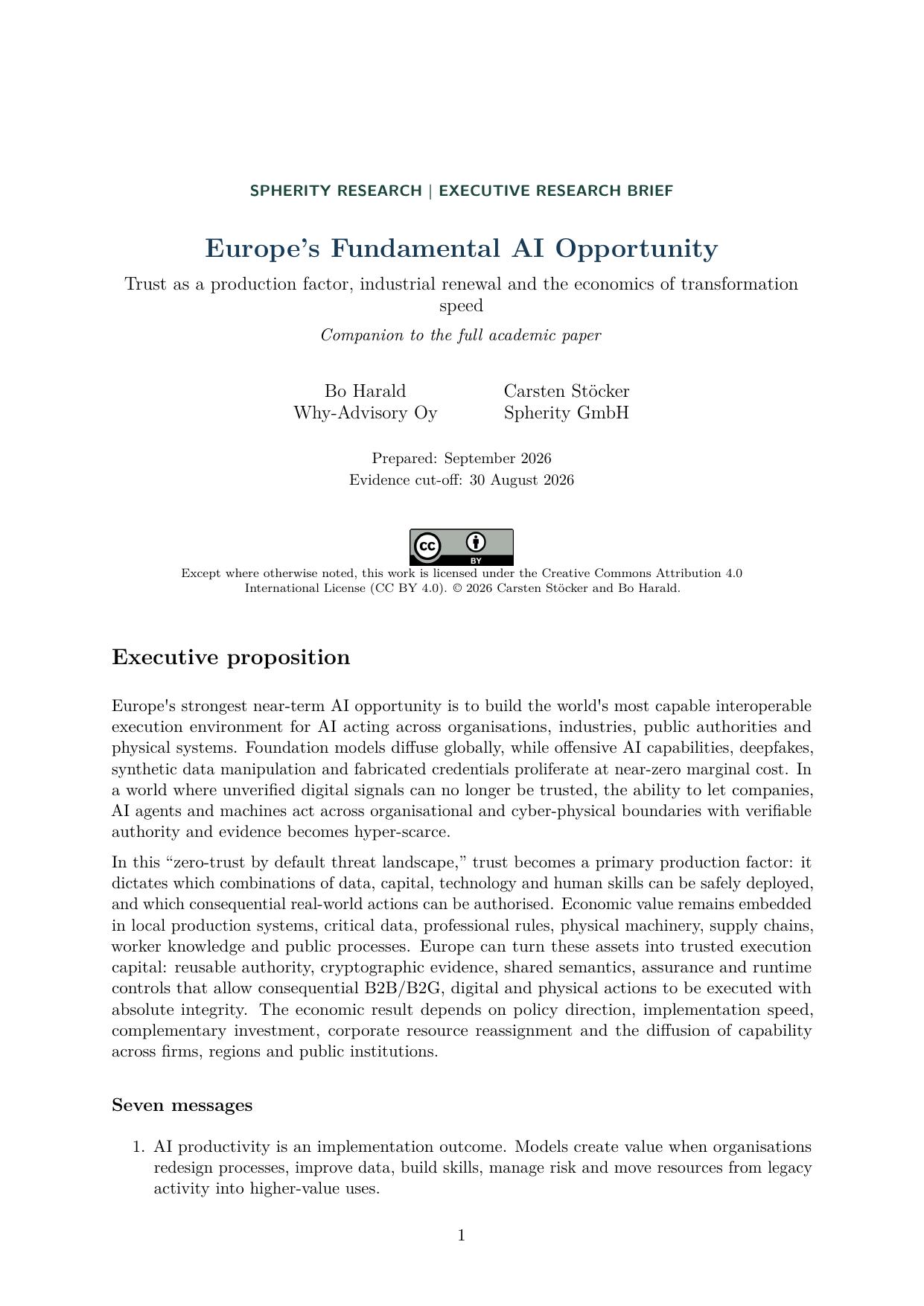
Europe’s strongest near-term AI opportunity is to build an interoperable execution environment in which organizations, AI agents, machines, and public authorities can act across boundaries with verifiable identity, authority, evidence, policy, and recovery controls. In this model, trust is a production factor at the point of use; the accumulated, reusable capability is trusted execution capital. European Business Wallets, Trusted AI, industrial know-how, official registers, engineering standards, and cross-border institutions can convert that capital into faster authorized action, industrial renewal, productivity, and resilience.
Key takeaways
- AI productivity is an implementation outcome: models create value when organizations redesign core processes, build capabilities, and reassign resources.
- Trust becomes a production factor when verifiable identity, authority, evidence, semantics, policy, and recovery expand the valuable actions that can be safely authorized.
- Trusted execution capital is the reusable stock of technical, legal, and organizational capabilities that makes accountable digital and physical execution possible.
- Europe has a leading starting position in trusted industrial, agentic, and physical execution because of its industrial base, Single Market, official registers, standards, and cross-border trust frameworks.
- Corporate leadership must set action-level risk appetite, retire or redesign legacy processes, and move capital, people, and management attention toward production deployment.
Download the executive research brief
Download the executive briefEurope’s Fundamental AI Opportunity: Trust as a Production Factor, Industrial Renewal and the Economics of Transformation Speed. The decision-focused companion for boards, executives, policymakers, and institutional leaders.
Download the long academic paper
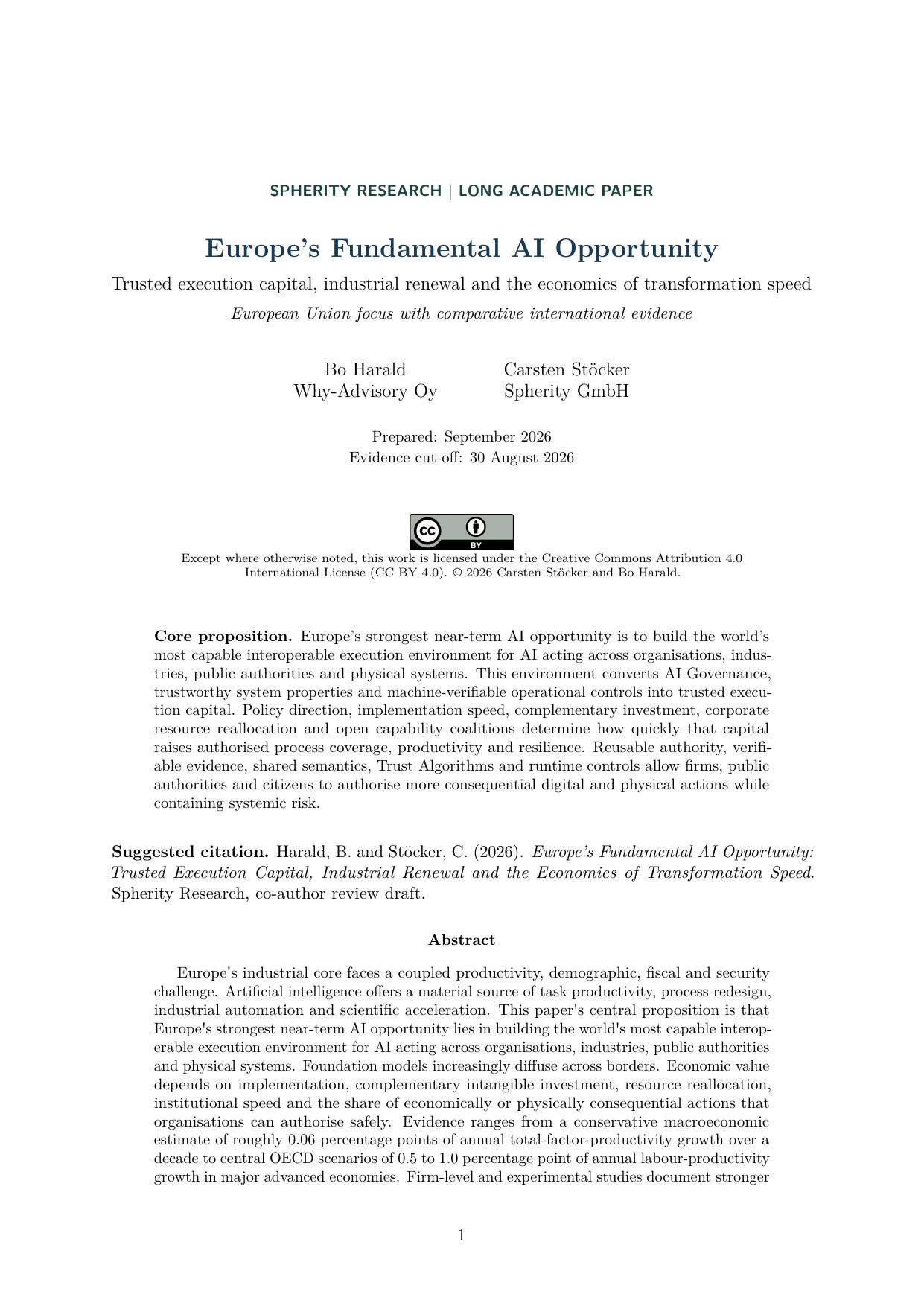
Download the long versionEurope’s Fundamental AI Opportunity: Trusted Execution Capital, Industrial Renewal and the Economics of Transformation Speed. The full analytical framework, comparative evidence, model, and leadership agenda.
What is Europe’s fundamental AI opportunity?
Core proposition of the long version
Europe’s fundamental AI opportunity is to build the world’s most capable interoperable execution environment for AI acting across organizations, industries, public authorities, and physical systems. Foundation models diffuse internationally. The scarcer capability is to let companies, agents, software, machines, and institutions execute consequential actions across boundaries with verifiable authority, reliable evidence, shared meaning, enforceable policy, and effective recovery.
Europe can compete by turning trust into reusable execution infrastructure—and turning that trusted execution capital into authorized process depth, productivity, industrial renewal, and resilience.
This is an implementation proposition, not a claim that governance alone produces growth. AI value depends on process redesign, complementary investment, workforce capability, infrastructure, management quality, policy direction, and the speed at which resources move from legacy activity into higher-value uses.
Executive brief: how trust creates economic value
The executive brief identifies four linked mechanisms through which trust creates economic value:
- Lower transaction and coordination costs. Reusable identity, mandates, and evidence replace repeated bilateral checks and reduce verification friction.
- Greater authorized process depth. More of a workflow can move from human-assisted preparation to accountable execution across organizational and cyber-physical boundaries.
- Higher risk-adjusted productivity. Provenance, policy, least privilege, monitoring, interruption, and recovery reduce fraud, error, unsafe action, expected loss, and incident duration.
- Infrastructure and network effects. Once credentials, evidence formats, policies, and verification services are accepted, additional transactions and sectors can reuse the same foundations.
For management, the practical test is simple: holding models, data, people, and machinery constant, how many additional valuable actions can the organization safely authorize, automate, and reuse when identity, authority, evidence, and recovery are verifiable? If the answer changes materially, trust is contributing to productive capacity.
What “trust as a production factor” means
The research uses production factor in a broad managerial and institutional sense: an input that materially affects how productively labour, capital, data, knowledge, technology, and machinery can be combined. Trust does not replace established production factors and is not proposed as a separate national-accounts category. It is an enabling complement.
In conventional operations, people, contracts, and long-standing relationships supply context for action. AI agents and connected machines increase both the speed and autonomy of decisions. They can discover suppliers, access data, commit resources, alter production settings, or initiate physical action. In that environment, trust enters production directly because cross-company action depends on current answers to questions of identity, legal authority, evidence quality, semantics, policy, system state, and recoverability.
Trust becomes a production factor, a shield against systemic disinformation, and a source of speed when it is designed as reusable infrastructure. Speed becomes a source of productivity when it expands authorised action and produces durable capability in a zero-trust world.
The defensive role matters as much as enablement. AI lowers the cost of deepfakes, synthetic evidence, social engineering, and automated cyberattack. Cryptographic identity, provenance, zero-trust access control, least-privilege policy, status, revocation, monitoring, and tested recovery reduce both the likelihood and impact of failure. By containing expected loss, they can also widen the set of actions that boards, regulators, insurers, and counterparties are willing to authorize.
Why Europe has a leading starting position
Europe does not lead every layer of AI, but it has a distinctive starting position for trusted industrial, agentic, and physical execution:
- a large Single Market with recurring cross-border business and public-sector transactions;
- industrial assets, engineering knowledge, installed machinery, regulated sectors, and strong product-safety disciplines;
- official registers and public authorities able to issue and verify authoritative evidence;
- cross-border law, standards, assurance practices, and institutions that can support mutual recognition;
- the European Digital Identity Framework as a legal and technical foundation for digital identity; and
- the proposed European Business Wallet (EBW) as infrastructure for organizational identification, authentication, attestations, document exchange, representation rights, and mandates.
These strengths are an opportunity, not a guaranteed outcome. Europe’s advantage depends on implementation speed, verifier coverage, issuer and authoritative-source availability, common semantics, open conformance, usable standards, cross-border recognition, production deployment, and diffusion from frontier firms and regions into SMEs, the Mittelstand, public bodies, and adjacent industries.
From trust to trusted execution capital
If trust is a production factor at the point of use, trusted execution capital is the accumulated stock that supplies it. The term describes reusable technical, legal, and organizational capabilities that allow digital and physical actions to be attributed, constrained, evidenced, monitored, interrupted, and corrected.
| Reusable capability | Economic and operational contribution |
|---|---|
| Organizational, agent, workload, machine, and asset identity | Reduces ambiguity and repeated onboarding. |
| Representation rights and mandates | Makes delegated action attributable and bounded. |
| Verifiable evidence and provenance | Lowers due-diligence cost and supports current, auditable decisions. |
| Shared semantics and validation rules | Enables automated interpretation across organizations and jurisdictions. |
| Machine-readable policy and Trust Algorithms | Converts risk appetite and applicable rules into permit, restrict, escalate, or deny decisions. |
| Status, revocation, monitoring, interruption, and recovery | Limits expected loss and closes the control loop when conditions change. |
AI Governance, Trustworthy AI, and Trusted AI are complementary layers. AI Governance defines legitimate purposes, accountability, decision rights, oversight, and remedies. Trustworthy AI defines the socio-technical qualities a system should achieve, including robustness, safety, security, transparency, fairness, and human oversight. Trusted AI makes selected claims and controls machine-verifiable for a specified actor, action, context, and time. Trusted execution is the authorized decision and action under those controls.
European Business Wallets are an important component of this architecture, but not the whole system. Wallets need authoritative sources, issuers, business registers, trust registries, status and revocation services, shared semantics, policy engines, relying-party verification, and operational assurance around them. Together, these capabilities can support B2B and B2G transactions, Industrial AI, Physical AI, agentic commerce, secure supply chains, and cross-border public services.
Corporate leadership, risk-taking and resource reassignment
AI productivity does not arrive from adoption counts. Corporate leaders must make explicit portfolio, risk, and resource choices.
| Transformation horizon | Leadership task | Evidence of progress |
|---|---|---|
| Bounded productivity | Improve discrete tasks while building data, evaluation, and workforce capability. | Cycle time, quality, learning, and controlled production use. |
| Core-process redesign | Rebuild end-to-end processes such as procure-to-pay, engineering change, maintenance, and regulatory reporting. | Retired duplication, wider authorized process coverage, and recurring operation. |
| Business-model change | Develop agentic commerce, autonomous operations, outcome-based services, and ecosystem participation. | External reuse, accountable autonomy, new revenue, and resilient partnerships. |
Boards should set risk appetite by action, not by the generic label “AI.” A drafting assistant, a procurement agent committing funds, and a physical agent acting on critical equipment require different mandate, evidence, safety, monitoring, and recovery thresholds. This action-based approach allows autonomy to expand as evidence and operational confidence accumulate.
Resource reassignment is equally important. Funding new AI programs while preserving every legacy process creates duplication and weakens the investment case. Leaders should identify what will be retired, simplified, consolidated, or rebuilt; move capital, people, and management attention accordingly; and preserve evidence from failed projects so weak approaches can be stopped without losing institutional learning.
Industrial renewal and the economics of transformation speed
The long version separates stakeholder acceptance and readiness to adopt from post-adoption effectiveness and authorized process depth. Its Trusted Execution Transformation and Diffusion Model treats implementation velocity, complementary capabilities, resource reassignment, trust, transition costs, and spillovers as mutually dependent drivers.
The model illustrates three coherent transformation regimes for 2026–2040:
- Fragmented drift: slow implementation, national fragmentation, vendor silos, and pilots that rarely redesign core processes.
- Coordinated acceleration: stable direction, faster implementation, interoperable trust services, common procurement cases, and mission coalitions.
- Trusted industrial leadership: trusted execution infrastructure becomes a strategic European asset and diffuses across firms, regions, public institutions, and sectors.
Median sensitivity runs illustrate a 2040 real-GDP uplift below 1% in fragmented drift, around 4% in coordinated acceleration, and around 10% in trusted industrial leadership. These are conditional scenarios, not forecasts. Their purpose is to show how implementation speed, authorized process depth, complementary investment, and diffusion can compound—not to identify a stand-alone causal coefficient for trust infrastructure.
A practical 36-month action agenda
First 12 months: select measurable missions; appoint accountable deployment owners; establish baselines; map core processes and action-level risk; and publish initial identity, mandate, evidence, and policy profiles.
Months 12–24: run production deployments with meaningful users, budgets, assurance, and recurring transactions. Open procurement frameworks, shared testing, managed trust services, and supplier training to followers.
Months 24–36: stop or redesign weak approaches; move strong components into recurring procurement and private investment; and diffuse reusable services, evidence models, and operating routines into adjacent sectors and jurisdictions.
Leaders should measure time-to-capability: idea to approved production, source data to verified evidence, pilot to recurring operation, update to validated release, incident to containment, and first deployment to external reuse. Announcements and pilot counts are weak substitutes for operational evidence.
Primary sources and interpretive boundaries
The two papers synthesize macroeconomic, institutional, firm-level, technical, and policy evidence. Key primary and authoritative sources include:
- The Future of European Competitiveness, Mario Draghi and the European Commission.
- AI Continent Action Plan, European Commission.
- The Simple Macroeconomics of AI, Daron Acemoglu, NBER Working Paper 32487.
- Foundations for Growth and Competitiveness 2026, OECD.
- AI adoption, productivity and employment: evidence from European and US firms, BIS Working Papers No. 1325.
- European Digital Identity Framework, Regulation (EU) 2024/1183, EUR-Lex.
- European Business Wallets, European Commission.
- Zero Trust Architecture, NIST SP 800-207, NIST.
- EU Artificial Intelligence Act, Regulation (EU) 2024/1689, EUR-Lex.
The argument has clear boundaries. Trust infrastructure is an enabling complement, not a substitute for competitive models, compute, data quality, skills, finance, energy, process redesign, workforce policy, competition, or social legitimacy. Credentials do not prove that an action remains authorized now. Technical controls do not settle legal responsibility or public purpose. Scenario results are analytical illustrations rather than forecasts, and the evidence cut-off for both PDFs is 30 August 2026.

Open research
License and citation
The executive research brief, long academic paper, and this research topic page is licensed by its named authors under the Creative Commons Attribution 4.0 International License (CC BY 4.0). Reuse must credit every named author, link to this canonical version and the license, and indicate whether changes were made.
How to cite this work
Bo Harald; Carsten Stöcker (2026-09-04). “Europe’s Fundamental AI Opportunity: Trust as a production factor, trusted execution capital, industrial renewal, and the economics of transformation speed.” Why Advisory Oy; Spherity GmbH. https://spherity.github.io/spherity-research/europes-fundamental-ai-opportunity.html. Licensed CC BY 4.0.
Direct answers
Questions this research answers
What is Europe’s fundamental AI opportunity?
Europe’s strongest near-term opportunity is to build an interoperable execution environment for AI acting across companies, public authorities, industries, and physical systems. The differentiator is not model scale alone, but the ability to authorize consequential action with verifiable identity, mandate, evidence, policy, monitoring, and recovery.
What does trust as a production factor mean?
Trust is a production factor when it materially improves how people, capital, data, technology, and machinery can be combined. It is an enabling complement, not a replacement for classical factors and not a new national-accounts category. Its practical effect is to expand safe, accountable, and reusable action while reducing verification cost and expected loss.
What is trusted execution capital?
Trusted execution capital is the accumulated stock of reusable technical, legal, and organizational capabilities that lets digital and physical actions be attributed, constrained, evidenced, monitored, interrupted, and corrected. It includes identity, mandates, evidence, semantics, policy, assurance, runtime controls, status, revocation, and recovery.
How does trust create economic value?
Trust reduces transaction and coordination costs, expands authorized process depth, raises risk-adjusted productivity, and creates infrastructure and network effects when credentials, policies, evidence, and verification services can be reused across organizations and jurisdictions.
Why does Europe have a leading starting position?
Europe combines a large Single Market with industrial assets, official registers, regulated sectors, engineering and product-safety disciplines, public institutions, cross-border standards, the European Digital Identity Framework, and the proposed European Business Wallet. These foundations can support governed Industrial AI, Physical AI, and agentic execution.
What should corporate leaders do?
Boards should manage AI as a transformation portfolio, set risk appetite by action, select core processes for redesign or retirement, reassign resources from legacy activity, build capability partnerships, and measure time-to-capability rather than counting pilots.