
Spherity Research · Proof of concept, prototype and initial field testing
Verifiable AI Lab Analysis: From Measurement to Evidence
An educational case study of results, calibration, materials, agent validation and accountable decisions
Browse this case study
In brief
What does this research establish?
This case study proposes an evidence graph for AI-assisted laboratory analysis, informed by proof-of-concept work, a working AI Lab prototype and initial field testing. Result credentials link samples, calibration, consumable lots, reference data, AI Service Passports and validation profiles. Business wallets support organisational identity and bounded agent mandates; CABs and recognised issuers provide scoped assurance. The author reports BMW Dangerous Driving field testing, QI-Digital DCR/DCC testing and related concept work. The integrated architecture remains proposed; numerical examples are illustrative, not measured performance results.
Key takeaways
- Bind each result to the actual sample, device, calibration, material lots, reference release and permitted task.
- Link the AI Service Passport to a validation profile and TEVV evidence for the configuration actually used.
- Distinguish measurement uncertainty, validation confidence intervals and model scores.
- Check issuer recognition, action authorisation, evidence integrity, validity and status separately.
- Keep legal identity, laboratory competence, model-vendor assertions and independent assessment distinct.
- Offline verification is an as-of check against retained evidence; it cannot discover revocations after its status snapshot.
- Distinguish evidence maturity by activity. Field testing, a working prototype, vocabulary development and concept work inform the proposed architecture; numerical illustrations are not measured deployment outcomes.
- Connect VERA, EIDA, AI Service Passports, Agent Identity and Trusted AI around evidence owners and a receiver’s explicit policy.
Case-study PDF: Verifiable AI Lab Analysis — Measured. Signed. Trusted?
The same 19-slide document shared on LinkedIn. Covers use cases, calibration, materials, AI validation, statistical illustrations and Spherity products. The detailed use-case appendix is available on this web page.
Case study at a glance
- Evidence level
- Proof of concept, working prototype and initial field testing. Proposed architecture, informed by the activities listed below.
- Use cases
- Food testing; textile and pharmaceutical product authenticity; product provenance; milk-tank cleaning measurements; forensic analysis; automotive driving-event labels.
- Challenge
- A result can travel without the evidence needed to judge its origin, scientific support and permitted use.
- Approach
- Bind the result to the sample, device, calibration, materials, references, AI service and responsible organisation through an evidence graph.
- Deliverables
- A 19-slide companion PDF, sixteen downloadable figures, worked statistical illustrations and a staged validation plan. This page is a design study, not an executable implementation or a laboratory certificate.
- Main lesson
- Verifiable provenance and authority support scrutiny. They do not establish scientific correctness.
Implementation and testing context
The author's implementation update of 14 November 2026 distinguishes the maturity of the contributing activities:
- BMW Dangerous Driving: field test.
- AI Lab: working prototype.
- Semantic vocabulary: work in progress.
- QI-Digital: DCR/DCC testing within the project.
- Sphin-X: concept work.
- Catena-X Trusted AI: concept work.
- Dairy use case with Siemens: Innovation Challenge work.
These activities inform the proposed integrated architecture. Their individual maturity does not imply that every component has been deployed together or independently validated. The statistical examples on this page remain calculated illustrations, not measured project results.
Abstract
A laboratory output may be a concentration, a spectrum, a marker match, a cleaning measurement certificate or a forensic analytical finding. A verdict is one possible interpretation of that output. This case study proposes an evidence architecture for verifiable AI lab analysis: a result credential links to the particular sample, instrument, calibration, consumable lots, reference data, agent configuration and validation evidence used in an actual run. A business wallet supports organisational identity, credential presentation and bounded delegation. Recognised issuers, conformity assessment bodies and authoritative sources supply different kinds of evidence; they are not interchangeable trust labels.
The page follows the result from physical input to measurement, matching, interpretation and receiver policy. It distinguishes measurement uncertainty from validation confidence intervals and model scores, and shows what an evidence graph can and cannot establish. Food, authenticity, cleaning and forensic examples make the pattern concrete. An automotive driving-label example near the end explores its transfer beyond laboratories. The proposed integrated architecture draws on the proof-of-concept, prototype, initial field-testing and concept activities identified above. Numerical illustrations are synthetic. The stated project context does not imply organisational endorsement or certificate issuance; generic roles in the diagrams remain illustrative.
1. Start with the result, not only a verdict
Laboratories already use quality systems, traceability records and signed reports. The problem examined here is narrower: what happens when an AI-assisted result leaves that controlled environment? A recipient may receive a value or label without the evidence needed to assess the sample, method, software version or issuer’s competence. A signed PDF can establish attribution, but its supporting records may remain difficult to retrieve and check automatically.
An educational way to separate the concepts is to follow four layers:
- Observation: the recorded spectrum, image, chromatogram, sensor reading or sequence data.
- Analysis: a concentration estimate, detected marker, candidate match or extracted feature, with method and limitations.
- Interpretation: an authenticity conclusion, threshold assessment, forensic proposition or other claim supported by that analysis.
- Decision: release a batch, accept a certificate, request another test or refer the result for expert review under a receiver’s policy.
The same credential architecture can carry each layer, but must identify which layer is being asserted. A probability-like model output is not automatically a probability that a product is authentic; a cryptographic verification result is not a laboratory verdict.
2. One evidence pattern, several use cases
| Use case | Result that could travel | Evidence the receiver needs |
|---|---|---|
| Food testing | Measured analyte concentration and uncertainty; a separately stated compliance assessment | Sample and preparation records, validated method, calibration, relevant controls and reference-material certificate |
| Textile or pharmaceutical authenticity | Detection of an invisible product marker and a comparison with a registered reference | Physical item or lot binding, reader configuration, marker registration, reference-library version, false-match evidence |
| Product provenance | A scoped claim connecting a tested item to a registered production lot | Manufacturer and lot records, custody events and the limits of what the marker identifies; a marker alone does not prove the whole supply chain |
| Milk-tank cleaning | Measurement certificate for a specified site and sampling time, with a documented acceptance rule | Sampling location, device, swab or reagent lot, positive and negative controls, procedure and threshold; ATP screening alone does not establish pathogen absence |
| Forensic / criminal investigation | Analytical findings, candidate matches or an expert interpretation | Exhibit identity, custody, contamination controls, lawful reference access, validated comparison method and review |
Tailorlux’s material-marking and reader products provide a motivating product-authenticity context [13]. The AI analysis and credential integrations described here are proposed extensions, not verified capabilities of those products. The revised diagrams use generic roles across the use cases. Transfer to another domain requires a different method, validation profile, terminology and acceptance policy. The architecture should preserve those differences rather than reduce every output to “pass” or “fail”.
3. Make the physical input and actual run traceable
The first requirement is a credible link between the physical object and the digital record. Assign sample, exhibit, production-lot or equipment identifiers at collection; record who sampled what, when, where and under which procedure. Bind custody transfers, seals and preparation steps to those identifiers. A hash detects changes to a digital file; it cannot establish that the file came from the claimed physical sample.
Retain raw data, preprocessing steps, units, timestamps, device and firmware versions, environmental conditions and the configuration used for the run. If an agent retrieves reference records or calls tools, record the selected records, database release, tool versions and relevant execution outputs. Where prompts or retrieval context affect the analysis, pin those too. Protect confidential, proprietary and personal data through controlled evidence access; do not put raw DNA records or secret marker recipes into a public credential.
Open any figure for the full-size view, or use its SVG and PNG download links. On a small screen, scroll the comparison tables horizontally.
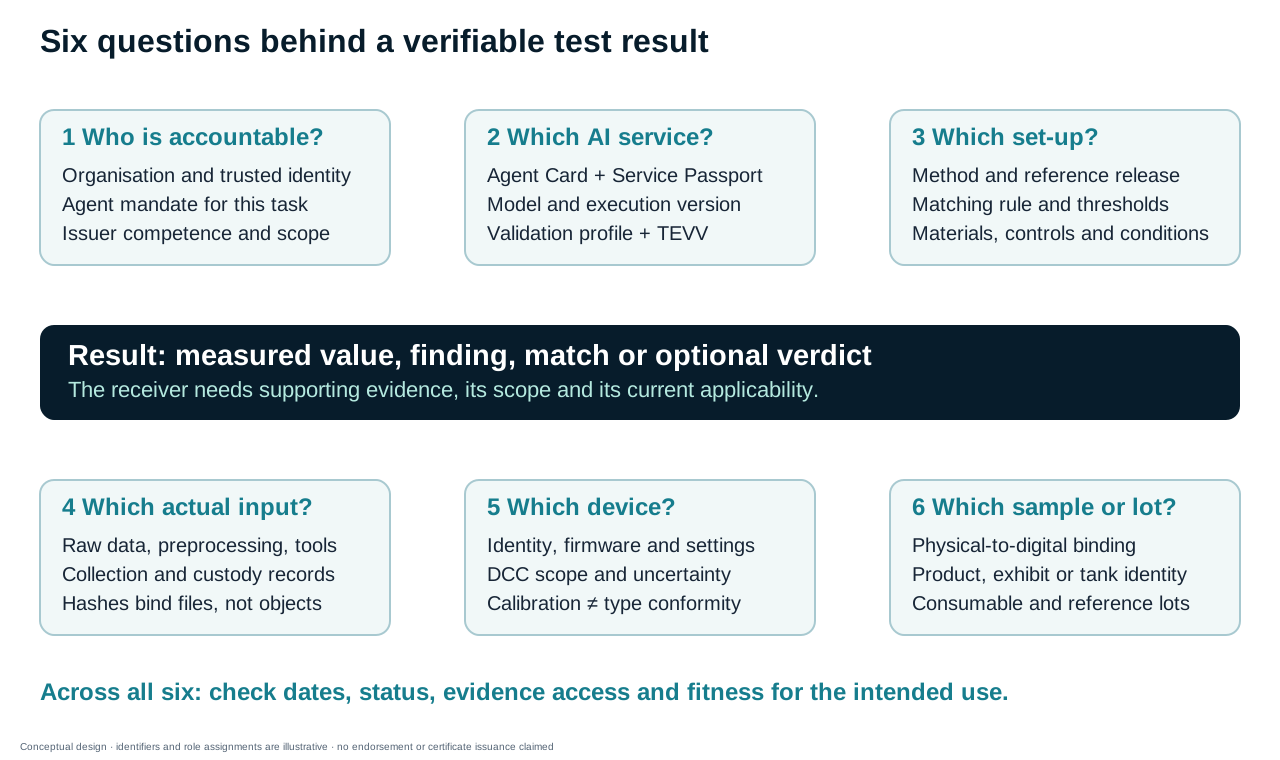
The revised problem-framing diagram asks which supporting evidence travels with each type of result. It includes quantitative measurements, analytical findings and optional verdicts, together with the materials and validation evidence needed to assess them. The laboratory retains responsibility for collection and measurement, even when downstream checks become automated.
4. Connect calibration, measurement and matching
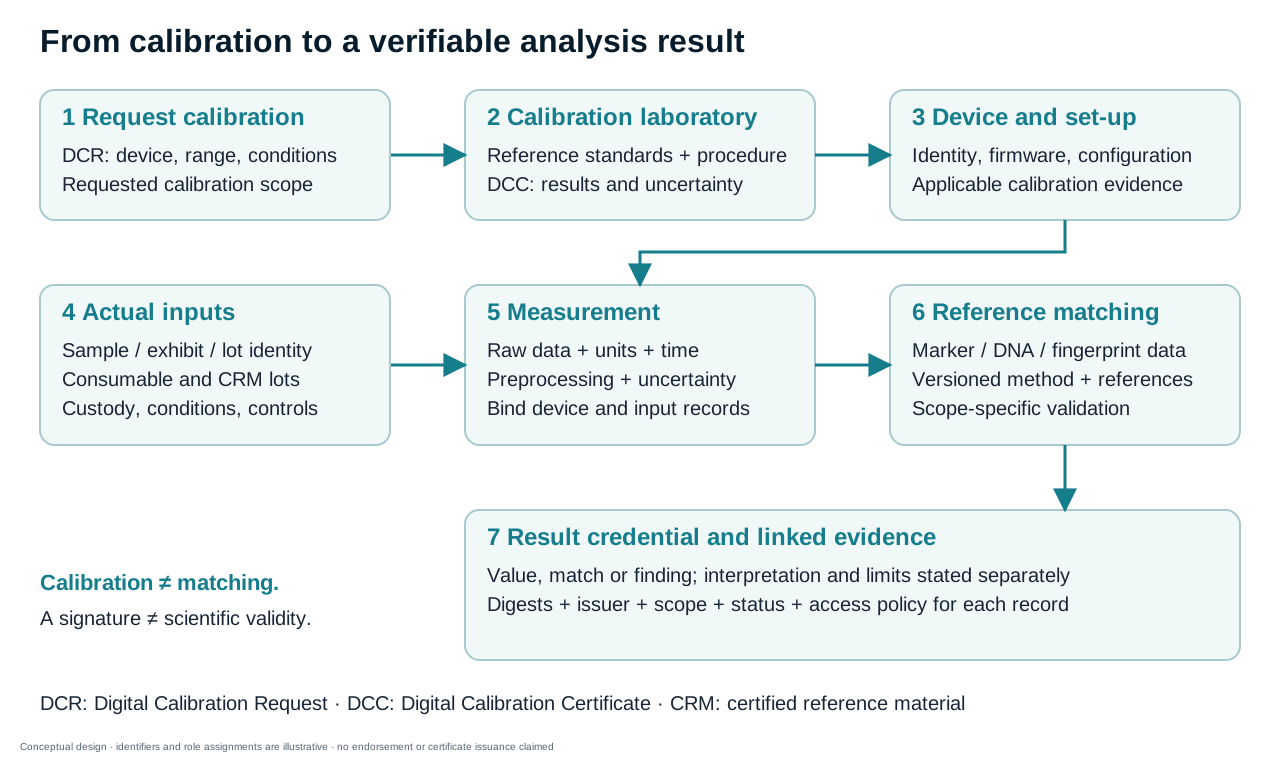
Calibration and matching answer different questions. Calibration characterises the relationship between an instrument’s indications and reference values, with uncertainty and stated conditions. Matching compares an observation with a reference under a defined algorithm and decision rule. Calibration does not certify every later measurement or validate the matching algorithm.
In the QI-Digital terminology used here, DCR means Digital Calibration Request and DCC means Digital Calibration Certificate. A PTB presentation hosted by QI-Digital also distinguishes a Digital Calibration Answer and a Digital Test Certificate [15]. The request expresses the calibration need; the certificate records the performed calibration and its results. A DCR is not itself calibration evidence. PTB publishes a structured DCC schema [16]; it is a domain format, not automatically a W3C verifiable credential. Preserve the original signed document and link its digest, issuer, version and relevant scope into the evidence graph.
QI-Digital brings together BAM, PTB, DAkkS, DIN and DKE. BAM — Bundesanstalt für Materialforschung und -prüfung — contributes to digital quality infrastructure and reference-material work [7]. That provides a useful foundation for machine-readable assurance, without implying that BAM operates or endorses the proposed Spherity workflow.
For a marker test, pin the marker registration and authorised reference-library release. For forensic DNA analysis, pin the relevant reference records, search and interpretation method and access authority. Fingerprint comparisons require their own validated procedures and reporting vocabulary; they cannot inherit a DNA likelihood ratio or a product-marker threshold. A database hit is an analytical lead or finding within a method, not an automatic identity, authenticity or guilt determination.
5. Identify consumables and reference materials
An authentic instrument can produce an unreliable result with the wrong reagent, an expired control or a contaminated sampling device. The proposed run record therefore identifies each relevant consumable and reference material by producer, product, lot or batch, and certificate or declaration revision. Four questions stay separate: Is it authentic? What property is certified or declared? Was it suitable and in condition at use? Did the run’s controls pass?
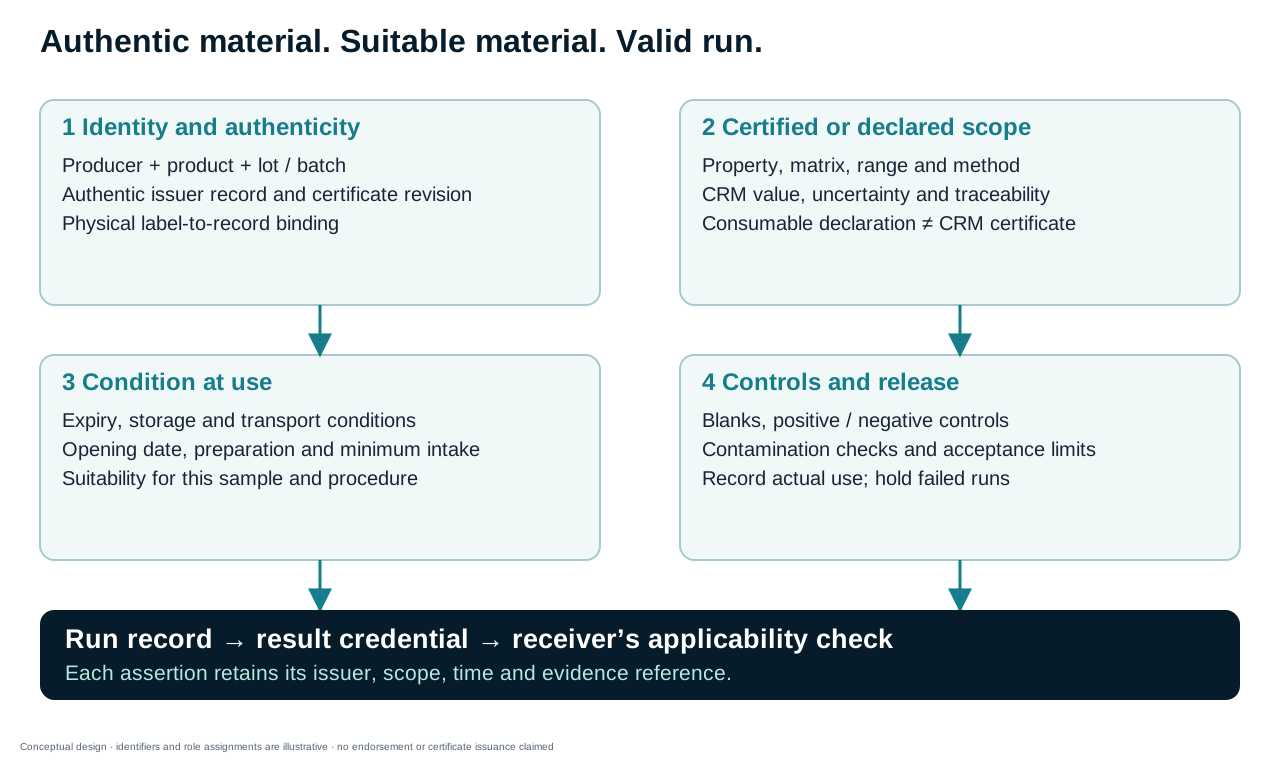
Concrete examples show why these checks matter:
- Food analysis: JRC’s ERM-BD284 milk-powder certified reference material supports aflatoxin M1 analysis [17]. Its certificate has a defined property, matrix and use conditions. Immunoaffinity columns used for sample preparation are consumables, not automatically certified reference materials [18]. Bind both lots to the run, but describe their different roles.
- Optical marker analysis: BAM’s fluorescence calibration kit provides reference materials for specified optical calibration purposes [19]. This can support an instrument check; it does not certify the identity of a marker-bearing textile or medicine. Marker standards, sample holders and cleaning materials also need method-specific suitability checks.
- Forensic DNA: amplification kits can include master mix, primer mix and control DNA [20]. Sampling swabs, tubes and other covered products may have claims under ISO 18385 concerning minimisation of human DNA contamination [21]. Check the specific scope and lot documentation; this is not a blanket guarantee of sterility, zero contamination or correct interpretation. Laboratory contamination controls remain necessary [22].
- Cleaning verification: ATP sampling devices and their positive controls support a defined cleaning-monitoring procedure [23]. Record the sampling area, storage, expiry, device and threshold as well as the consumable lot. A low ATP reading is not a general food-safety certificate.
For certified reference materials, retain the certified property, uncertainty, metrological traceability, minimum sample intake, storage and stability information where applicable. JRC’s certificate guidance explains why these conditions matter [17]. A manufacturer’s certificate of analysis, an accredited calibration certificate and a CRM certificate are different assertions. A genuine document alone does not prove fitness for the particular test.
6. Give the AI service a passport and a validation profile
The verifiable AI Service Passport is a proposed evidence container in this case study, not an established certification scheme. It identifies the accountable organisation, the service and agent, the permitted task and the versions that define the evaluated configuration. It links four complementary records:
- Verifiable Agent Card: machine-readable identity, interfaces and declared capabilities, bound to the service’s authorised key or issuer. The A2A Agent Card is a useful discovery model [24]; a signed card still does not demonstrate scientific competence.
- Execution configuration: model and software identifiers, preprocessing, tools, prompts where relevant, reference releases, thresholds and change history.
- Validation profile: intended use, sample matrices, operating range, relevant populations, challenge cases, acceptance criteria and required human review.
- Validation evidence: who performed test, evaluation, verification and validation (TEVV), with which datasets and procedures, on which version, with what results and limitations.
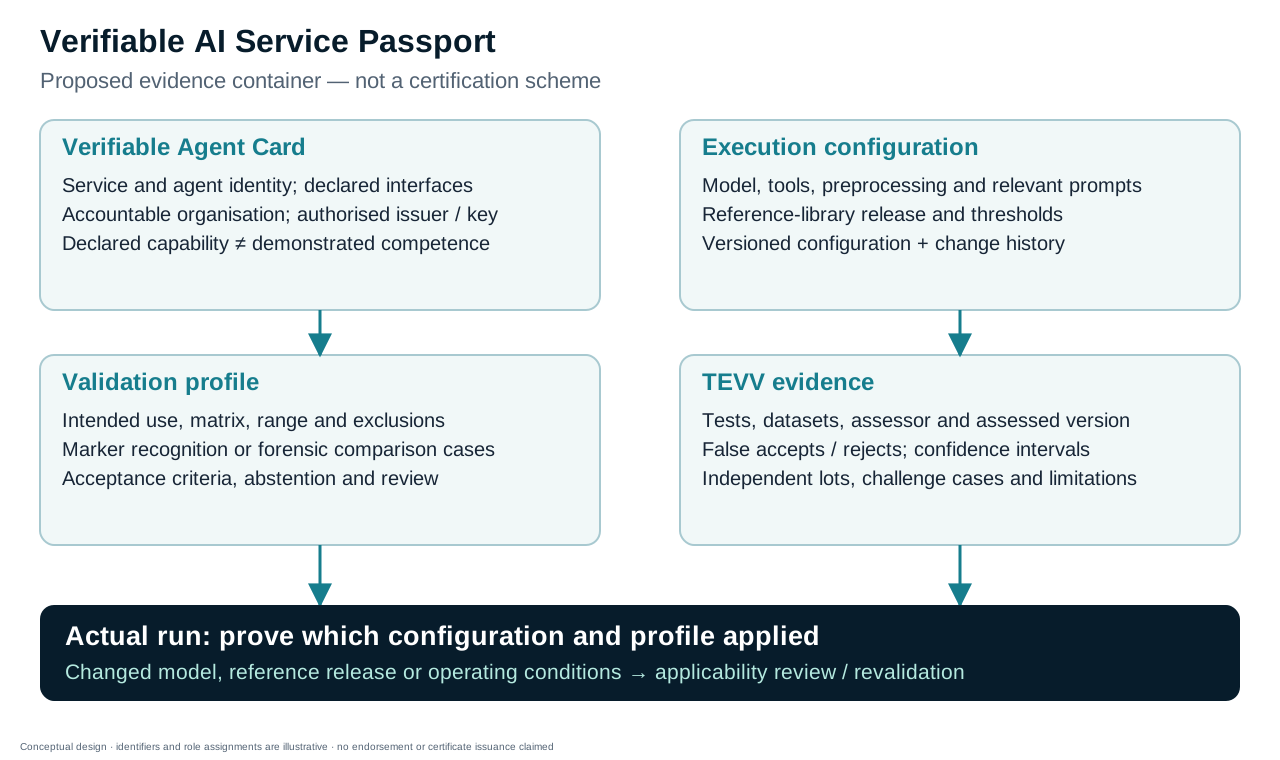
A marker-recognition profile should test genuine markers, close non-matches, damaged or aged material, background interference and unknown items. Validation must avoid leakage between training and evaluation data: repeated scans of one lot do not replace independent lots. A biological-evidence profile needs domain-specific contamination, mixture and reference-population considerations. A cleaning profile needs the relevant surfaces, sampling procedure and decision threshold. NIST AI RMF provides broader guidance on measurement and evaluation of AI risks [25]; it does not supply a ready-made laboratory validation protocol.
Report false acceptances and false rejections, uncertainty or confidence intervals, test-cohort composition and exclusions. Specify when the agent must abstain or escalate. Changes to the model, reference database, instrument, preprocessing or material can invalidate the profile’s applicability and trigger revalidation. A passport links the actual run to evidence; it must not treat an old assessment of a different configuration as current assurance.
7. Use the right uncertainty statement
“Confidence” is too ambiguous to stand alone. A credential should name the quantity, method, assumptions and denominator behind each number.
Measurement uncertainty. The following synthetic example attributes a normal uncertainty distribution to a concentration measurand. The estimate is 10.0 mg/L and the combined standard uncertainty is 0.20 mg/L. With coverage factor k = 2, expanded uncertainty is 0.40 mg/L and the coverage interval is 9.60–10.40 mg/L. Under the stated ideal normal model, that interval contains approximately 95.45% of the distribution. The y-axis is probability density, in inverse mg/L; a curve height is not a probability [26][27].
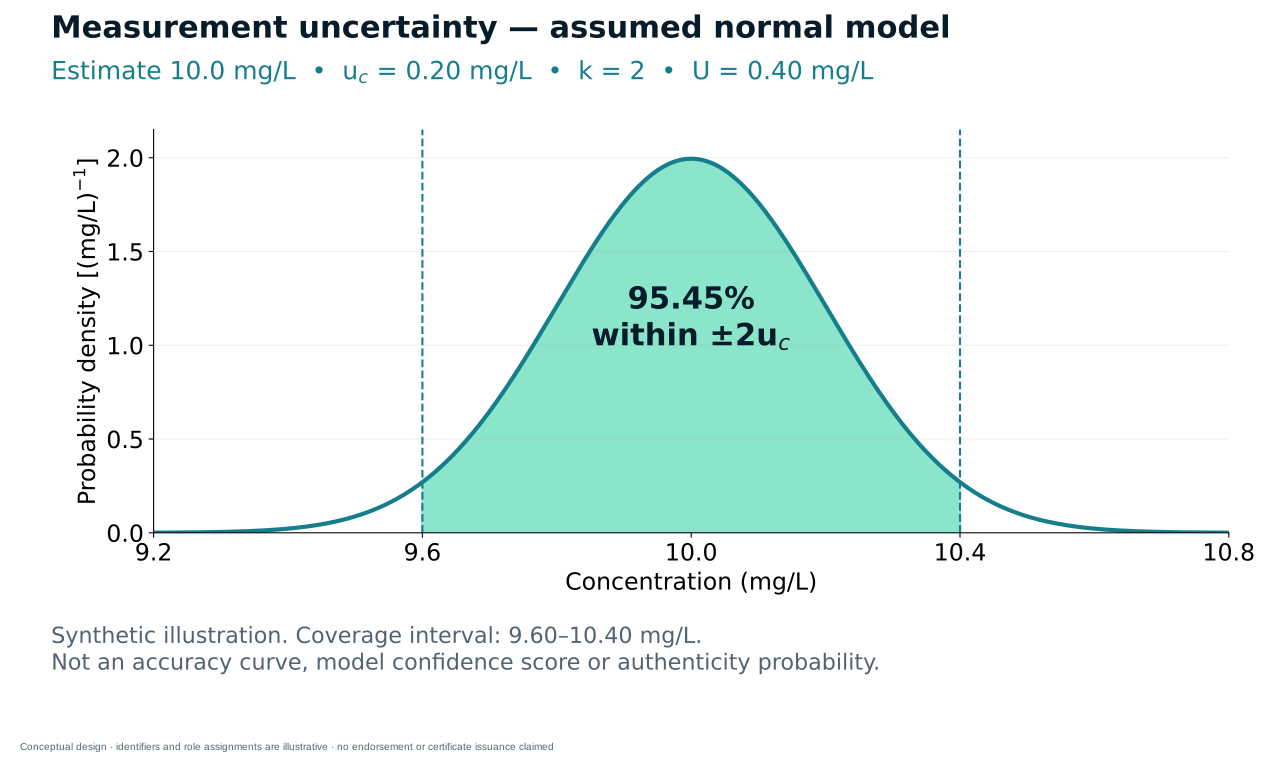
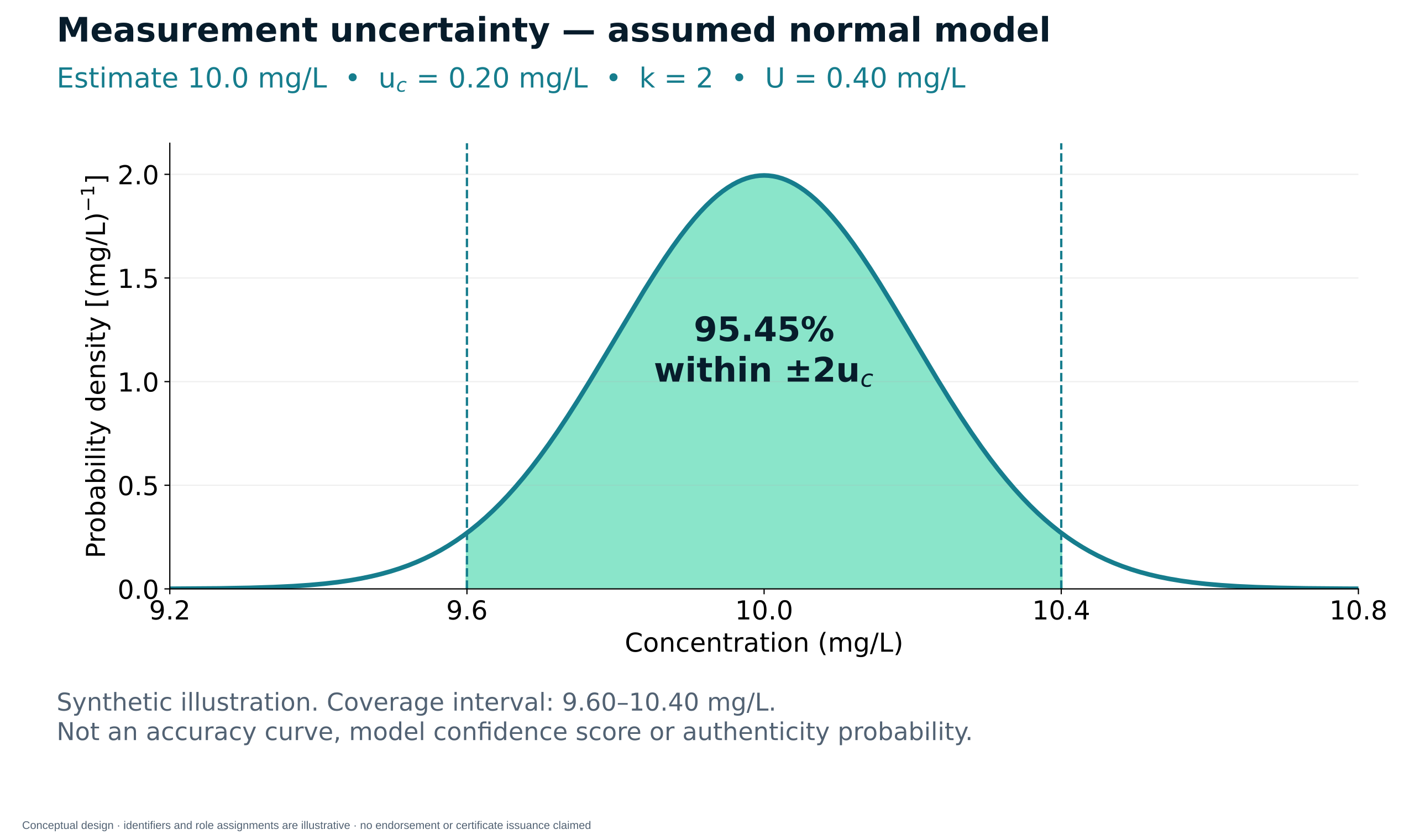
This is an uncertainty distribution, not an “accuracy curve”. Real uncertainty evaluation needs an appropriate measurement model and contributions such as calibration, sampling, preparation, repeatability and reference values. Normality and k = 2 must be justified; finite degrees of freedom or non-normal models can require another approach. Uncertainty alone also does not specify a conformity decision rule or its guard band.
Validation confidence interval. In a separate synthetic marker-detection example, 98 correct detections among 100 known-positive samples and 980 among 1,000 both estimate sensitivity at 98%. Two-sided 95% Wilson intervals are respectively 93.0–99.4% and 96.9–98.7% [28]. The larger independent sample gives a tighter interval under the sampling assumptions. It does not establish performance on a different population.
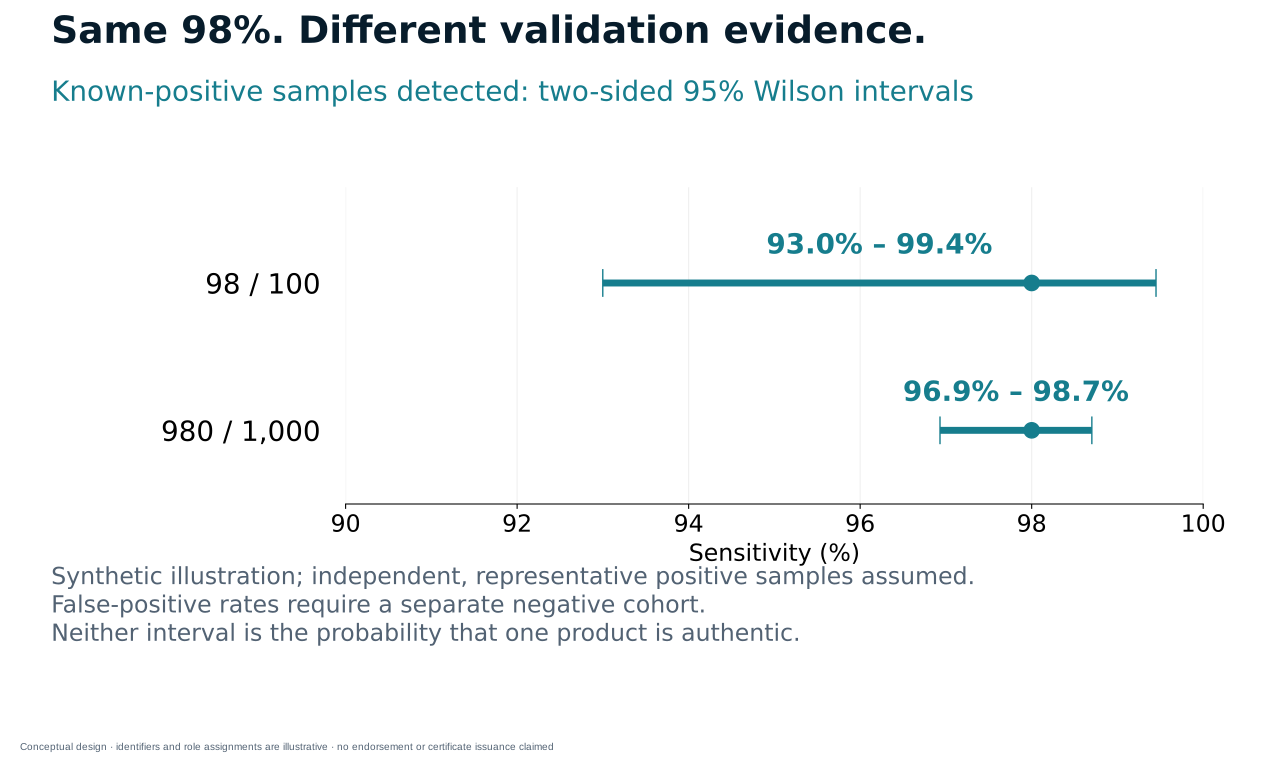
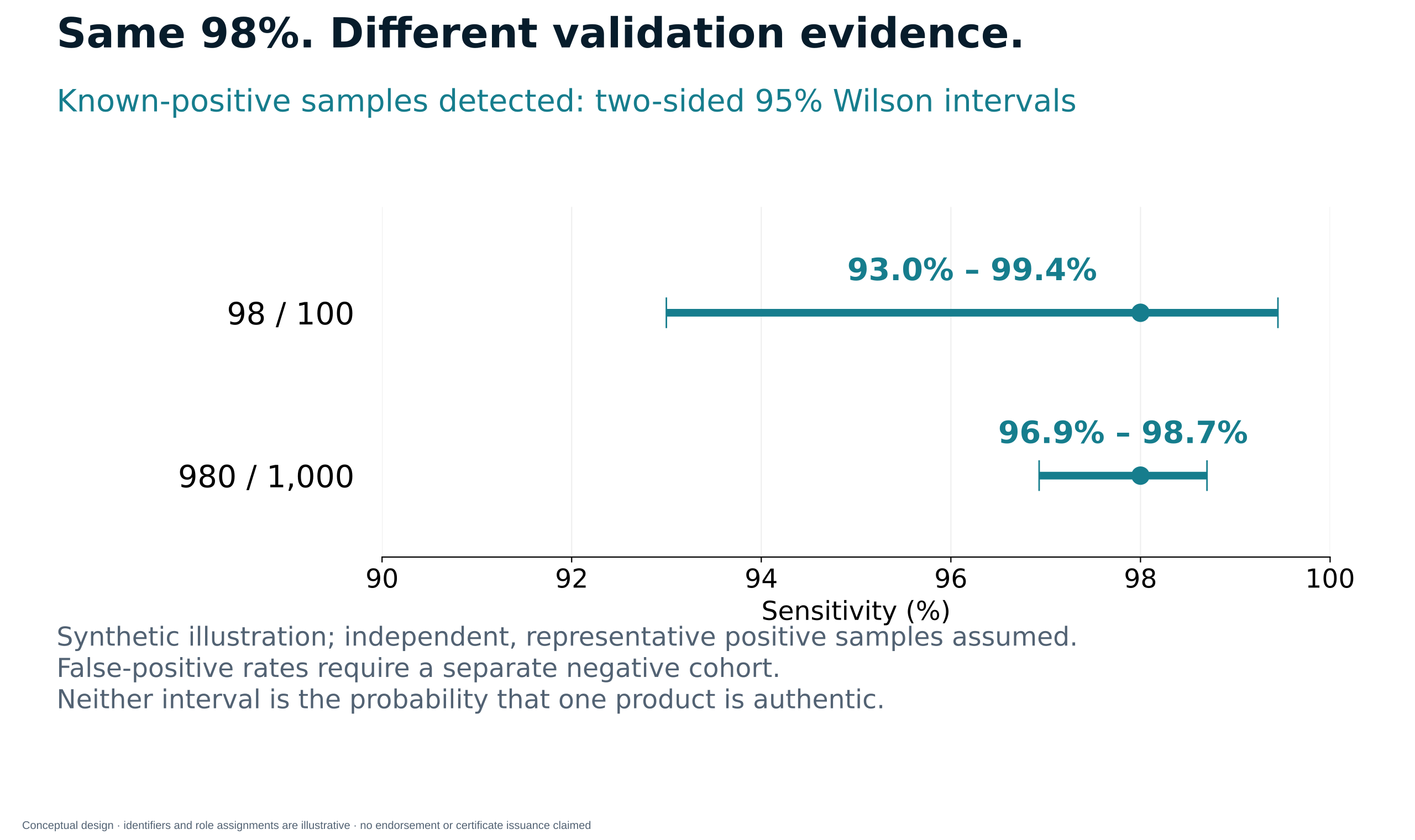
These intervals assume independent, representative positive samples. False-positive rates need a separate negative cohort. Neither interval gives the probability that one product is authentic. A model score requires its own calibration and interpretation; forensic likelihood ratios compare the probability of evidence under explicitly stated competing propositions, not the probability that a suspect is guilty [29]. Higher percentages alone would not make a forensic example more rigorous.
8. Separate the wallet, the issuer and the authority
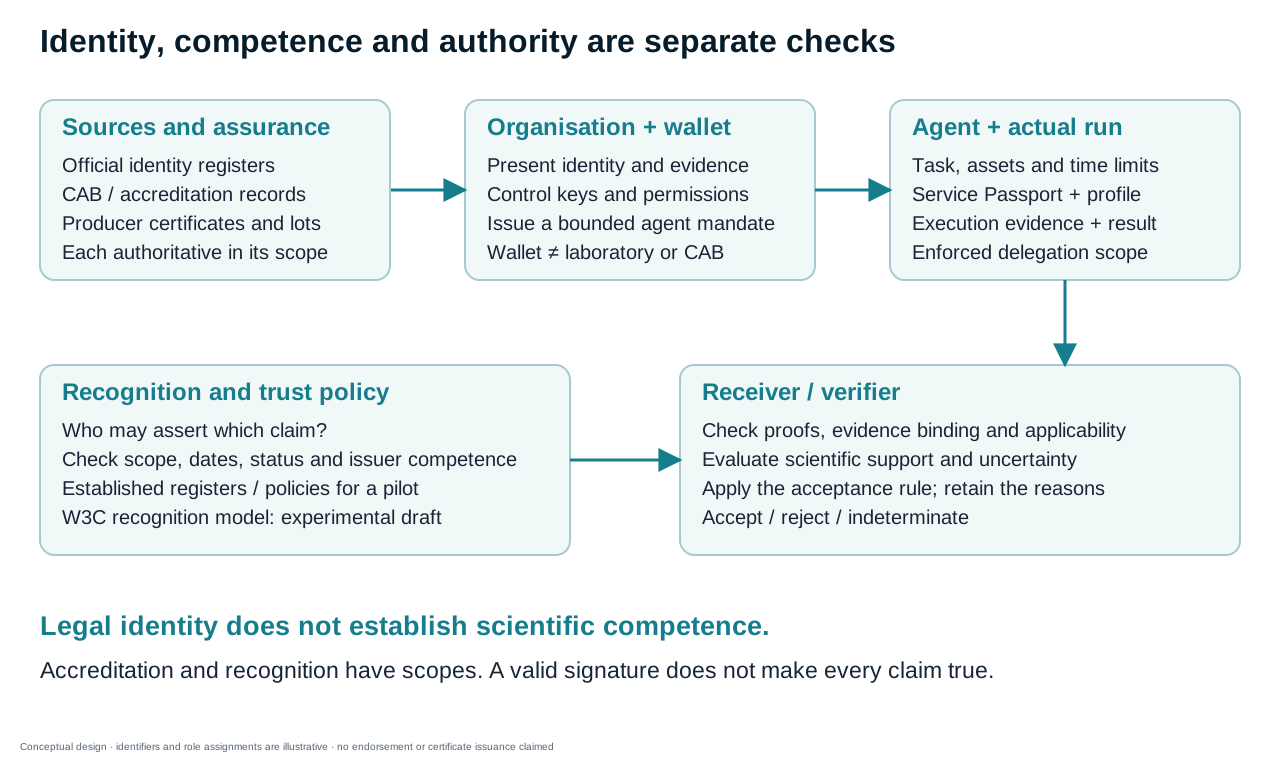
The business wallet is the organisation’s control point for identity credentials, presentations and authorised delegation. In this proposed pattern, a laboratory presents its legal identity and scope-related evidence, then authorises an agent for a bounded task: specified methods, assets, recipients, actions and time limits. Protected keys and execution controls must enforce that mandate. A wallet is not the measurement system, an accreditation body or a substitute for laboratory governance.
The European Commission describes European Business Wallets as a regulatory proposal at this review’s cutoff [30]. The architecture below is a design pattern, not a claim that a particular legal wallet service or interface has been deployed. An EU Company Certificate can support company-information evidence under the relevant framework [10]; legal identity alone says nothing about competence to perform a particular assay.
| Role | What it contributes | What must still be checked |
|---|---|---|
| Authoritative / authentic source | An official register, competent authority record, issuer’s original certificate or authenticated manufacturer record | Authenticity of the record; authority for the specific claim; version, time and scope. A genuine vendor assertion is not automatically independent assurance. |
| Conformity assessment body (CAB) | Testing, calibration, inspection, certification or another defined conformity-assessment activity | The applicable scheme, competence, independence where required, and the precise assessed object and scope |
| Accreditation body | Recognition of a CAB’s competence for a specified accreditation scope | Current status, scope annex, locations, methods and conditions; not a blanket endorsement of every result |
| Business wallet | Organisational identity, evidence presentation and bounded authority delegation | Key control, mandate chain, revocation, least privilege and actual enforcement |
| Recognised entity / recognition authority | An ecosystem’s scoped statement that an entity may perform particular actions | Who recognises whom, for what action, under which policy and validity period |
| Receiver / verifier | Proof and status checks, evidence evaluation and an acceptance decision | Its own trust policy, scientific requirements, access rights and responsibility for the resulting decision |
Testing and calibration laboratories can themselves be CABs. DAkkS distinguishes accreditation activities and applicable standards; ISO/IEC 17025 concerns testing and calibration laboratory competence [12]. Do not conflate accreditation with product certification or with an AI management-system certificate. For example, ISO/IEC 42001 certification concerns an organisation’s AI management system [14]; it is not proof that this model classified this sample correctly.
The W3C Recognized Entities v1.0 Working Draft of 12 November 2026 proposes a way to express ecosystem recognition for specified actions. It is explicitly experimental and not fit for production deployment [5]. It is useful here as a conceptual model, not a production dependency. A pilot can use established registers and trust policies while separately experimenting with the draft. Recognition is scoped and revocable; it is not a universal quality score.
9. Assemble and verify the evidence graph
A result credential should carry the result’s essential meaning and link to the evidence supporting it. “Part of the credential” need not mean copying every document into one payload. Use typed, versioned references with digests and access conditions for larger or sensitive artefacts. Hashes establish correspondence with retained bytes; they do not guarantee future availability or establish that a source’s assertion is true.
The revised system diagram brings the operational workflow together with three distinct supporting branches: organisational authority, calibration and materials, and validation and assurance. Generic roles replace the first edition’s hypothetical named certificate issuers. The evidence graph then shows how to follow each claim to a scoped source.
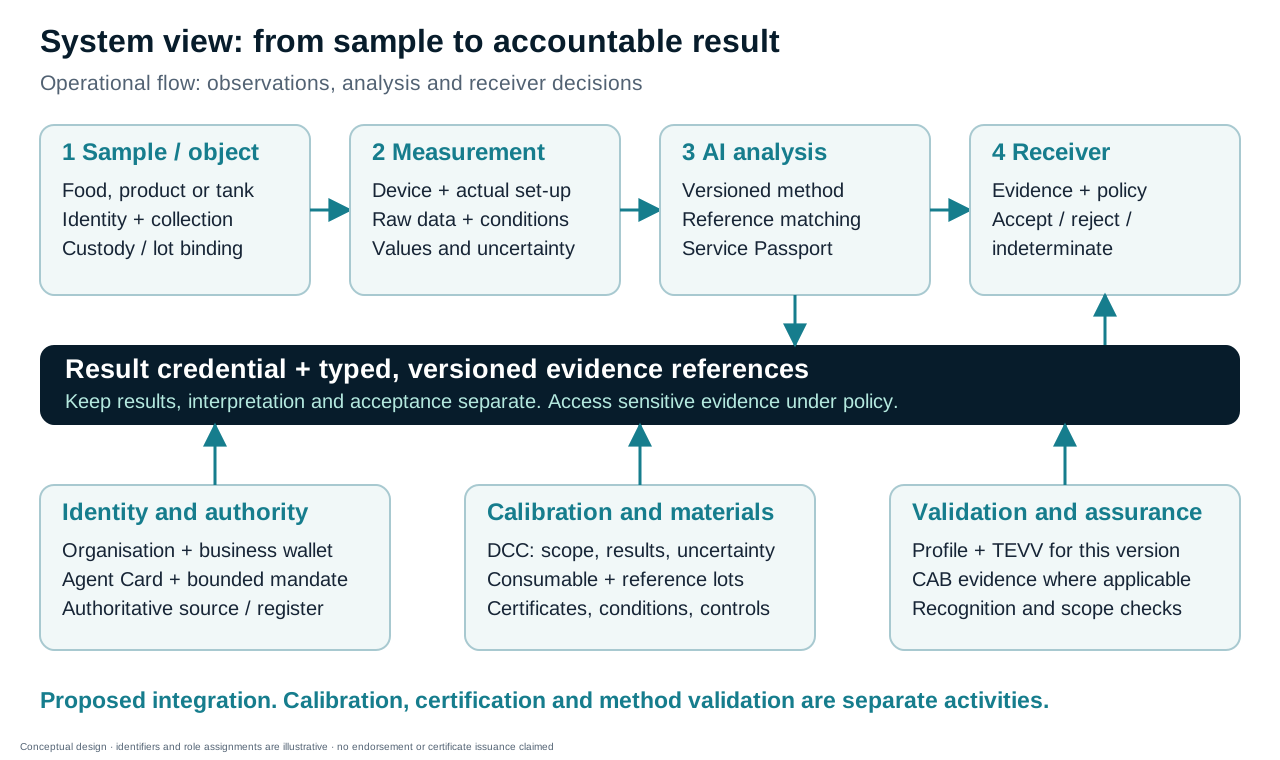
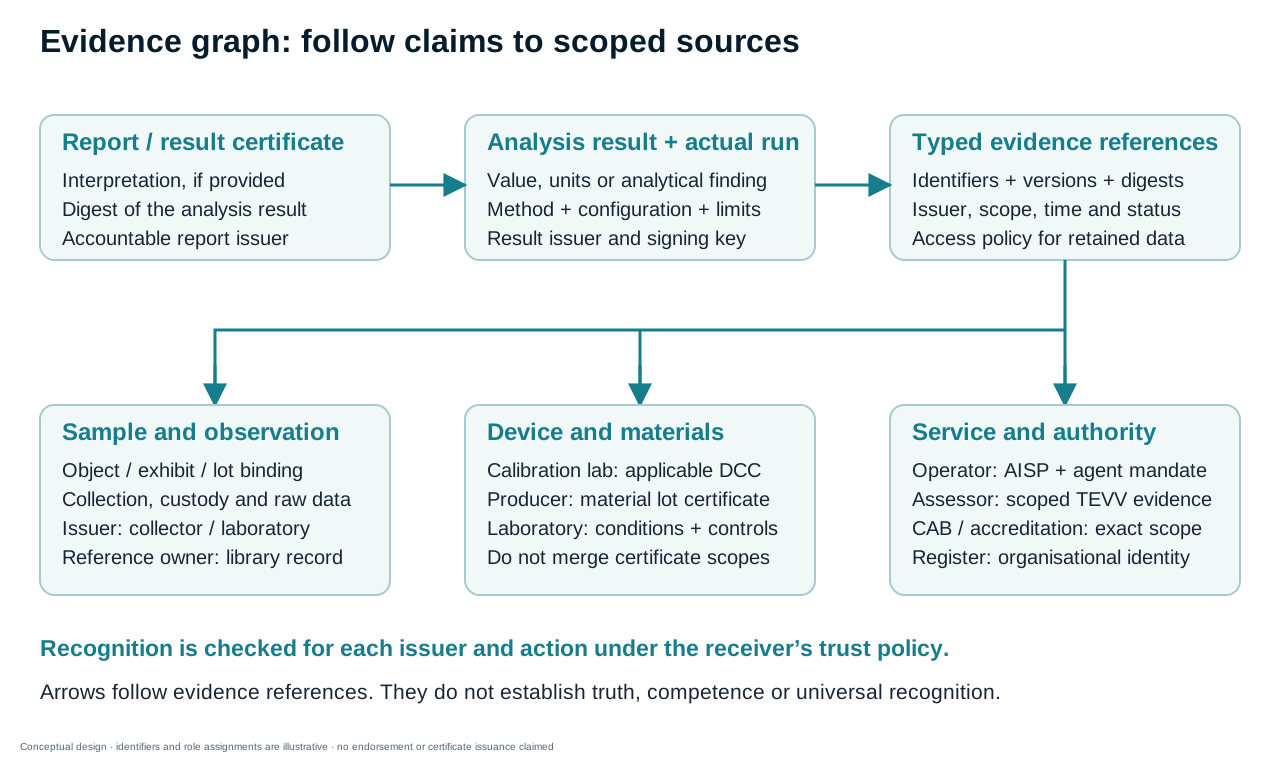
A useful result envelope identifies: the result and units; sample or object; actual run; method and decision rule; device and set-up; DCC and relevant calibration conditions; consumed material lots and certificate references; reference-library release; AI Service Passport and validation profile; accountable issuer and task mandate; timestamps, status and evidence-access policy. For W3C credentials, use the Verifiable Credentials Data Model 2.0 with an appropriate securing mechanism [9]. Mapping a DCC or other domain record into the graph requires an explicit profile; a wrapper must preserve the original issuer and semantics.
The receiver then follows an ordered procedure:
- Verify the record: validate its schema, cryptographic proof and intended recipient or presentation binding where required.
- Check attribution and authority: resolve trusted keys, organisational identity, delegated mandate and recognition for the claimed action.
- Resolve evidence: verify referenced digests, versions, subject identifiers, validity and status at the relevant times.
- Check applicability: confirm calibration scope, material condition, reference suitability and validation coverage for this run and sample.
- Apply the decision rule: evaluate uncertainty, thresholds, required review and missing evidence under the receiver’s policy.
Return accepted, rejected or indeterminate, with reasons and an audit record. Missing or stale evidence must not silently become acceptance. Offline verification requires retained evidence, trusted keys and authenticated status information for an explicit evaluation time; it cannot discover a later revocation without an update. Not every chain ends at a public register: private reference libraries and contractual trust anchors may be appropriate if the receiver explicitly accepts their scope and governance.
For the underlying architecture, read Proofs over Statements for evidence graphs, Multi-Trust Architectures for cross-organisational authority, and European Business Wallets for Zero Trust AI Agents for legal-person mandates. Evidence Graphs for Industrial AI connects this pattern to the data plane. These are related Spherity research proposals, not independent validation of this case.
10. Apply the pattern to forensic analysis
In a criminal investigation, distinguish the laboratory’s official identity, its authority to handle the exhibit, its competence for the method, the vendor’s software claims and the examiner’s interpretation. Public-body identity may come from the relevant official authority rather than a company register. The custody chain records collection, seals, transfers, subsampling, preparation and access. Consumable and control records help investigate contamination; they do not make contamination impossible.
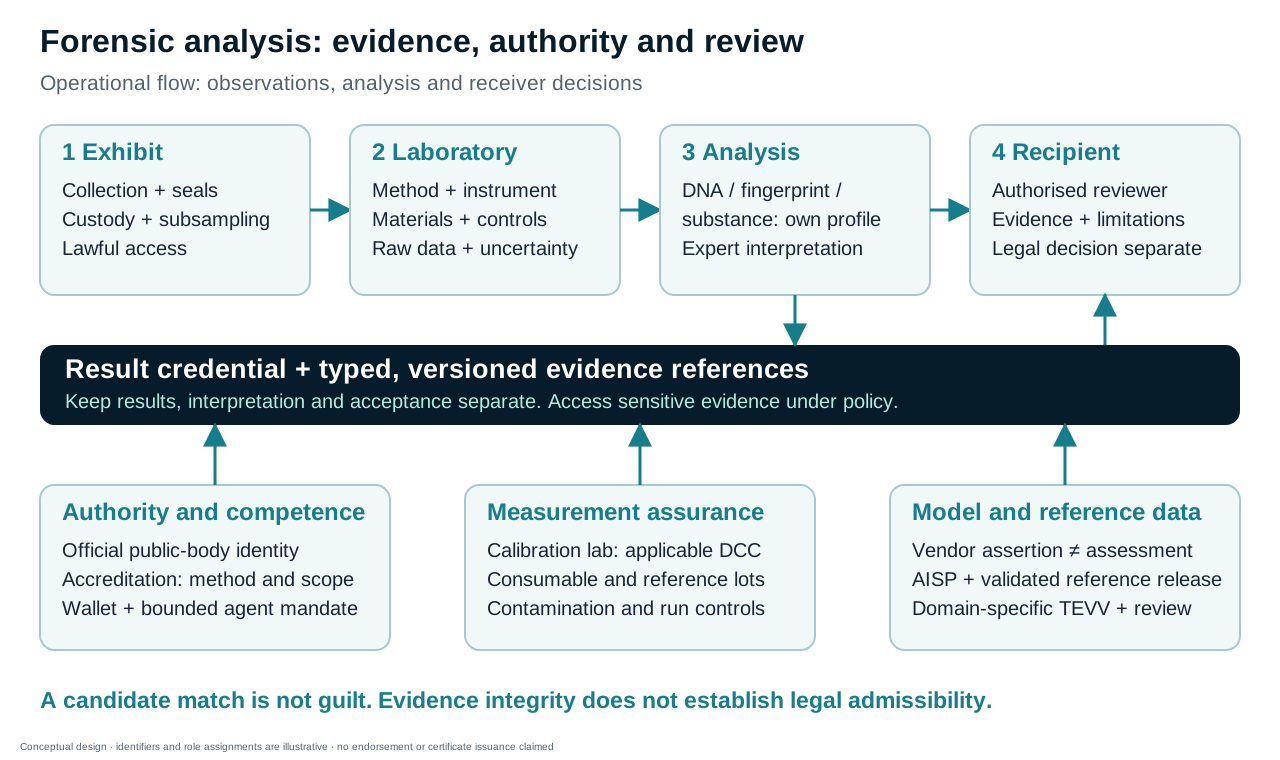
The revised forensic diagram includes material lots, measurement assurance, method validation and reference-access evidence alongside the authority chain. Record uncertainty or evidential strength in the terms appropriate to the method. A DNA database search, a fingerprint comparison and a biological-source comparison need distinct profiles. Report the propositions and limitations appropriate to the discipline; a candidate match is not a conclusion about guilt. NIST’s scientific review of DNA-mixture interpretation illustrates why interpretation needs its own evidential basis [29].
Re-analysis requires retained samples where feasible, raw data, software and reference versions, runtime information and lawful access. The credential can make the audit trail easier to follow; it cannot establish legal admissibility, cure an invalid method or replace expert scrutiny. Sensitive evidence should be disclosed only to authorised recipients, with minimal public metadata.
11. Build a small, testable pilot
Start with one method, one result type and one receiver. Choose, for example, a marker-authenticity test or a cleaning measurement certificate; do not claim general laboratory competence from that pilot.
- Define the intended use, sample population, result semantics and acceptance policy with the receiver and laboratory quality lead.
- Map the existing evidence and its owners: LIMS records, calibration provider, material producer, reference-library operator, accreditation register and software supplier.
- Issue a minimal signed result that pins sample, raw data, method and actual configuration. Keep the existing controlled laboratory records as sources.
- Add the Service Passport, validation profile, wallet identity and bounded agent mandate. Record who assessed each claim and where independent assurance is required.
- Link calibration, material and reference evidence. Define retrieval, retention, privacy and offline-status policies before automating acceptance.
- Exercise failure paths, compare with qualified human review, and publish the limits of the evaluation before expanding scope.
Validation and evidence gaps
The following are expected decisions, not observed results. They define tests for the proposed pilot.
| Test condition | Expected response |
|---|---|
| Valid signature; sample identifier differs from the acquisition record | Reject the evidence binding or require investigation |
| Authentic DCC; instrument range or conditions do not cover this use | Reject applicability or return indeterminate |
| Genuine consumable; expired, incorrectly stored or unsupported lot | Block release under the method’s material policy |
| Valid agent identity; mandate expired or task outside its scope | Reject authorisation |
| Valid assessment; model or reference release changed | Require the applicable change assessment or revalidation |
| Accredited laboratory; requested method outside the recorded scope | Do not present that result as covered by the accreditation |
| Valid signatures; scientifically incorrect result | Cryptographic checks can pass; scientific validation must fail |
| Missing status evidence or unavailable confidential reference | Return indeterminate or request authorised evidence access |
Measure evidence completeness, verification latency, status handling and reviewer effort against the existing workflow. Evaluate scientific sensitivity, false positives and false negatives separately on appropriately sampled data. Report cohort sizes, intervals and exclusions. Claims about less duplicate testing, improved trust or faster release remain hypotheses until measured with receivers who accept the evidence.
12. How Spherity can help
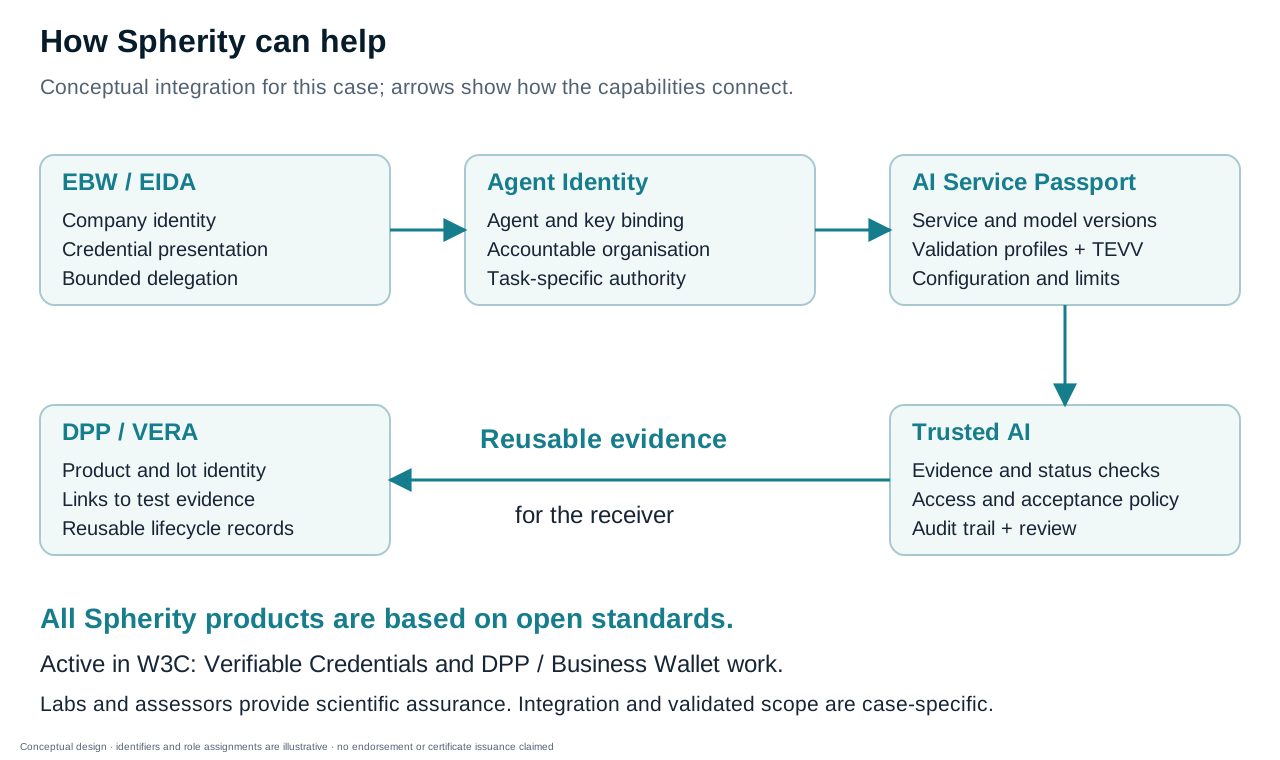
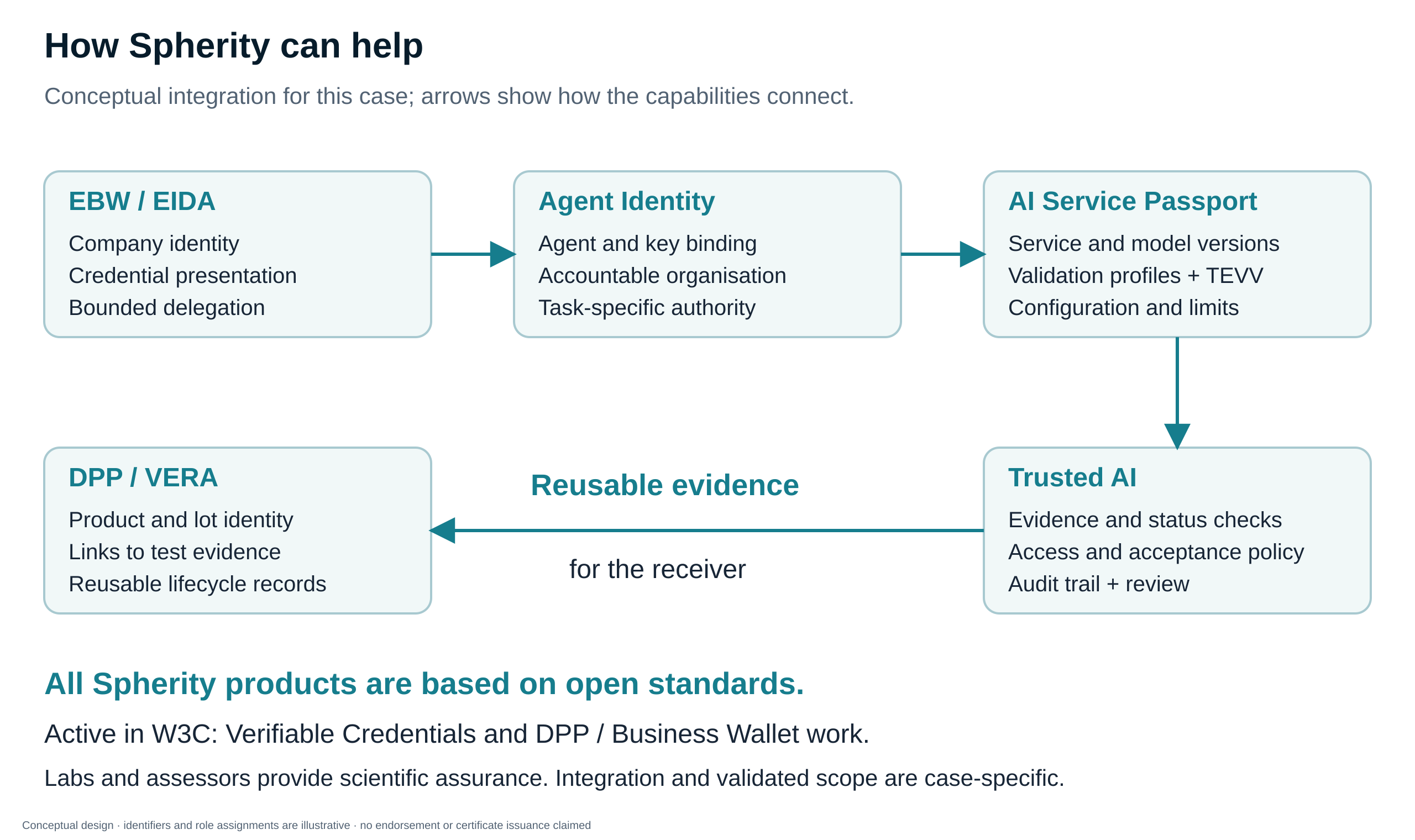
Spherity’s products connect product evidence, organisational authority and accountable AI services. In this case, the opportunity is to connect existing laboratory records to portable evidence and receiver checks. The chart maps product and capability roles onto the proposed workflow; it does not claim that the complete laboratory integration has already been deployed.
| Product / capability | How it helps this case |
|---|---|
| DPP / VERA | Link product and lot identity to test results and supporting lifecycle evidence. A DPP is relevant to the product-facing applications; it is not required for every laboratory or forensic result. |
| EBW / EIDA | Present organisational identity and source credentials; support delegated authority and controlled evidence exchange. |
| AI Service Passport (AISP) | Link service and model versions, configuration, intended-use profiles and TEVV evidence. The laboratory-specific profile proposed here needs implementation and validation. |
| Agent Identity | Bind the acting agent and its keys to an accountable organisation and a bounded mandate. |
| Trusted AI | Support evidence and status checks, access policy, audit trails and referral for review. Scientific acceptance criteria remain method-specific. |
The public VERA product description, EIDA business-wallet description and Agentic Trust offering provide the product context. These are complementary capabilities, not five independent certificates of scientific correctness. Integration with the laboratory information management system, device records, calibration providers and reference libraries must establish the bindings described in this study.
All Spherity products are based on open standards. Spherity is active in W3C, including the Verifiable Credentials Working Group and contributions to DPP / Business Wallet use cases and vocabulary work. Open standards support portability and interoperability; they do not mean that every proposed profile is a final standard, that the software is open source, or that W3C endorses a product. In particular, AISP is not presented here as a completed W3C certification standard.
For a pilot, agree one method and result type, connect the evidence owners, define the credential and validation profiles, then test successful, rejected and indeterminate outcomes with the receiver. Spherity can support the identity and evidence integration; laboratories, CABs and other competent assessors retain responsibility for their scientific and conformity-assessment claims.
13. Transfer case: Automotive Driving Labels
The Automotive Driving Label case is deliberately placed after the laboratory examples. It shows which concepts transfer and which must change. A vehicle-data pipeline can label a driving event, annotate a scene or classify a trajectory. That label is an analytical output with provenance; it is not automatically a certificate that the vehicle is safe or that a driver behaved unlawfully. Earlier work on data provenance in vehicle data chains provides the background [6].
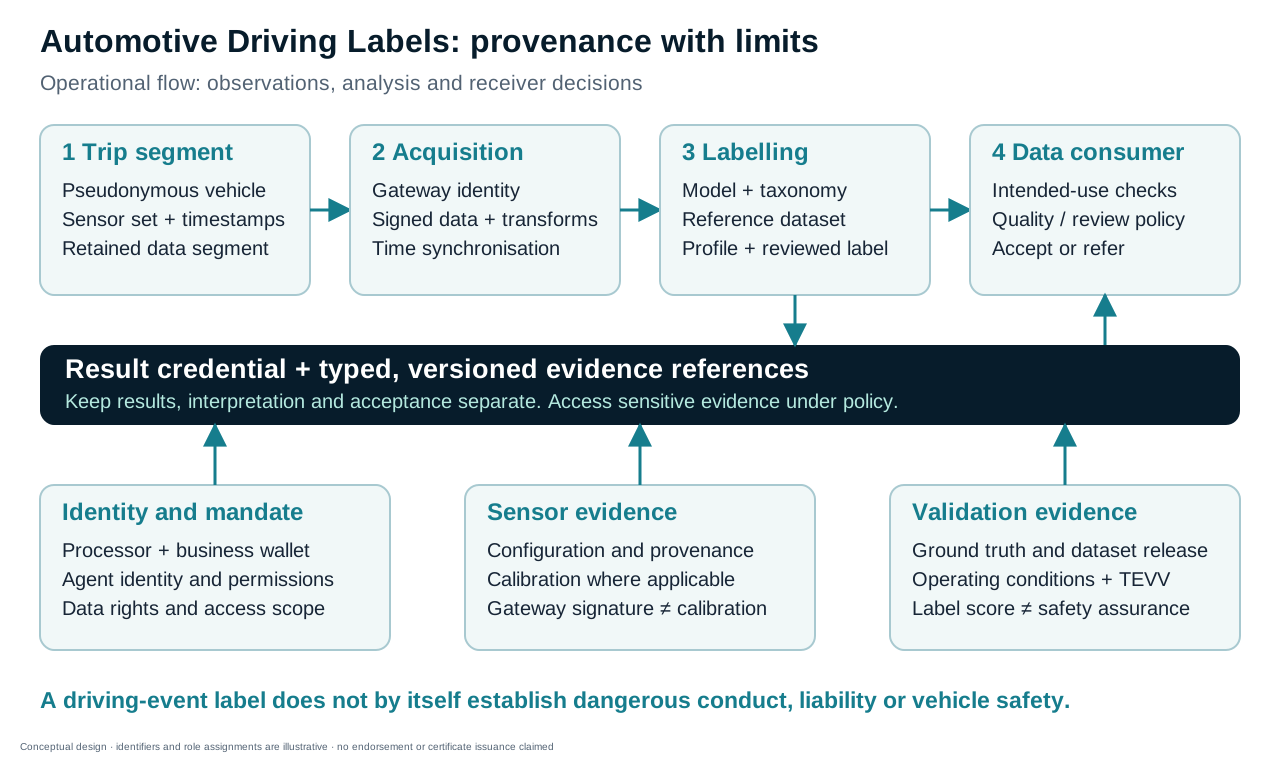
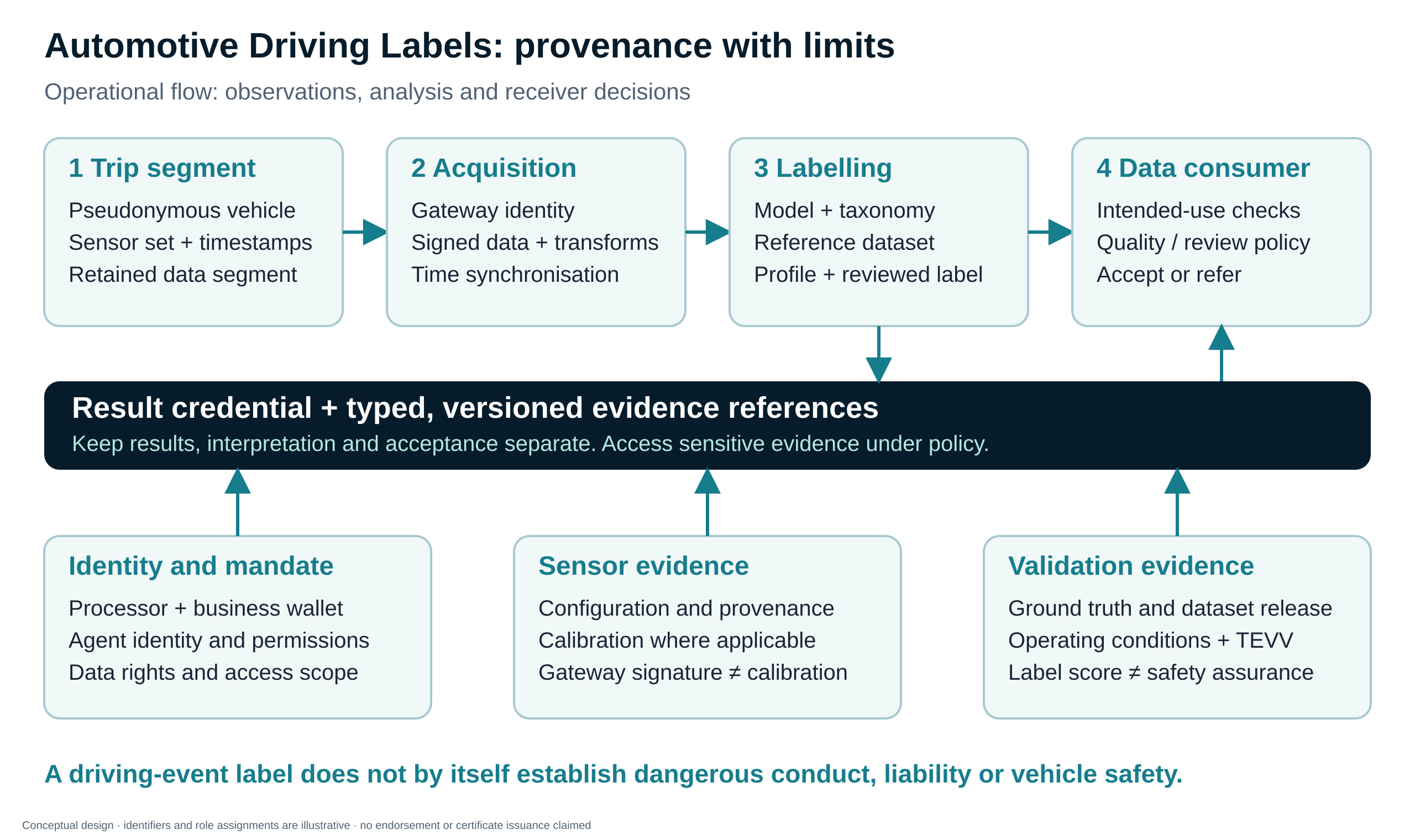
The laboratory’s sample becomes a bounded sensor-data segment; device set-up becomes sensor configuration and time synchronisation; reference material becomes an appropriate calibration or reference source where the measurement requires one. The analysis profile becomes the label taxonomy, operational conditions, ground-truth procedure, dataset release and evaluated software version. Do not relabel a training dataset as a certified reference material or assume that every automotive label needs a DCC.
Bind the label to raw-data hashes, sensor and transformation provenance, model version, annotator or agent mandate and quality-review evidence. Record disagreements and uncertainty rather than hiding them behind one score. The receiver can then decide whether the label is suitable for a particular training, validation or engineering purpose. The reusable lesson is the evidence structure, not a universal cross-domain assurance certificate.
14. Outlook: portable evidence with explicit limits
The opportunity is to make laboratory evidence reusable across organisational boundaries while retaining its scientific meaning. A product passport, quality workflow or data space could consume a scoped result and follow its supporting evidence, instead of repeatedly requesting disconnected documents. The DPP5.0 study explores registers, semantics and policy as parts of that wider infrastructure. A register can help discover evidence and its meaning; registration alone does not validate a test result.
Spherity’s proposed role in this pattern is the identity, delegation and evidence layer: connect business wallets, agents, recognised issuers and receiver policies. Laboratories, CABs, reference-material producers and competent authorities retain their respective responsibilities. Useful next work is a narrow interoperability pilot with real evidence owners, clearly defined schemas and independent evaluation. Success would mean that a receiver can explain which result was produced, from what evidence, by whose authority, within which validated limits — and why it was accepted or refused.
Appendix: concrete use-case architectures
The main figures introduce the reusable principles. This appendix restores the operational and credential detail of the original case-study charts: who captures the input, which records an analysis uses, who signs the result and what the receiver checks. The diagrams use illustrative record IDs to make the relationships concrete. They are proposed implementation patterns; the reported maturity of each contributing activity remains as stated in the evidence-level panel.
In the workflow diagrams, solid arrows show operational hand-offs and dashed arrows show supporting records. Figure 14 is a reference graph: solid arrows follow typed record references, while its dashed connector shows receiver evaluation under policy. Each diagram includes its own legend. A source record may be a signed credential, a DCC, a laboratory record or a controlled reference document. Referencing a record does not convert it into a credential or establish the truth of its contents. Sensitive raw data and reference libraries can remain under access control while the result carries identifiers, digests and retrieval policy.
These larger diagrams are best read using the full-size SVG or PNG links. They supplement the educational figures in the main text. The companion 19-slide PDF is unchanged; this appendix is part of the web case study.
A1. Product authenticity: sample to signed report
The original product case used Tailorlux marking and reader products as its concrete context [13]. The revised workflow keeps that physical context without assigning unverified credential-issuance roles to Tailorlux, a register provider or a conformity assessment body. A sample from lot L-0417 is captured as SCAN-17, evaluated in run R-8812, and referenced by report REP-17. These are illustrative identifiers, not field-test records.
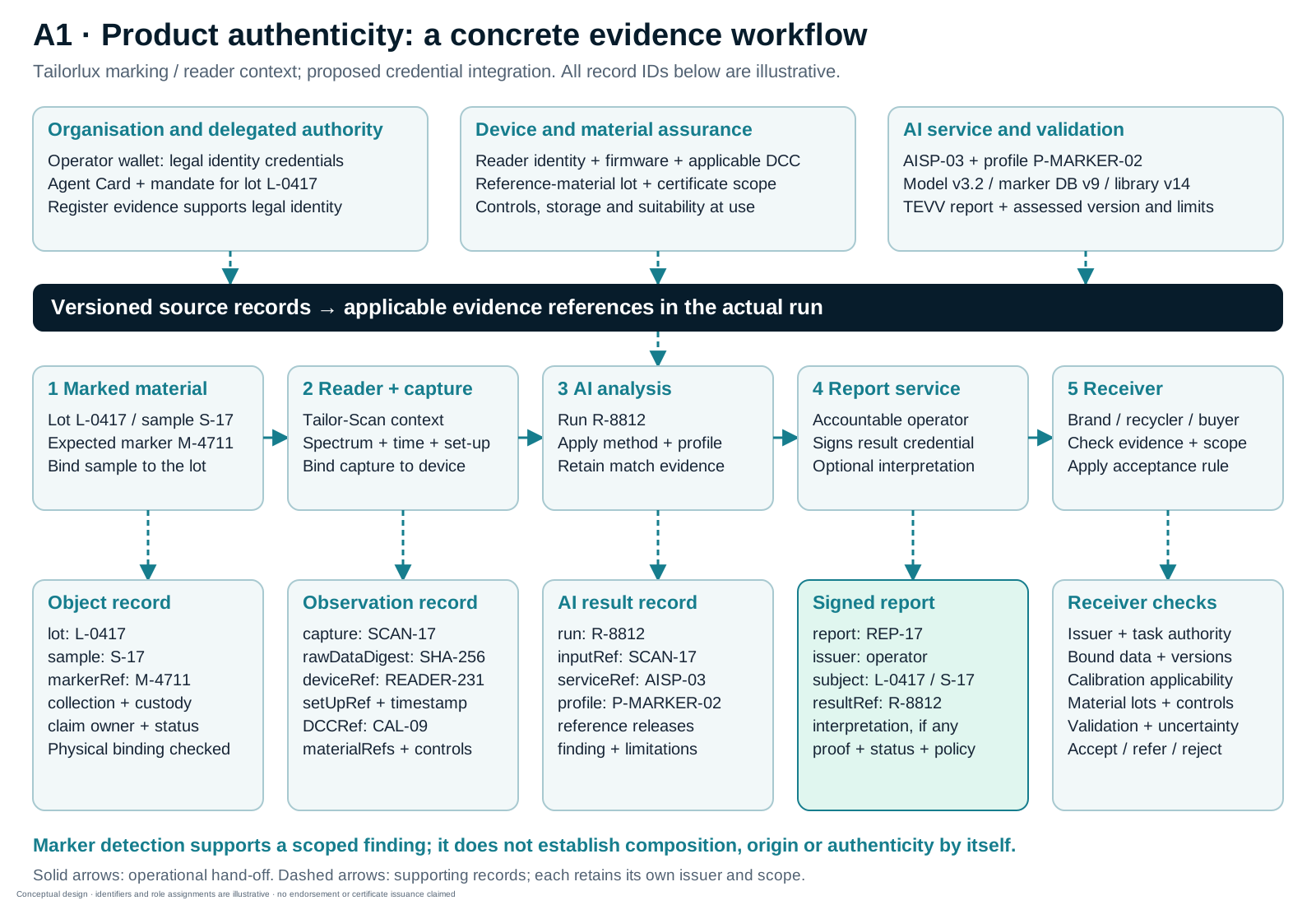
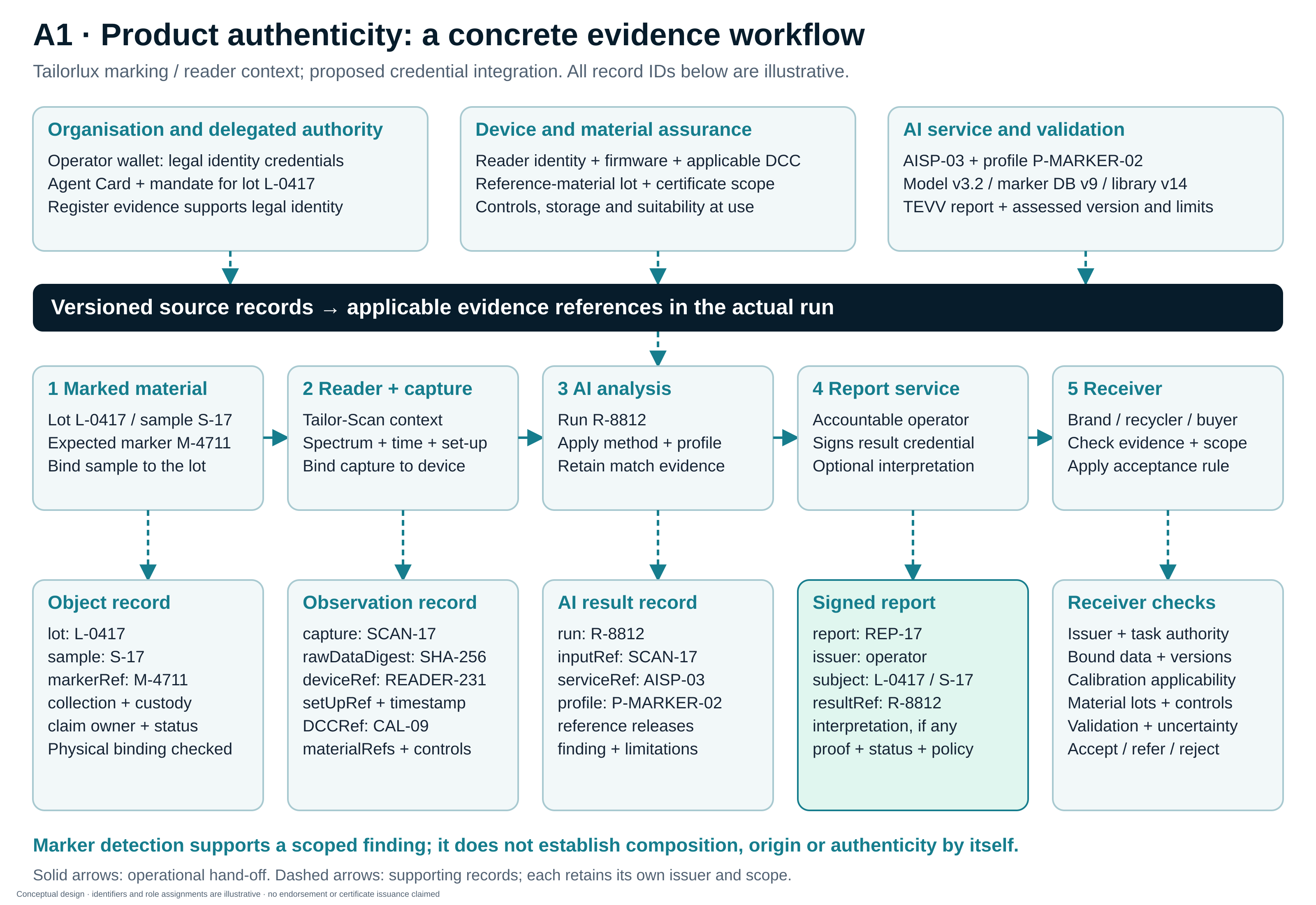
The result should identify the observed marker finding and its method-specific limitations. A broader authenticity conclusion additionally needs a reliable marker-to-product registration, physical sample-to-lot binding, relevant reference data and a justified decision rule. Neither a marker match nor a signed report alone proves fibre composition, geographic origin or the authenticity of every item in a lot. The receiver follows the source records and decides whether their scope supports the claim being made.
A2. One result, six assertion families
The first-edition evidence graph usefully distinguished task, object, input, reader and set-up assertions. This worked version keeps those concrete relationships and makes materials, the AI Service Passport, validation evidence and bounded authority explicit. The diagram follows the same illustrative run, R-8812, so the workflow and evidence view can be read together.
Read the solid arrows from report → analysis run → supporting records. The six marked junctions branch independently from the run; the left and right cards do not point to one another. The dashed connector shows the receiver applying its policy to the report and following its evidence references. It is an evaluation relationship, not a credential issued by the analysis service.
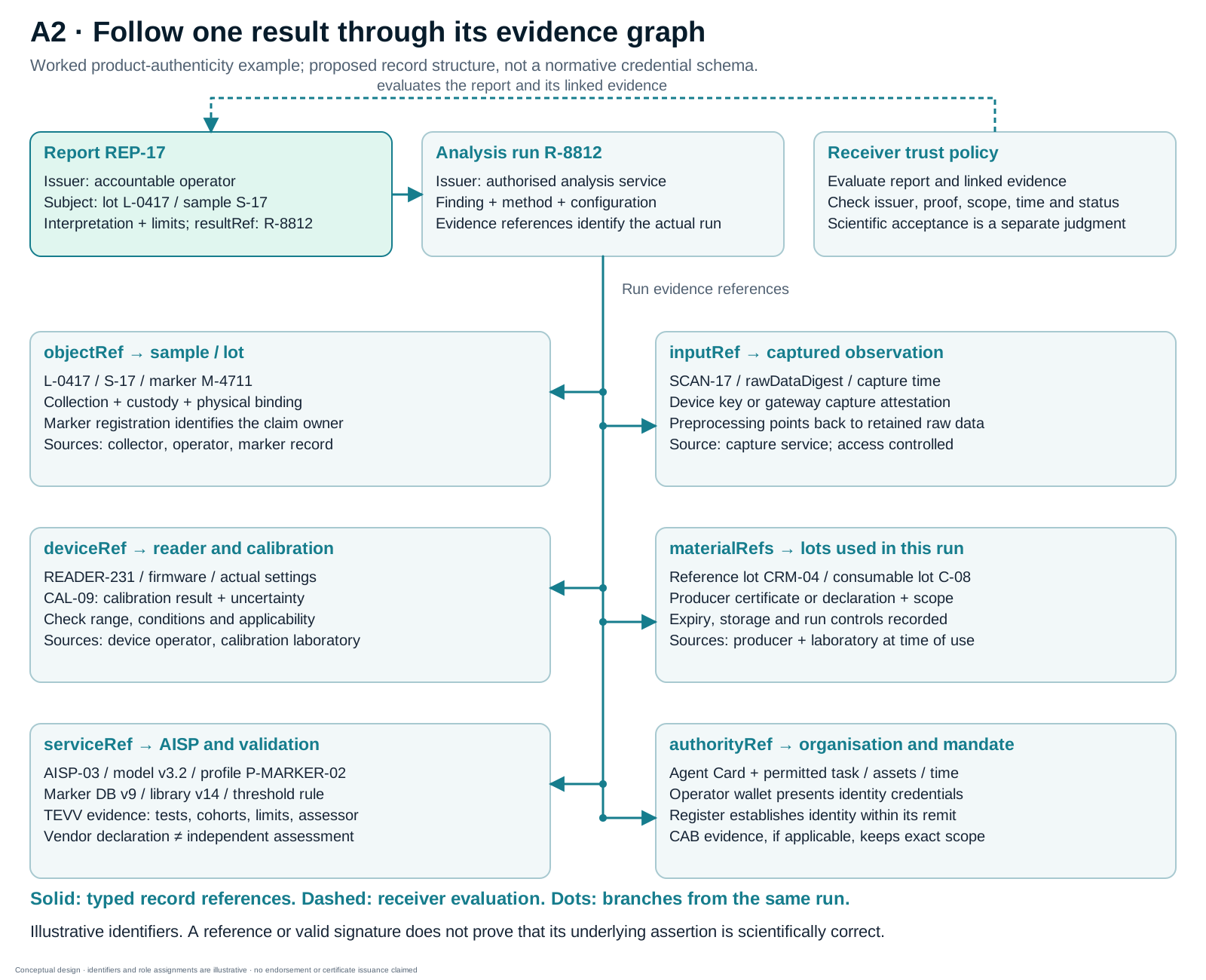
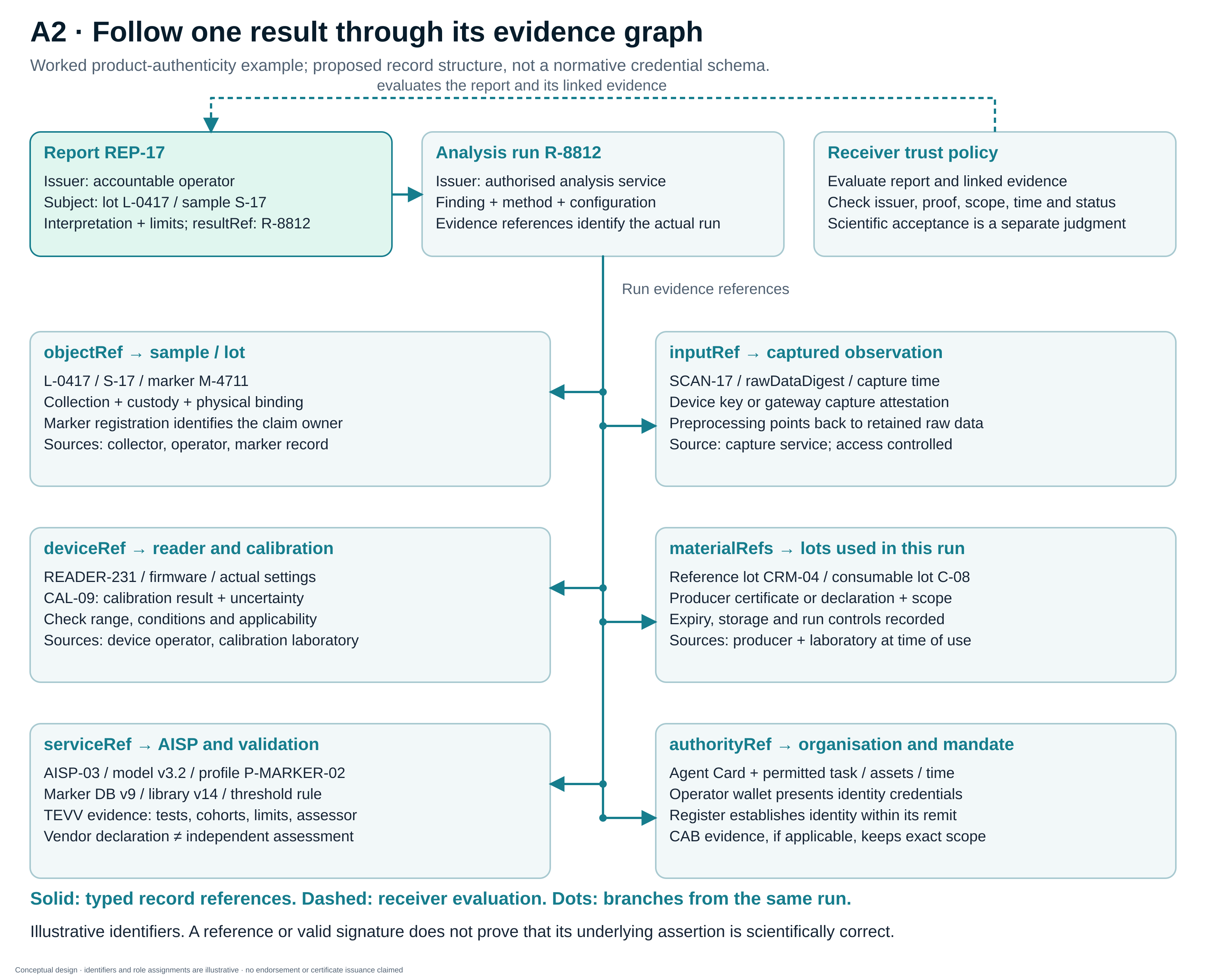
Each reference needs enough information to resolve the correct record and check its issuer, version, scope, time and status. A digest binds the referenced bytes; the capture and custody process must establish the physical relationship. The organisation’s business wallet presents identity and delegation evidence, while the calibration provider, material producer, laboratory and assessor remain responsible for their own claims. A register’s authority over legal identity does not make it a scientific authority. The labels in this example are a proposed structure and can inform the semantic vocabulary work in progress; they are not a completed interoperability specification.
A3. Forensic analysis: preserve custody and interpretation
The original forensic chart is retained as a spectral-analysis example: exhibit E-0931, subsample S-0931-A, method M-12 and run F-12. It now separates the instrument’s observation, the analysis service’s candidate finding and the expert’s interpretation. The model vendor’s declaration is evidence about what the vendor asserts; an independent assessment, where available, is a separate record with its own issuer and scope.
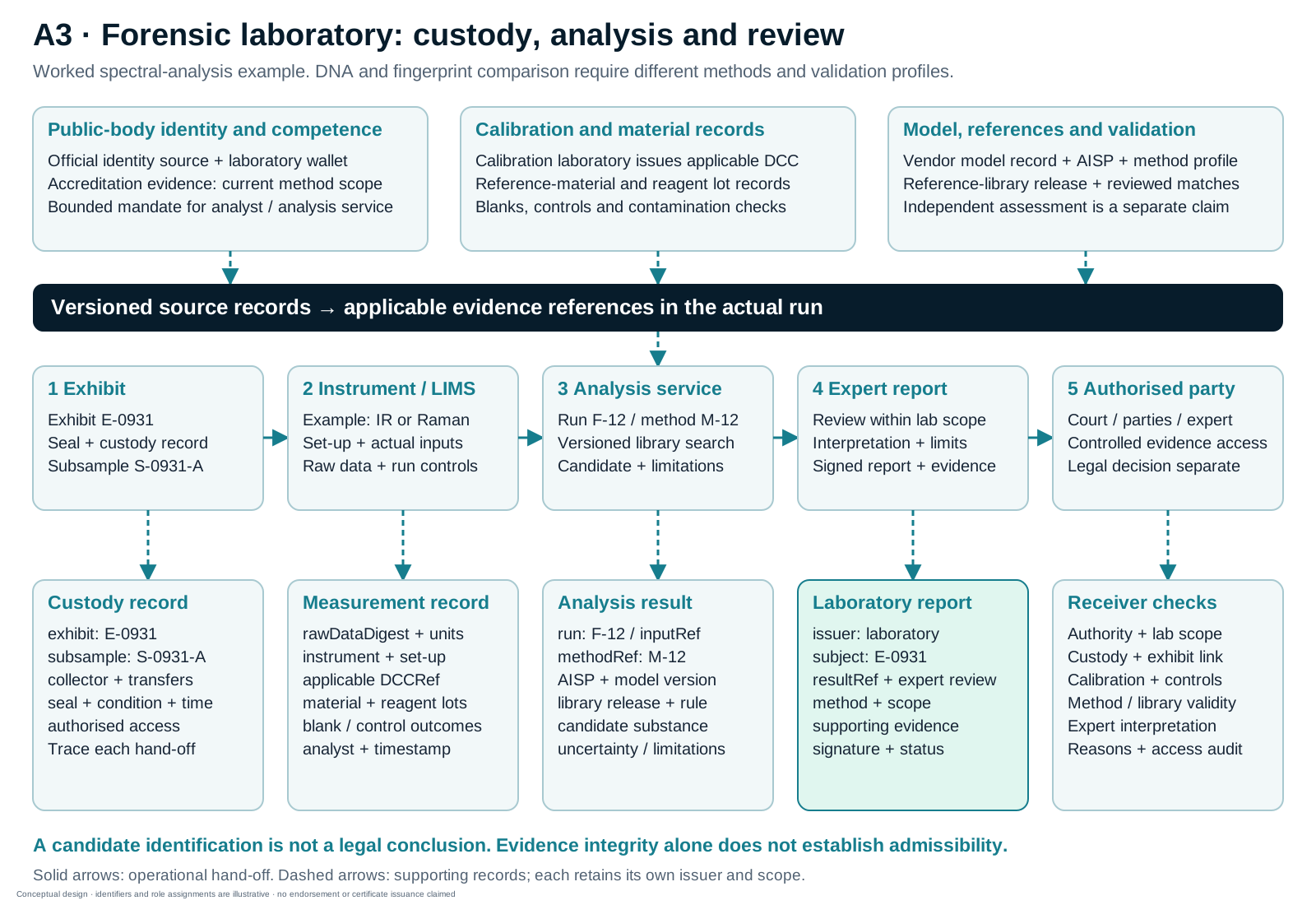
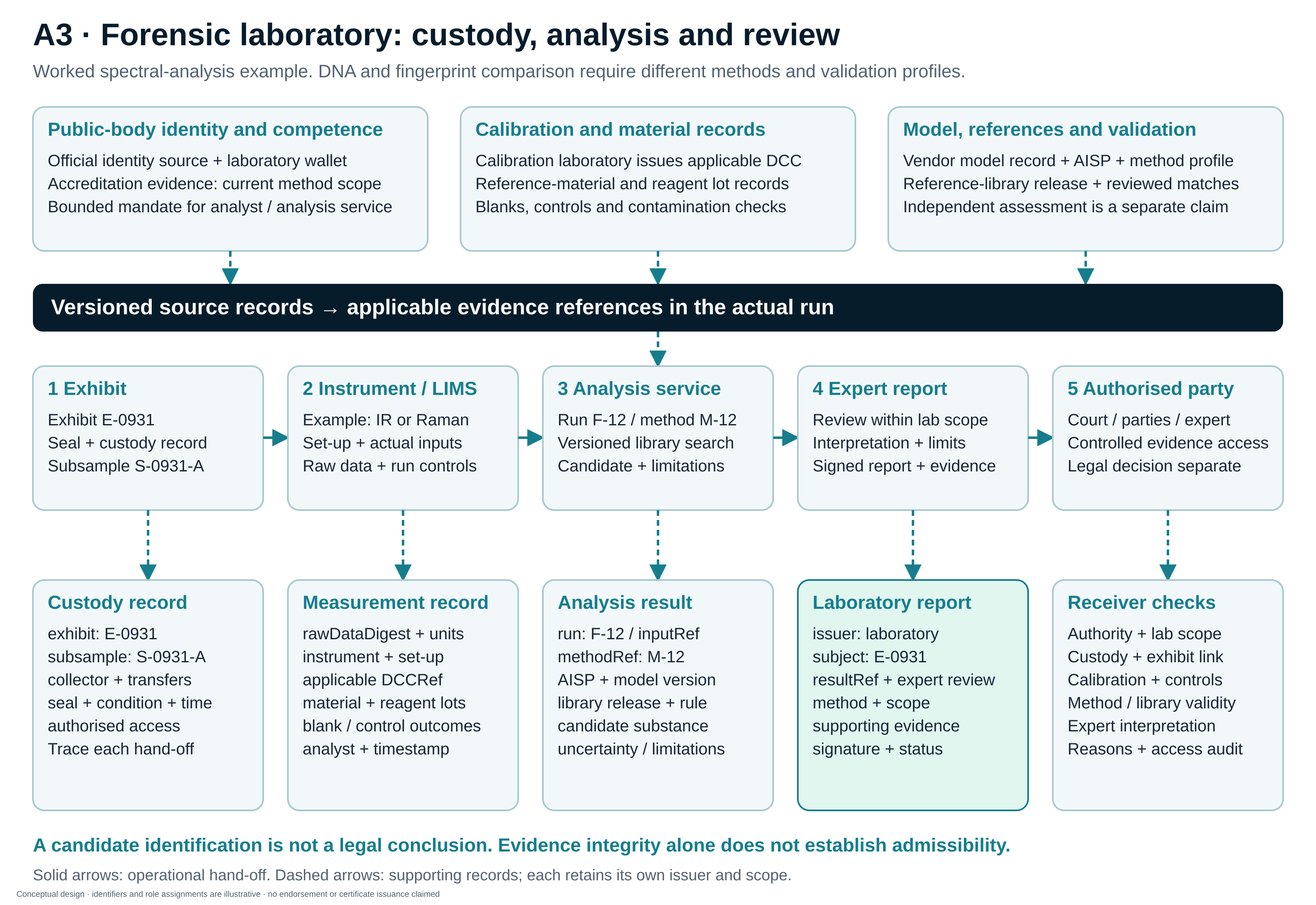
Custody transfers, sample preparation, consumable and reference-material lots, blanks and controls must remain connected to the actual run. A DCC supports calibration within its stated scope; it does not validate the matching method or the expert’s conclusion. For DNA or fingerprint comparison, replace the spectral method and library with discipline-specific references, validation profiles and interpretation procedures. Do not transfer a spectral similarity score into a probability of identity or guilt. Access rights and the legal handling of the evidence remain separate decisions.
A4. Automotive Driving Labels: preserve intended use
The reported BMW Dangerous Driving field test supplies practical context for the automotive use case. The diagram below is a proposed credential and provenance pattern, not a reconstruction of the exact field-test implementation. It follows a bounded trip segment through capture, event labelling, a data-product record and an engineering receiver. Its IDs, model version and taxonomy are illustrative.
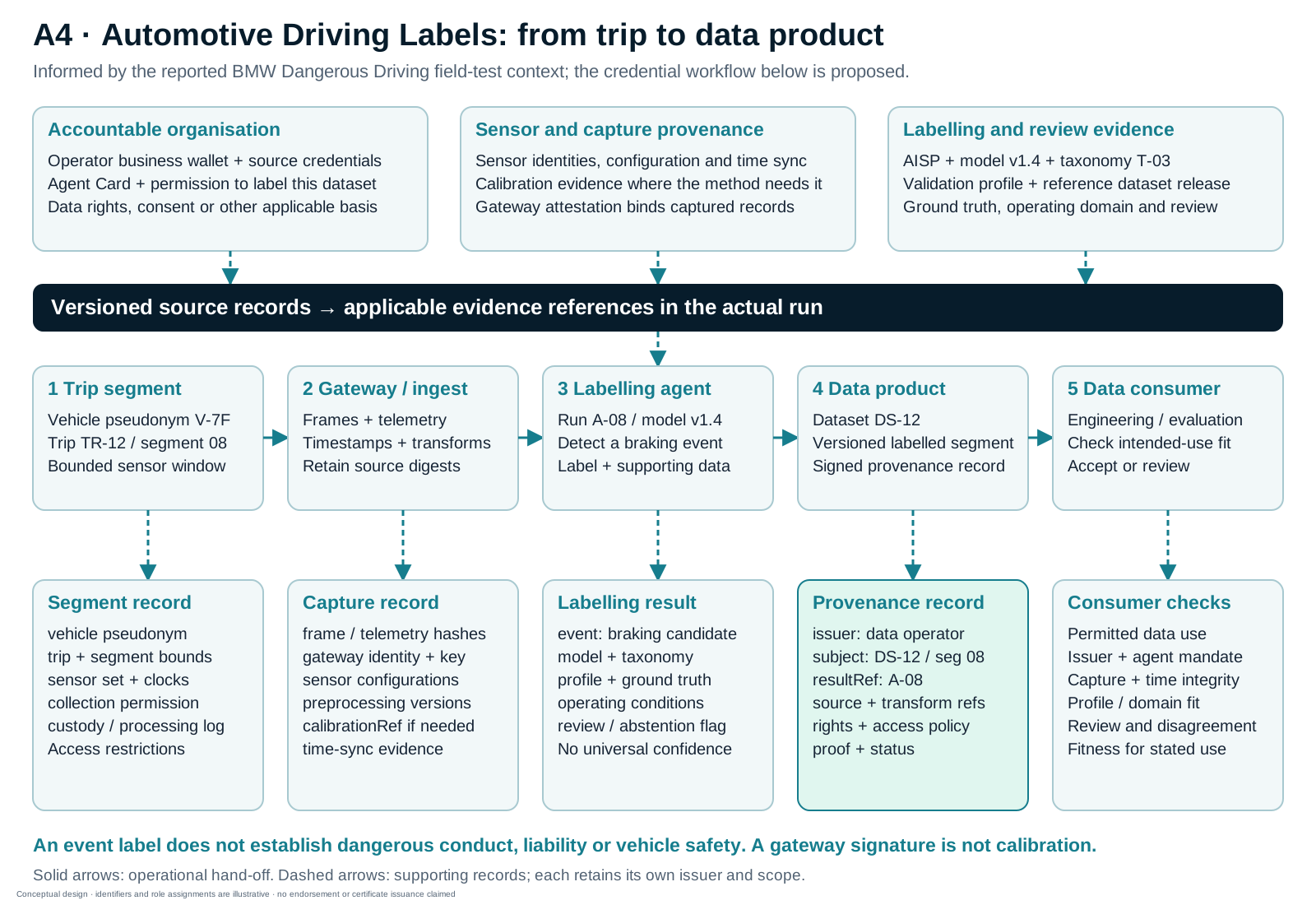
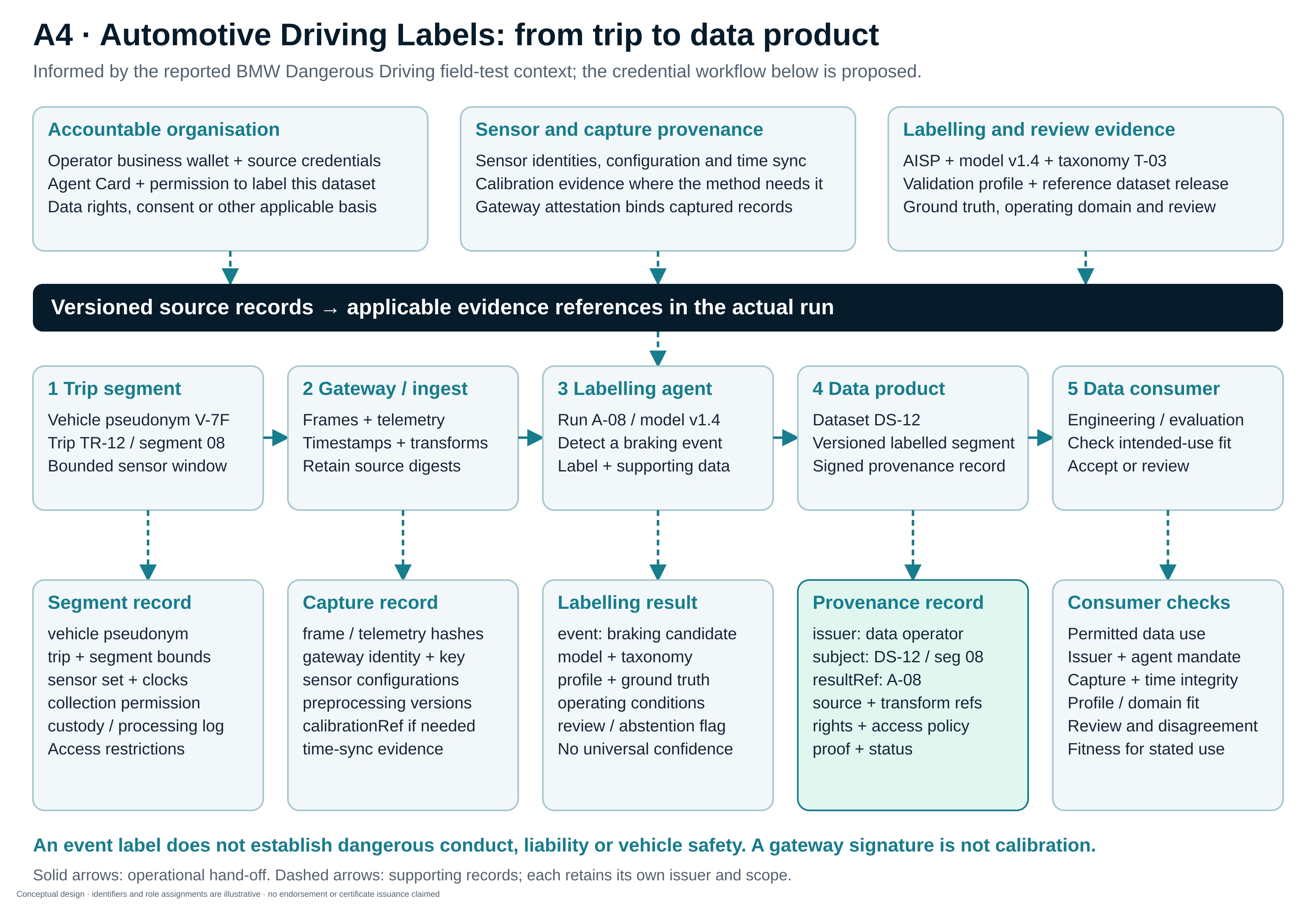
A braking-event candidate needs a defined taxonomy, ground-truth procedure, operating-domain limits and a review path. Record sensor timing and transformations so a receiver can assess the label’s intended use. The data-product record also retains permitted use and evidence-access policy. A signed gateway record establishes attribution and integrity under the relevant keys; it does not substitute for sensor calibration or show that a driver acted dangerously. This distinction matters when the same data moves from collection into training, evaluation or engineering decisions.
References
- Stöcker, C., Rüther, M., Jürgens, G. (2020). Collection of relevant milk quality data “from cow to dairy”. Spherity whitepaper, version 073. Historical background, not validation of this proposed system.
- Fritz, D., Stöcker, C., Suichies, B. Transforming “Release to Market Process” in regulated industries with decentralized micro-certificates. Primer, version 02. Historical background.
- Spherity Research. Proofs over Statements.
- Spherity Research. Multi-Trust Architectures for Authorised Agentic Actors.
- W3C. Recognized Entities v1.0, Working Draft, 12 November 2026. Experimental; not fit for production deployment.
- Wilms, D., Stoecker, C., Caballero, J. (2021). Data Provenance in Vehicle Data Chains. IEEE VTC2021-Spring.
- BAM. QI-Digital. Bundesanstalt für Materialforschung und -prüfung; initiative with PTB, DAkkS, DIN and DKE.
- PTB. Digitalisation of the quality infrastructure.
- W3C. Verifiable Credentials Data Model v2.0, Recommendation, 15 May 2025.
- European Union. Directive (EU) 2025/25, including the EU Company Certificate framework.
- Spherity Research library; related studies are linked in the text and further-reading section.
- DAkkS. Basics of accreditation.
- Tailorlux. Material marking and verification products. Product context only; the credential architecture is a separate proposal.
- TÜV SÜD. ISO/IEC 42001 AI management-system certification.
- Hackel, S., PTB. The DCC and the DTC — One Norm Family, One Format, QI-Digital-hosted presentation; DCR/DCA/DCC/DTC terminology.
- PTB. Digital Calibration Certificate schema, v3.3.0.
- European Commission JRC. How to read our certificates; ERM-BD284 milk-powder reference material.
- R-Biopharm. AFLAPREP M WIDE immunoaffinity columns. Illustrative consumable, not an endorsement.
- BAM. Fluorescence Calibration Kit certificate.
- Promega. PowerPlex Fusion 6C System technical manual. Illustrative kit components, not an endorsement.
- ISO. ISO 18385:2016, minimising human DNA contamination in products used to collect, store and analyse biological material for forensic purposes.
- UK Forensic Science Regulator. DNA contamination controls: laboratory.
- Hygiena. UltraSnap surface ATP sampling device; positive-control kit. Illustrative products, not endorsements.
- A2A Project. Protocol specification and Agent Card.
- NIST. AI Risk Management Framework: core functions, including MEASURE.
- JCGM / ISO. Guide to the Expression of Uncertainty in Measurement, section 6.
- NIST. Technical Note 1297: expanded uncertainty.
- NIST/SEMATECH. Confidence intervals for a binomial proportion, including Wilson intervals.
- NIST. DNA Mixture Interpretation: A Scientific Foundation Review, NIST IR 8503.
-
European Commission. European Business Wallets. Proposal status checked 14 November 2026.
- Spherity. VERA Digital Product Passport, EIDA European Business Wallet and Agentic Trust. Product context; the laboratory integration is conceptual.
- W3C. Verifiable Credentials Working Group participants; DPP / Business Wallet use cases and requirements, a work-in-progress contribution, not a W3C endorsement.

Open research
License and citation
This concept note, its original figures and the companion carousel PDF, subject to the exclusions below is licensed by its named author under the Creative Commons Attribution 4.0 International License (CC BY 4.0), except for the third-party material identified below. Reuse must credit every named author, link to this canonical version and the license, and indicate whether changes were made.
Third-party rights: Third-party organisation and product names, including Tailorlux, Tailor-Safe, Tailor-Scan, TÜV SÜD, Bundesanzeiger Verlag, BAM, R-Biopharm, Promega and Hygiena, remain the property of their respective owners. Linked third-party documents retain their own terms. Spherity names and logos are excluded from the research licence.
How to cite this work
Dr. Carsten Stöcker (2026-11-13). “Verifiable AI Lab Analysis: Measured. Signed. Trusted?.” Spherity GmbH. https://spherity.github.io/spherity-research/case-studies/verifiable-ai-lab-results.html. Licensed CC BY 4.0.
Direct answers
Questions this research answers
What is the evidence level of this case study?
Proof of concept, working prototype and initial field testing. The author's implementation update includes BMW Dangerous Driving field testing, an AI Lab prototype, a semantic vocabulary in progress, DCR/DCC testing in QI-Digital, Sphin-X concept work, Catena-X Trusted AI concept work and Innovation Challenge work on a dairy use case with Siemens. These activities inform a proposed integrated architecture; they do not establish that every component has been deployed together or independently validated. Numerical examples remain illustrative.
What does a verifiable AI lab result prove?
Proof checks can establish integrity and attribution under trusted keys and policy. An evidence graph links supporting records about the sample, calibration, materials, references, agent and authority. It does not establish scientific correctness or automatically justify a release decision.
What is the difference between DCR and DCC?
DCR means Digital Calibration Request; DCC means Digital Calibration Certificate. The request expresses the calibration need, while the certificate records the performed calibration and its results. A DCC is a domain document and is not automatically a W3C verifiable credential.
What does the business wallet do?
It supports organisational identity, credential presentation and bounded delegation to agents. It does not calibrate devices, accredit laboratories or validate scientific conclusions. The receiver still checks issuer competence, scope, status and applicable policy.
What is a verifiable AI Service Passport?
Here it is a proposed evidence container linking a verifiable Agent Card, execution configuration, validation profile and TEVV evidence to the actual run. It is not an established certification scheme.
How do confidence intervals differ from measurement uncertainty?
A measurement-uncertainty interval describes uncertainty attributed to a measurand under a stated model. A Wilson confidence interval describes sampling uncertainty in an estimated detection proportion. Neither is automatically the probability that one product is authentic or that a forensic conclusion is true.
Why identify consumables and reference materials?
The actual lots, certificate scope, storage, expiry and run controls can affect validity. Authenticity of a material does not alone establish its suitability; consumables, manufacturer certificates and certified reference materials have different assurance roles.
Can the evidence be checked offline?
Only against retained credentials, trusted keys and authenticated status evidence for an explicit evaluation time and freshness policy. An offline check cannot discover later revocation; stale or missing evidence may require an indeterminate result.
How can Spherity products support verifiable laboratory results?
VERA links product and lot identity to test evidence; EIDA supports organisational credentials and delegation; Agent Identity binds the acting agent; an AI Service Passport links configuration and validation evidence; Trusted AI supports checks, policy and audit trails. This is a proposed integration for the case. Laboratories and assessors retain responsibility for scientific assurance. Spherity products use open standards, and Spherity participates in W3C.