Spherity Research Programme · Overview
Securing Meaning in Trust Infrastructure
A research programme on the semantic supply chain of verifiable credentials, knowledge graphs and AI agents
Browse this paper
In brief
What does this research establish?
Verifiable credentials, product passports and AI agents rely on meaning that arrives outside the signed bytes, through JSON-LD contexts, vocabularies, rulebooks and code tables. This programme studies how that meaning is produced, released, verified and withdrawn, and proposes controls for it. Its first paper, Securing the Semantic Supply Chain (version 1.0, doi:10.5281/zenodo.24293613), is published with an open test harness; further papers are planned and none of the proposed requirements has been adopted by a standards body.
Key takeaways
- A valid signature is not a valid meaning: the definitions that give a credential its meaning form a supply chain of their own, protected today only at one verifier at one moment.
- Paper A provides the threat model, five findings on production libraries, a formal model, 30 mechanisms and 91 proposed requirements, with an open harness archived on Zenodo.
- The next steps concentrate on a high-assurance profile for W3C VCDM 2.0 across RDF, JSON-LD, CBOR-LD and YAML-LD, verifiable knowledge graphs for AI and key management for AI agents.
Start with the executive brief
Download the executive brief (PDF, 8 pages)Securing the Semantic Supply Chain. Why a valid signature is not a valid meaning, and what each role should do.
The question
Verifiable credentials are becoming legal and economic infrastructure: battery and product passports, wallets for people and businesses, customs data and the evidence that AI agents act on. A signature proves who issued a credential and that its signed content is unchanged, given a trusted binding between key and issuer. It does not prove what the credential means to the system that reads it.
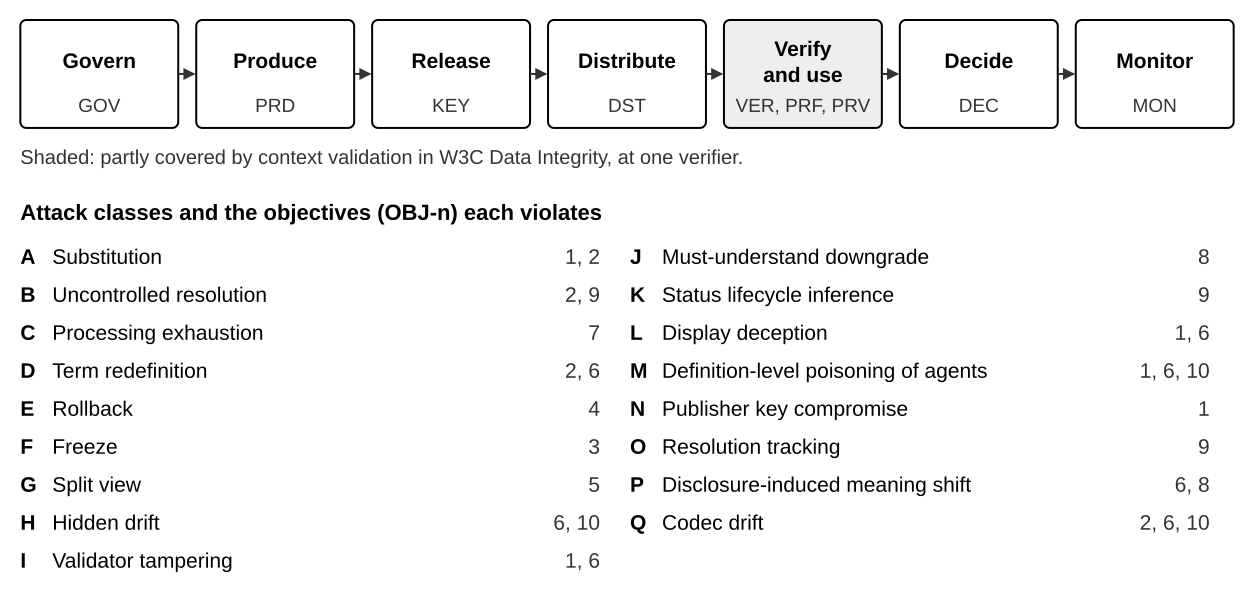
That meaning comes from elsewhere: JSON-LD contexts, vocabularies, ontologies, validation shapes, rulebooks, Type Metadata and code tables. They are published by someone, change over time, and are copied, cached and replaced outside the signed bytes. Together they form a semantic supply chain. This programme asks how that chain can be secured with the discipline that software and keys already have: authorised publishers, signed releases, freshness, rollback protection, withdrawal and decisions that record which meaning they applied.
Paper A: Securing the Semantic Supply Chain
Securing the Semantic Supply Chain: Meaning as a Foundation of Trust Infrastructure, version 1.0, 16 November 2026, doi:10.5281/zenodo.24293613. The paper gives the threat model of the semantic supply chain, five findings on production libraries, a formal model with proof sketches and 66 model-checked cases, 30 mechanisms and 91 proposed requirements, and six use cases from battery passports to verifiable business-partner records. It is published with an executive brief and supplements S1–S5 on mechanisms, requirements, the formal model, prior art and the review record.
Its results bind meaning, not its truth. Hardware isolation is simulated, not demonstrated, and the use cases motivate the requirements without having been deployed.
Software and reproducibility
The empirical results come from the open semantic supply chain harness (Apache-2.0 with third-party notices): worked examples on production libraries, the model checker and the tests. Version 0.4.0 of 16 November 2026 passes 136 tests from a clean extract and is archived at doi:10.5281/zenodo.24281131; doi:10.5281/zenodo.24168346 always resolves to the latest version. Source and release: ssc-harness-v0.4.0.
Standards work
The 91 requirements of Paper A are offered as a proposed baseline to the W3C High Assurance Profile for W3C VCDM 2.0 Community Group, which was proposed on 11 November 2026 and launched on 12 November 2026. No W3C group has adopted them. The requirements are available as CSV with the paper’s supplements.
What comes next
The following work is planned. It builds on Paper A’s formal model, requirements and harness; none of it is part of Paper A’s claims.
- A high-assurance profile for W3C VCDM 2.0. Conformance requirements per class, anchored on the credential’s RDF dataset: every admitted serialisation binds to that one dataset, with JSON-LD as the form that is exchanged and verified, CBOR-LD for compact, long-lived carriers and YAML-LD as an authoring source only.
- Verifiable knowledge graphs for AI. Committed graphs with provenance per fact, a pinned semantic closure including the entailment regime, incremental commitments, proofs for single facts and retrieved subgraphs, and withdrawal that reaches derived facts, caches and embeddings.
- Key management for AI agents, in preparation.
New papers will appear in this series as they are published.
Foundations
The programme builds on Proofs over Statements: Verifiable Evidence Graphs, which shows what a verifier must hold to trust a statement in an evidence graph and assumes pinned contexts and an authenticated context closure. Paper A supplies those assumptions. Related Spherity research on the EU DPP Registry, European Business Wallets and evidence graphs for industrial AI is listed below.

Open research
License and citation
This research programme page is licensed by its named author under the Creative Commons Attribution 4.0 International License (CC BY 4.0). Reuse must credit every named author, link to this canonical version and the license, and indicate whether changes were made.
How to cite this work
Dr. Carsten Stöcker (2026-11-16). “Securing Meaning in Trust Infrastructure: A research programme on the semantic supply chain of verifiable credentials, knowledge graphs and AI agents.” Spherity GmbH. https://spherity.github.io/spherity-research/securing-meaning-in-trust-infrastructure.html. Licensed CC BY 4.0.
Direct answers
Questions this research answers
What is the research programme Securing Meaning in Trust Infrastructure about?
It studies the semantic supply chain of verifiable credentials: the JSON-LD contexts, vocabularies, rulebooks and code tables that give signed data its meaning, how they are produced, released, verified and withdrawn, where today's stacks fail, and which mechanisms and requirements would secure them.
What has been published so far?
Paper A, Securing the Semantic Supply Chain: Meaning as a Foundation of Trust Infrastructure, version 1.0 of 16 November 2026, with an executive brief and supplements S1–S5 (doi:10.5281/zenodo.24293613), and the open semantic supply chain harness v0.4.0 (doi:10.5281/zenodo.24281131).
What comes next?
Planned are a high-assurance profile for W3C VCDM 2.0 in which every admitted serialisation (JSON-LD, CBOR-LD, YAML-LD as authoring source) binds to one RDF dataset, verifiable knowledge graphs for AI, and key management for AI agents. None of this planned work is part of Paper A's claims.
Has a standards body adopted the proposed requirements?
No. The 91 requirements are a proposal to the W3C Community Group for a High Assurance Profile for W3C VCDM 2.0, which was proposed on 11 November 2026 and launched on 12 November 2026; no W3C group has adopted them.