Research topic · Papers 1.0 · Demonstration 0.1.0
Europe’s answer to Palantir
A globally collaborative model for industrial AI
Browse this paper
In brief
What does this research establish?
Palantir shows the power of connecting data, business meaning, logic and governed action through an operational ontology. Europe’s strategic opportunity is to make comparable cooperation work across independently governed companies and platforms. This research proposes access-controlled, verifiable evidence graphs built on open international standards and industry-agreed semantics. Participants prepare their own information, exchange permitted evidence and retain authority over consequential actions. Europe can lead this effort with partners in the US, Asia-Pacific and other regions. Existing dataspaces are a first step: fast-track modernisation and demanding operational tests are still needed for AI-first use.
Key takeaways
- Preserve operational depth. Useful industrial AI needs interpreted relationships, evidence and controlled actions, not just more files.
- Make cooperation portable. Shared meaning, discovery and trust should connect authorized participants across providers, without making one intermediary indispensable.
- Prove the next step. Test performance, authorization, evidence freshness and provider substitution together. The papers propose this programme; they do not report a finished global infrastructure.
Two papers, one cooperation agenda
Executive Brief
Read the Executive Brief (PDF, 19 pages)A European Answer to Palantir
A globally collaborative counter model for industrial AI
Version 1.0 · 1 November 2026 · 30 references · CC BY 4.0
Academic paper
Read the academic paper (PDF, 45 pages)A Global Cooperation Model for Sovereign Industrial AI
European dataspaces and open standards for verifiable evidence across platforms
Version 1.0 · 1 November 2026 · 101 references · CC BY 4.0
Explore the robot evidence graph · Academic abstract and citation record
What is Europe’s answer to Palantir?
Palantir shows the power of connecting data, business meaning, logic and governed action through an operational ontology. Europe’s strategic opportunity is to make comparable cooperation work across independently governed companies and platforms. This research proposes access-controlled, verifiable evidence graphs built on open international standards and industry-agreed semantics. Participants prepare their own information, exchange permitted evidence and retain authority over consequential actions. Europe can lead this effort with partners in the US, Asia-Pacific and other regions. Existing dataspaces are a first step: fast-track modernisation and demanding operational tests are still needed for AI-first use.
Sovereignty means the practical capacity to choose partners, govern permitted uses and preserve essential operations. Palantir and other capable providers can participate. Shared vocabulary, discovery and trust operators can also become concentration points: credible substitution and continuity need testing.
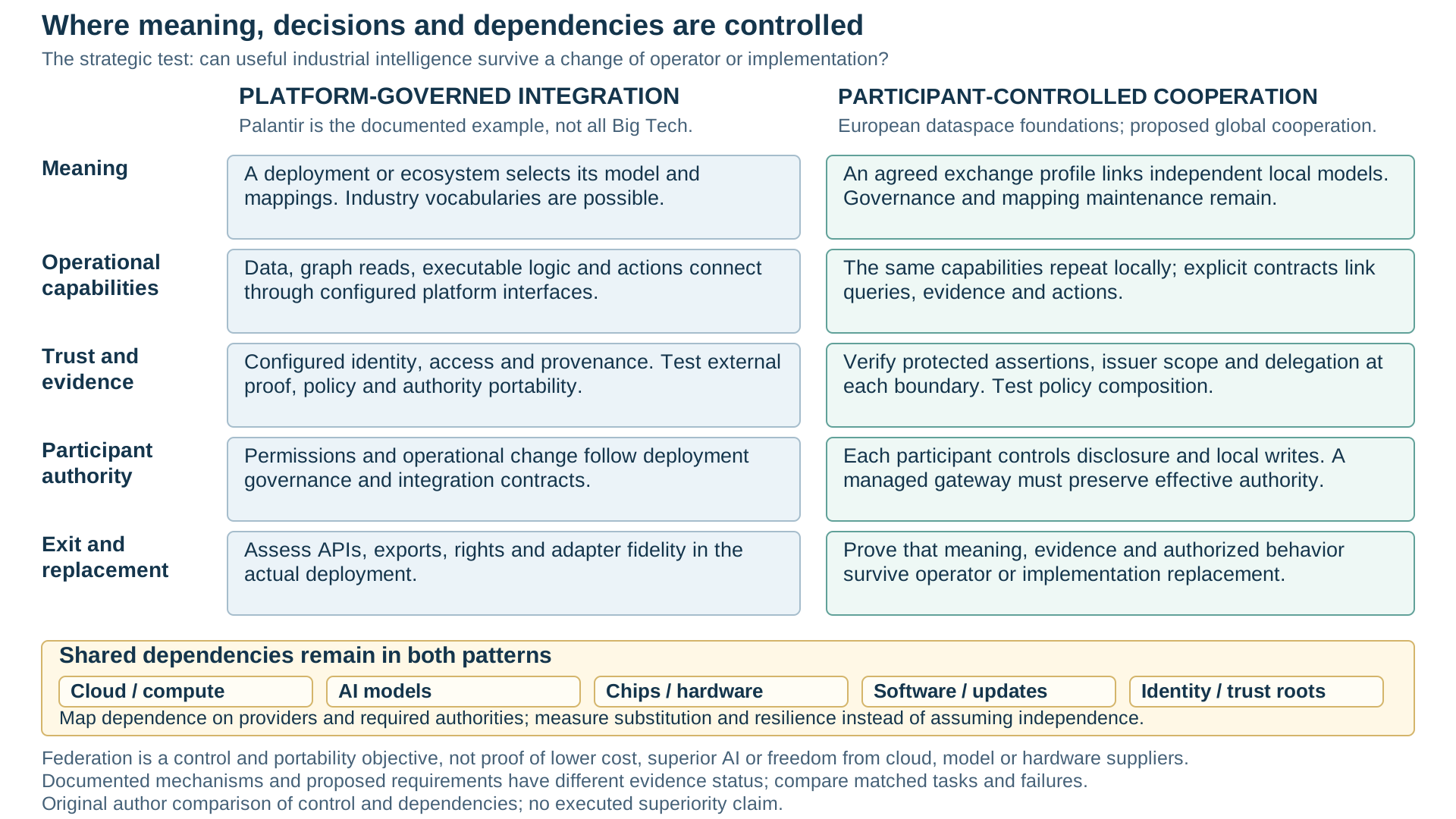
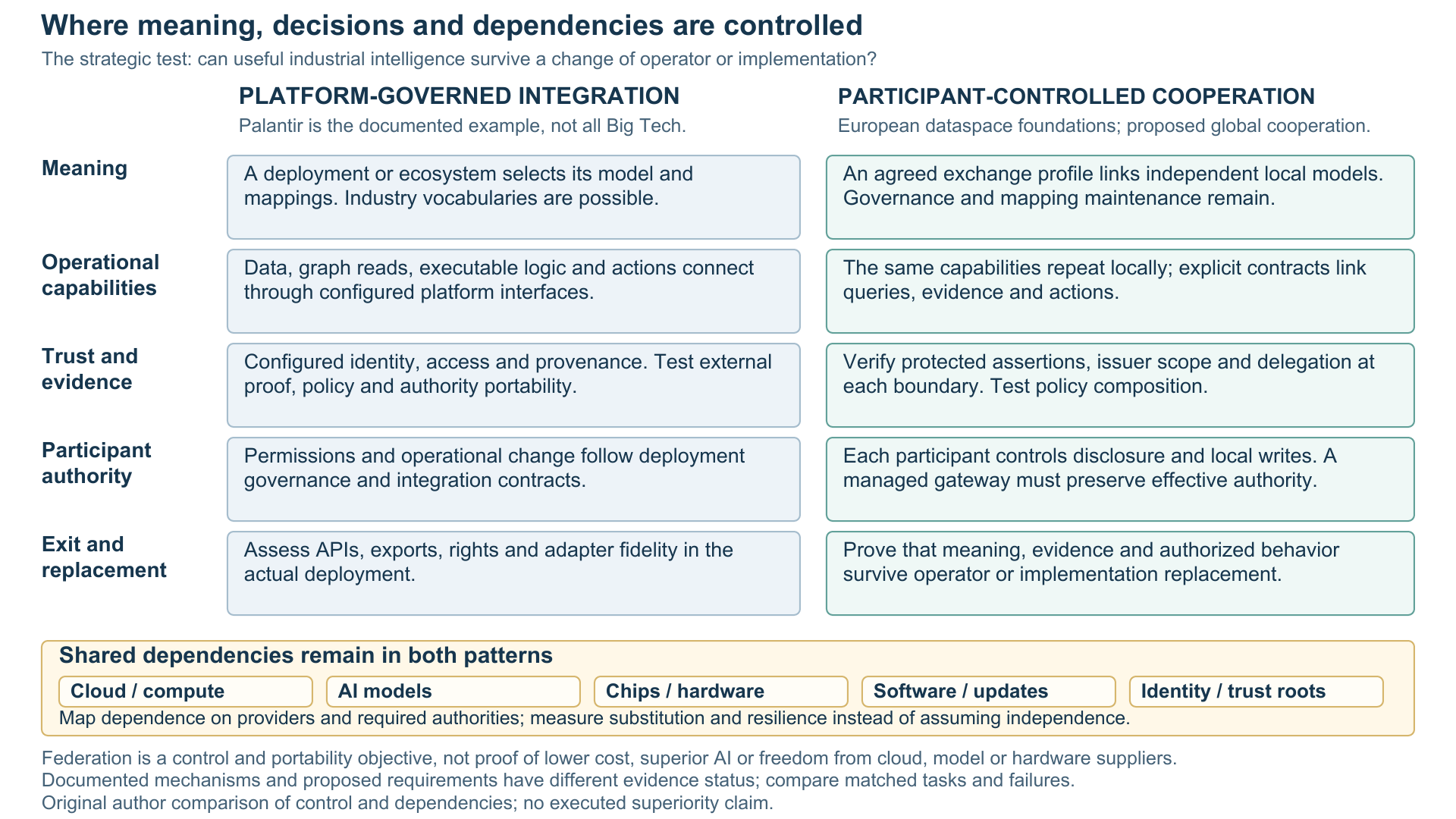
Two architecture patterns
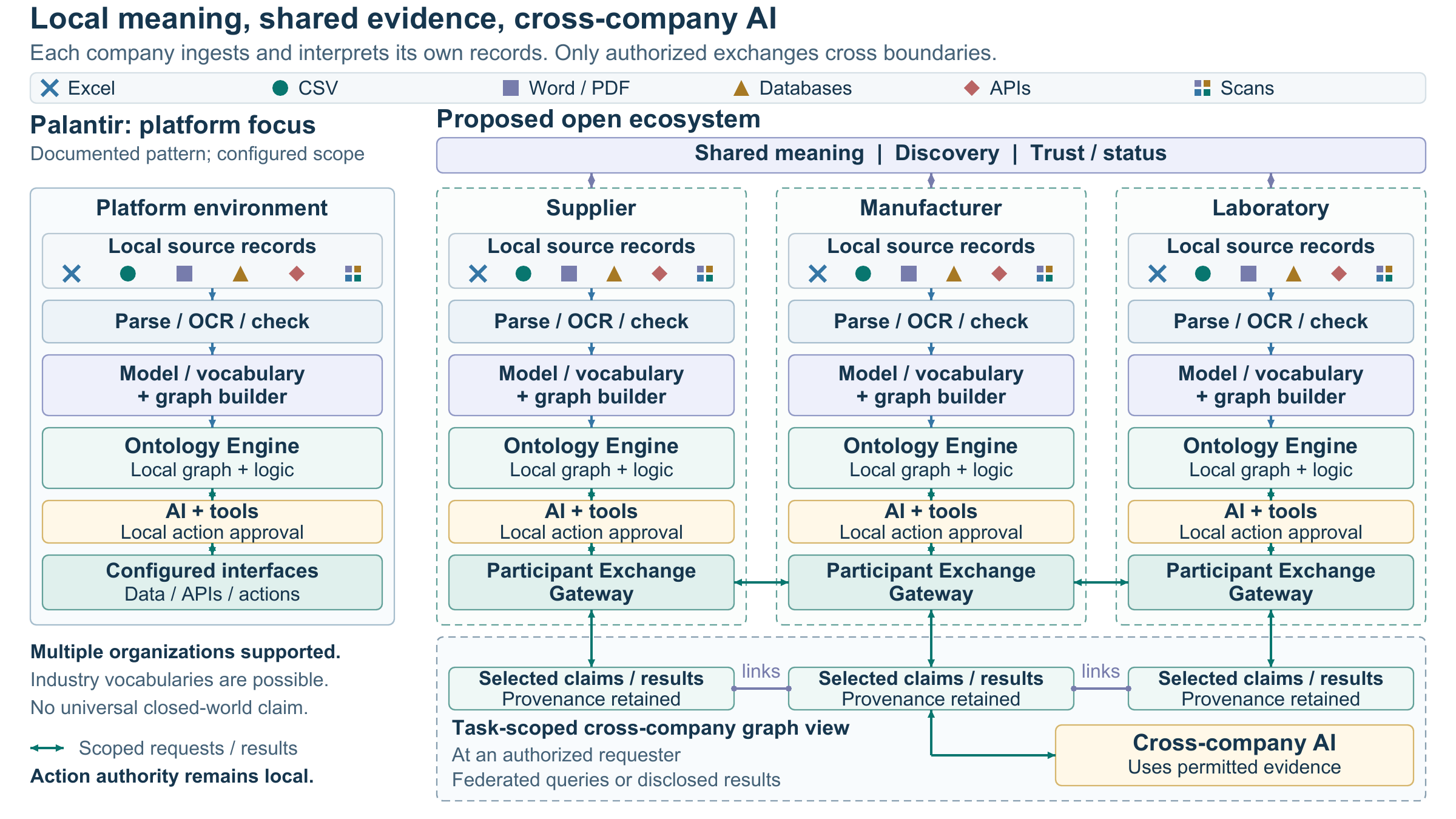
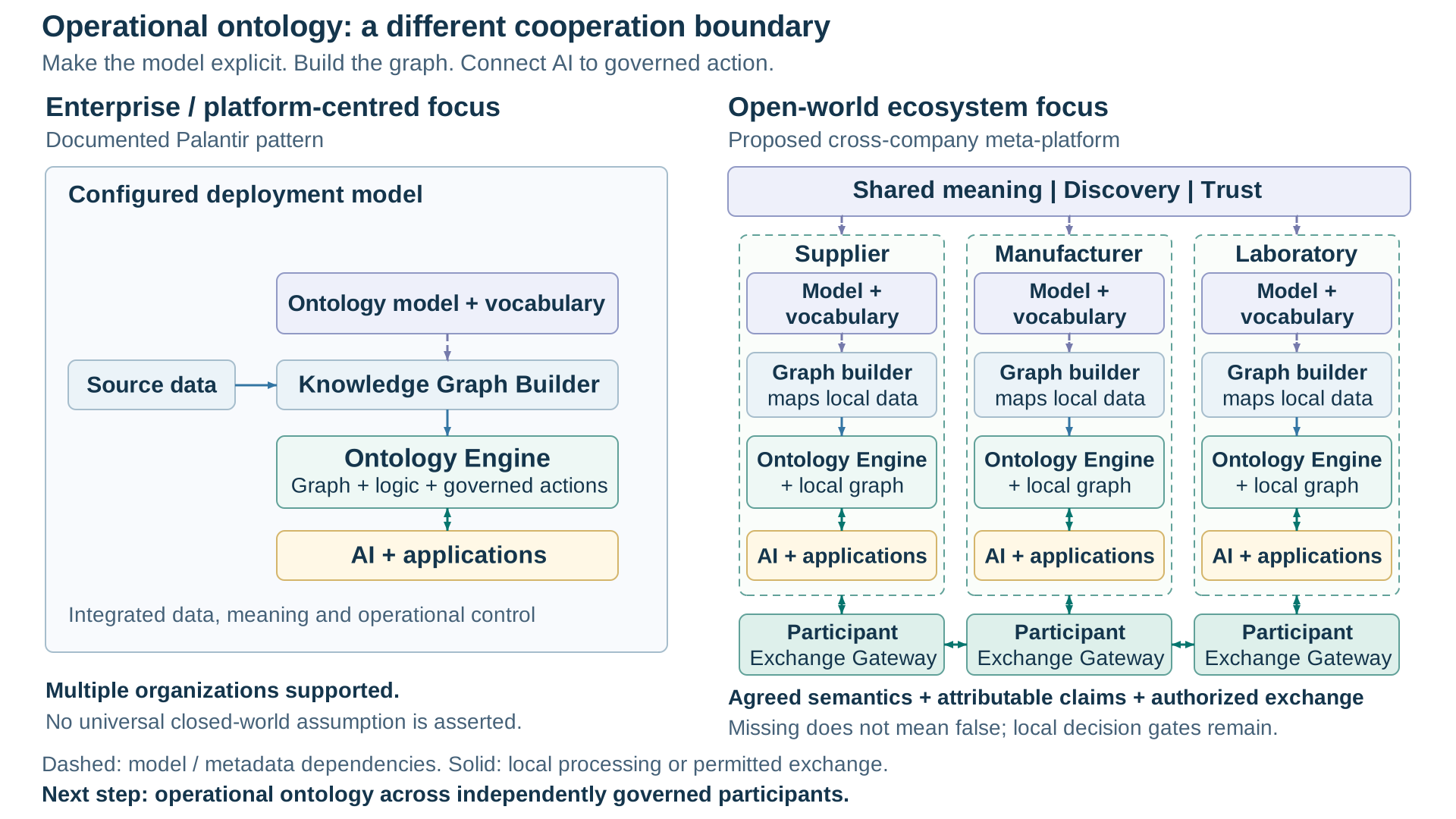
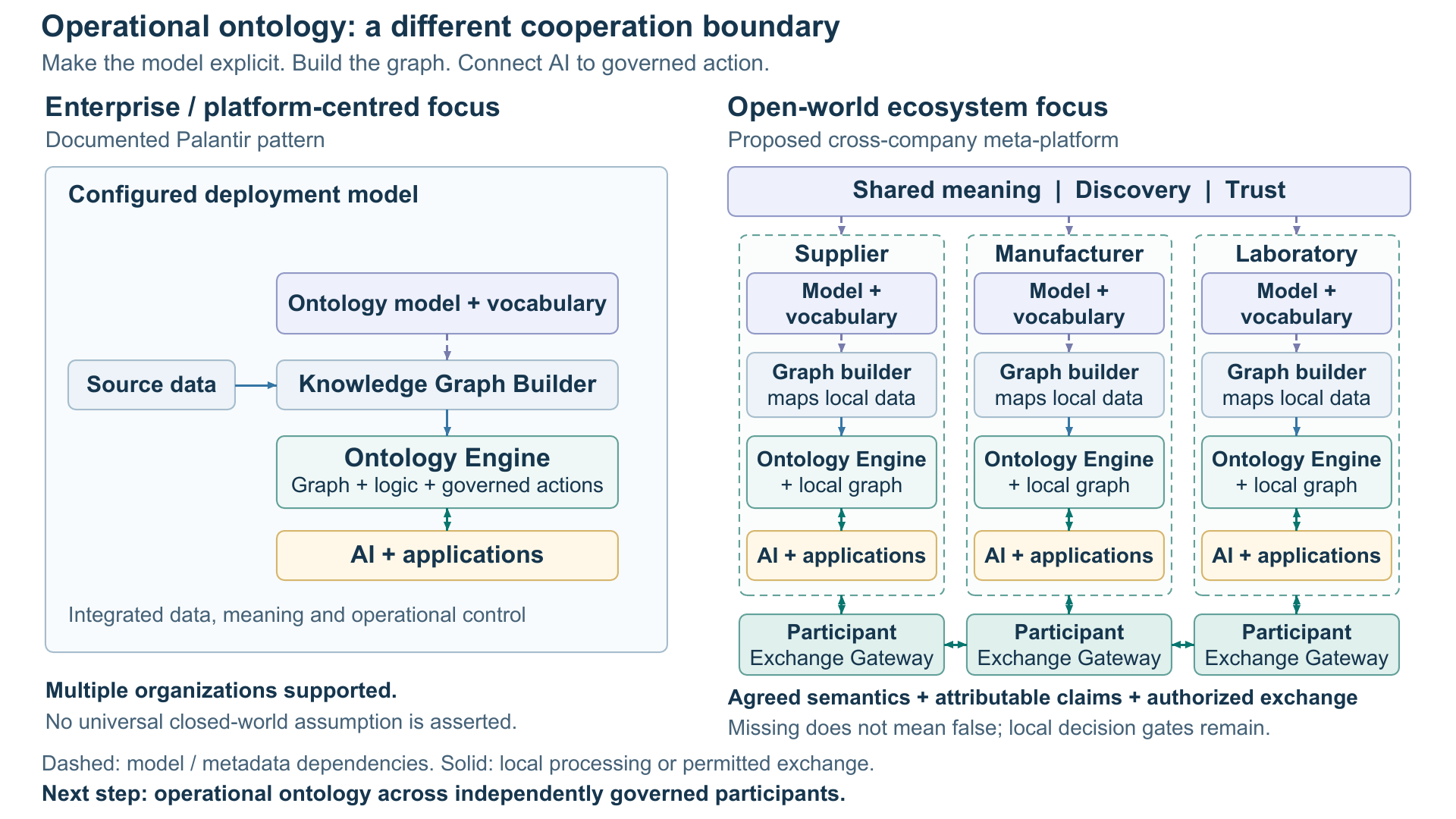
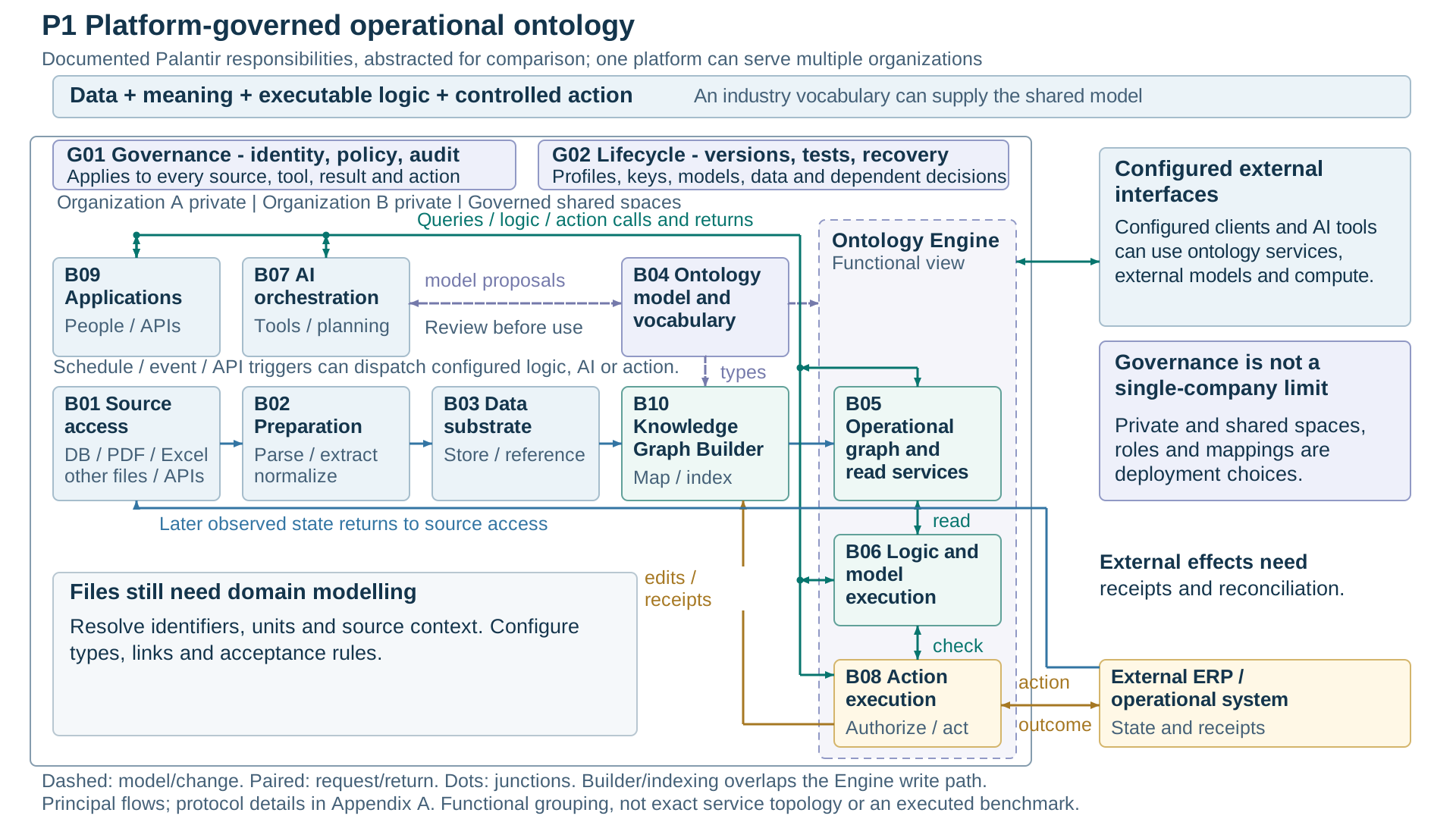
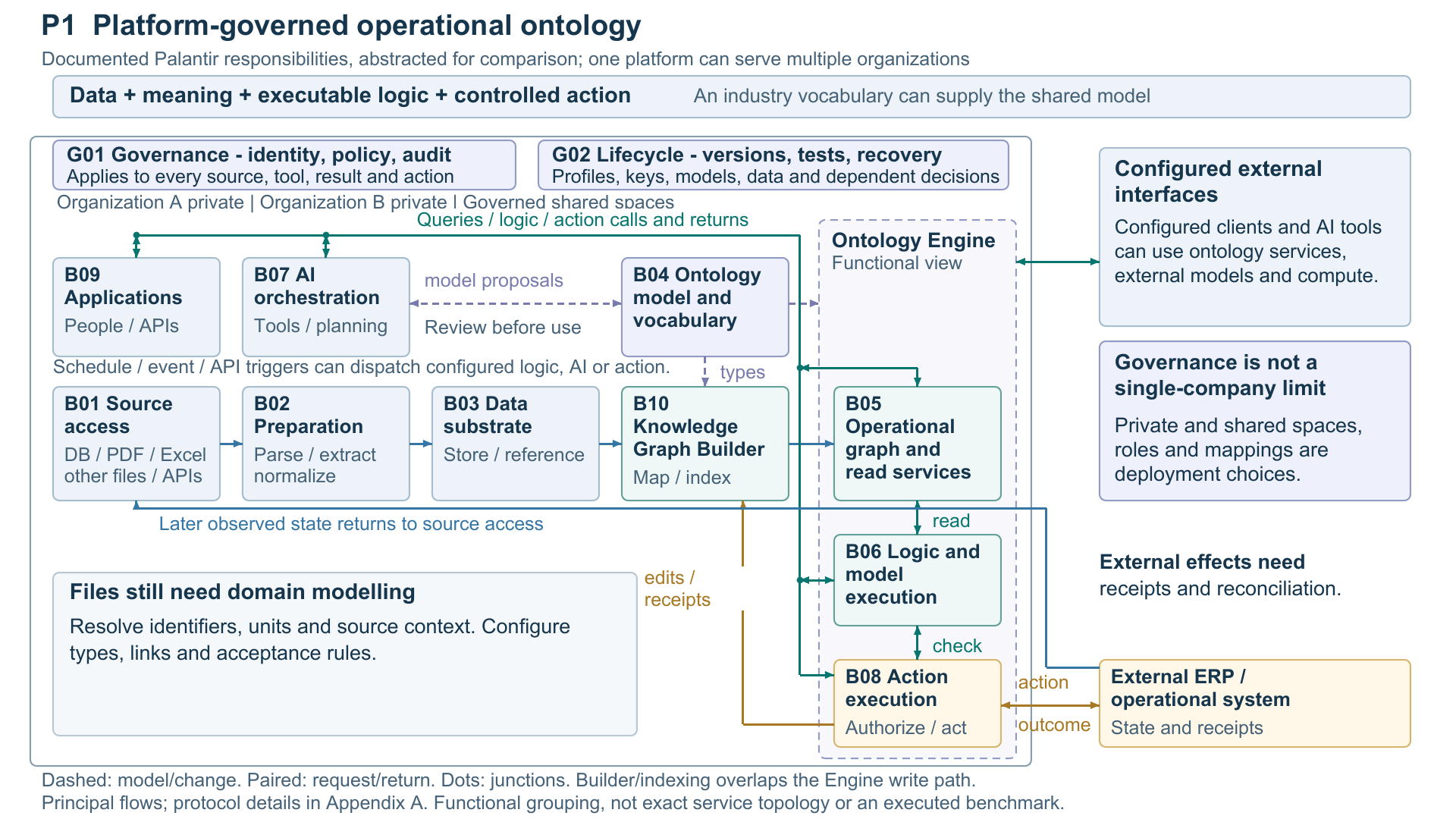
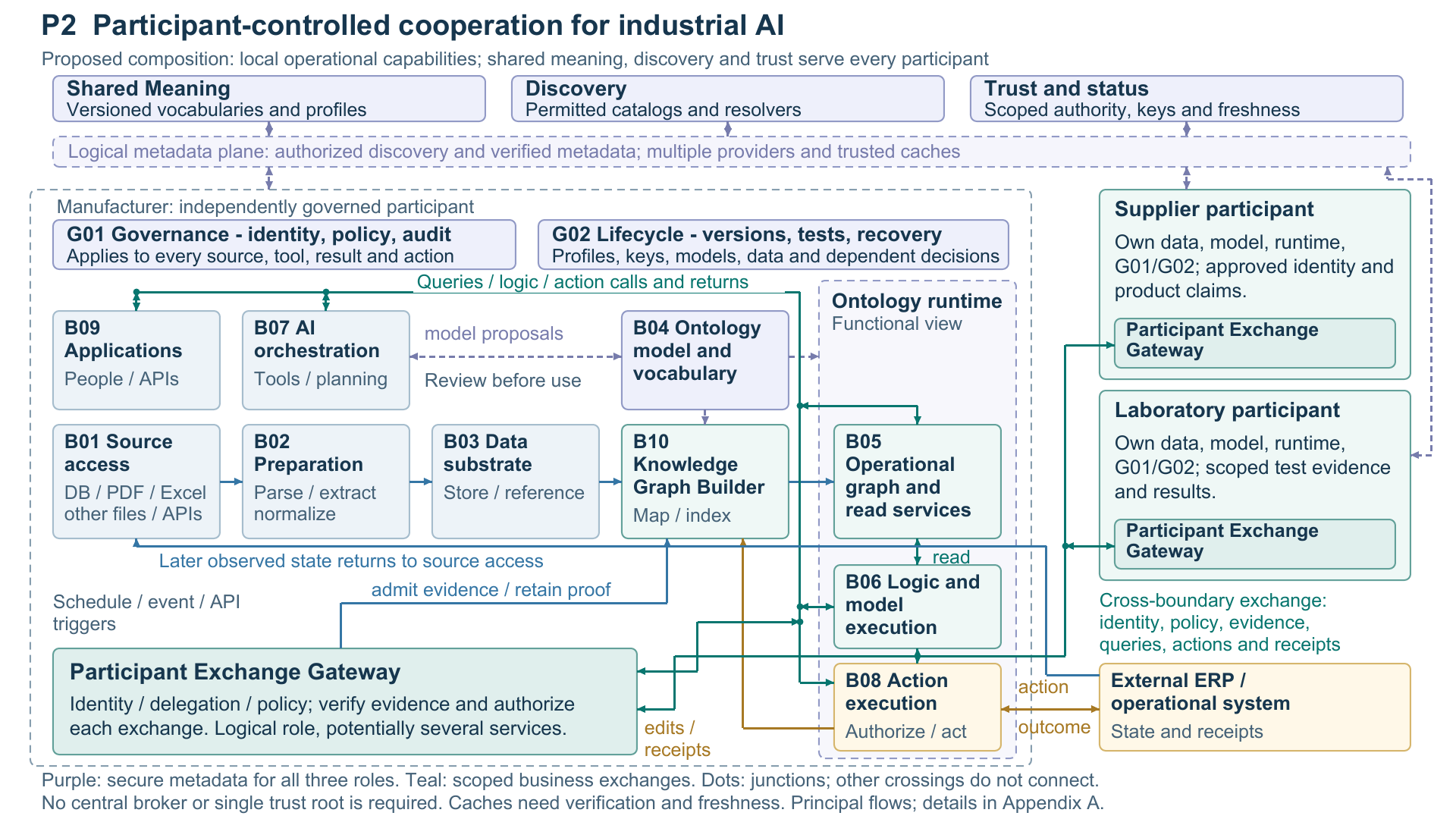
P1 is the author’s functional synthesis of documented Palantir capabilities (baseline 0.5). P2 proposes participant-controlled cooperation (baseline 0.4). Neither was benchmarked in this research.
| Question | Palantir-centred pattern, documented reference | Participant-controlled pattern, proposed extension |
|---|---|---|
| What creates value? | Operational ontology connects data, objects, relationships, logic, permissions and actions. | Comparable local capabilities cooperate across independently governed implementations. |
| Where are files processed? | Configured source access and preparation feed the operational model. | Each participant prepares its own sources before authorized exchange; no compulsory shared ingestion centre. |
| Can several companies participate? | Yes. Palantir documents multi-organization ecosystems and can use industry vocabularies. | Yes. Shared exchange contracts aim to work across independently chosen implementations. |
| How is meaning shared? | Configured platform models, mappings and operational interfaces. | Maintained industry-agreed vocabularies, mappings and profiles across providers. |
| Who controls action? | Configured platform and organizational permission boundaries. | Each responsible participant retains local decision and action authority. |
| What is the strategic test? | Evaluate useful operational integration and its lifecycle and exit costs. | Demonstrate preserved meaning, evidence and behavior when a replaceable provider changes. |
| What has this research proved? | It synthesizes documented architecture; no authenticated deployment benchmark was run. | It defines a design and test agenda; no composed production federation or superiority result is reported. |
“Knowledge Graph Builder” is an author-defined functional grouping, not a separately marketed Palantir product. See the detailed P1 and P2 diagrams.
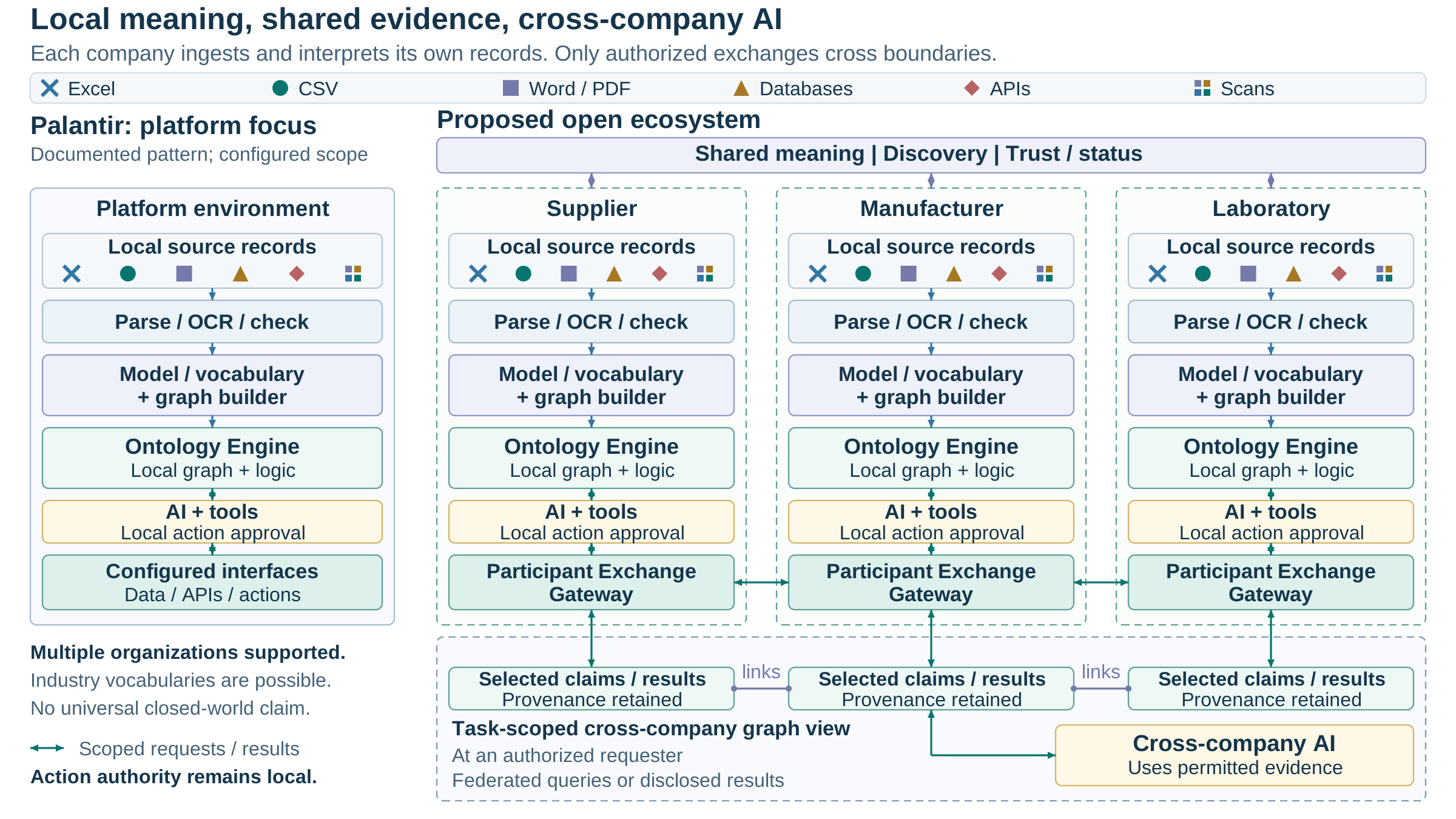
Executive Brief Figure 1, PDF page 4
SVG PDF PNG
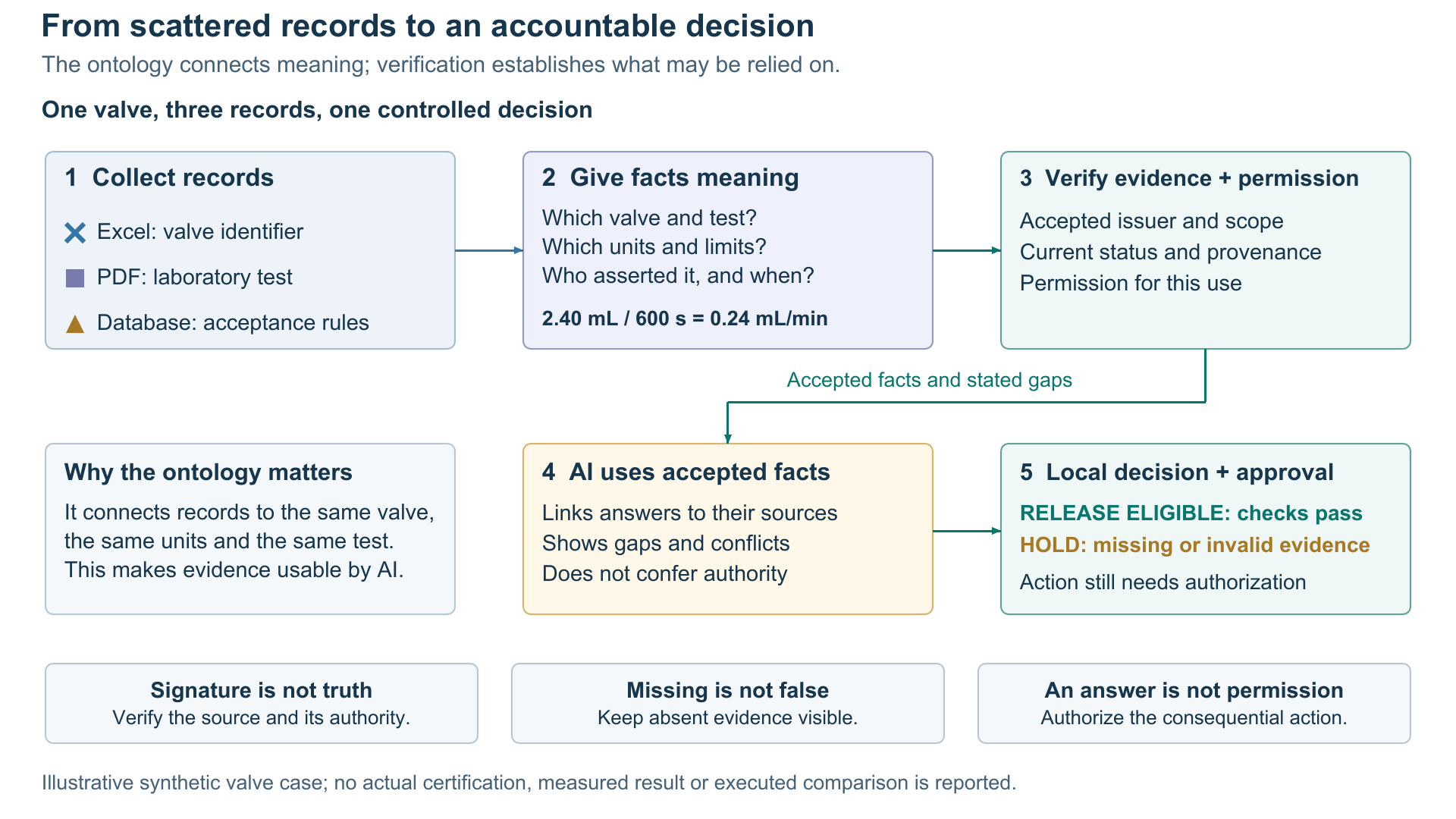
From records to meaning, evidence and governed decisions
- A knowledge graph connects identifiable things and claims using labelled relationships: this component belongs to this configuration; this report concerns this test.
- An evidence graph adds the supporting records, origin, interpretation, status and conditions under which a claim can be used.
- An assurance graph connects claims, evidence and reasoning to a bounded assurance argument. A signature establishes specific integrity/origin properties when verified; it does not establish physical truth, safety or legal acceptance.
Well-maintained graphs can help retrieve the relevant facts, preserve provenance, reuse explicit checks and show which decisions depend on changing evidence. This can reduce repeated document extraction, irrelevant prompt context and unsupported answers. Whether it reduces tokens, latency, cost or risk must be measured on the actual task, including graph maintenance, distributed retrieval and verification overhead. Graphs are not required for every AI task and do not eliminate hallucinations.
Open-world semantics allows knowledge to be incomplete: an unavailable report is not proof that it never existed or that the product failed. A bounded operational rule can still require accepted evidence before authorizing action. Open semantics does not mean public data or unrestricted access.
What changes when one test report is withdrawn?
Select a record in this fictional humanoid robot example to follow its relationships across a supplier, laboratory, manufacturer and operator. The graph connects components, configuration, test assertions, original reports, scoped authority and operational events. It makes the evidence behind a decision inspectable. It also shows where information is missing or a fresh review is required.
Fictional educational demonstration · Model 0.1.0 · 1 November 2026. All records are pre-disclosed. Filters and scenario controls illustrate the architecture; they do not enforce access control, verify signatures, run an AI model or establish regulatory compliance.
The interactive view needs JavaScript. The complete walkthrough, figure and records below remain available.
Humanoid H-01: follow the evidence
Evidence, sources and access conditions
What people and AI can do with these links
| People and software | Practical value to test |
|---|---|
| Locate the exact configuration and retrieve permitted facts | Less repeated extraction; smaller relevant prompt context |
| Follow sources, check scope and apply explicit rules | Fewer unsupported claims; more reviewable decisions |
| Trace a changed component or withdrawn report | Targeted reassessment, incident response and recovery |
| Reuse evidence across separate assessment scopes | Less duplicate work; faster commissioning and product changes |
| Record accepted premises, conditions and local approval | Accountable automation; measurable cost and time to market |
Follow the evidence: a static walkthrough
- Start with Configuration R3 (M02) of fictional humanoid H-01 (M01), performing nonmedical picking task TP-PICK (M03).
- Follow test assertion TA42 (L01) to its original report TR42 (L02), test method and laboratory scope. A report, an assertion and a release decision are different records.
- Follow release claim RC3 (M04) and the illustrative acceptance rule AR1 (M05). The rule requires current test support for the proposed decision.
- In the default Withdrawn scenario, TR42 is no longer accepted as a current premise under AR1. RC3 becomes HOLD, and dependent assessment/work-order records require review. Preserve the historical report and unrelated records. HOLD does not establish that the robot is unsafe or legally noncompliant.
- Switching to Available for review leads to REVIEW, not an automatic approval. The responsible actor still checks scope, conditions, permission and other evidence.
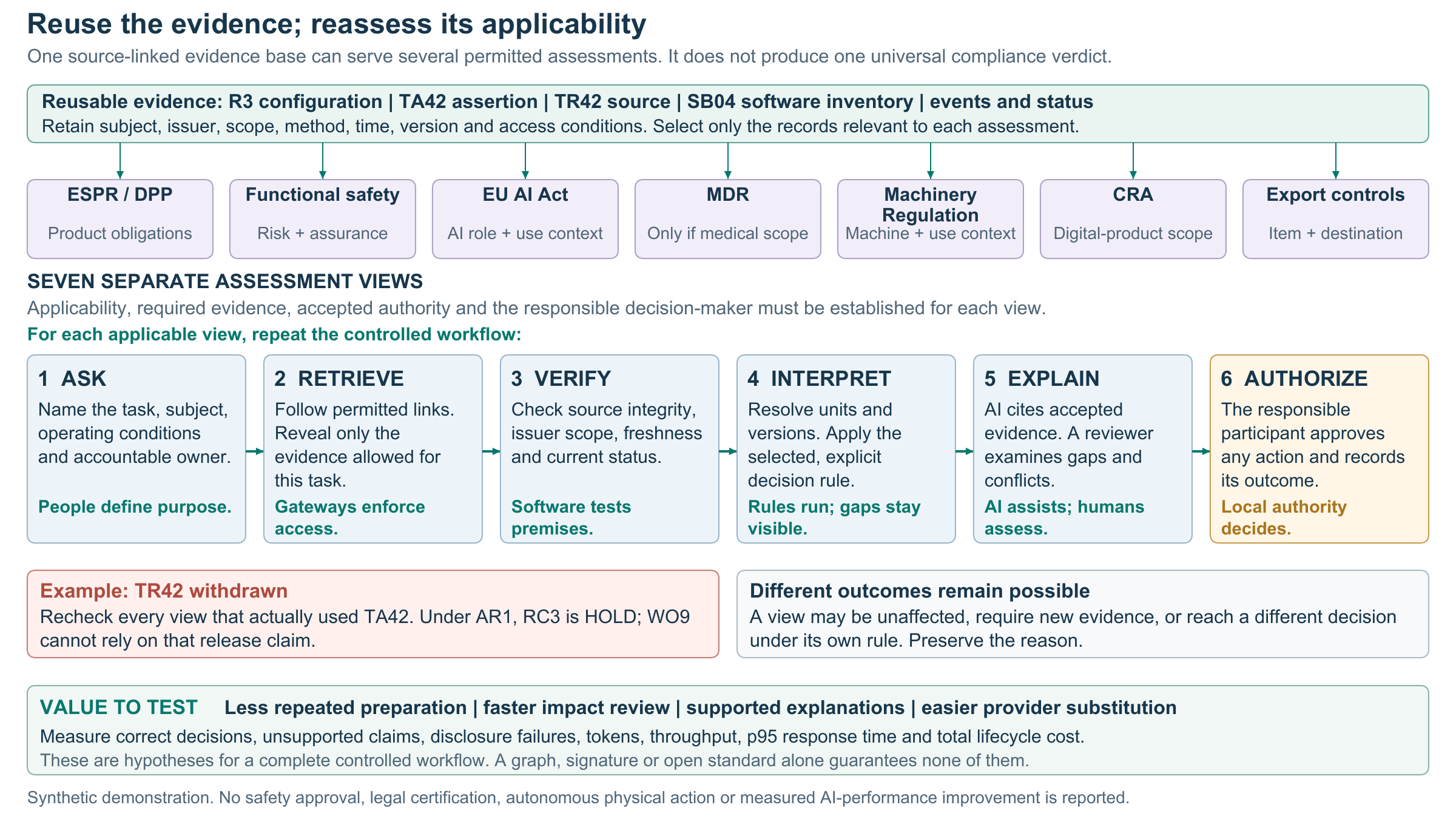
- Change the assessment lens to see different questions. A record can contribute to several assessments without creating one universal certificate or verdict.
The seven lenses are ESPR/DPP, functional safety, EU AI Act, MDR medical branch, Machinery Regulation, Cyber Resilience Act and export controls. These are not seven universally applicable duties. Product scope, intended use, dutyholder, jurisdiction and dates need separate assessment. This is not an exhaustive legal inventory.
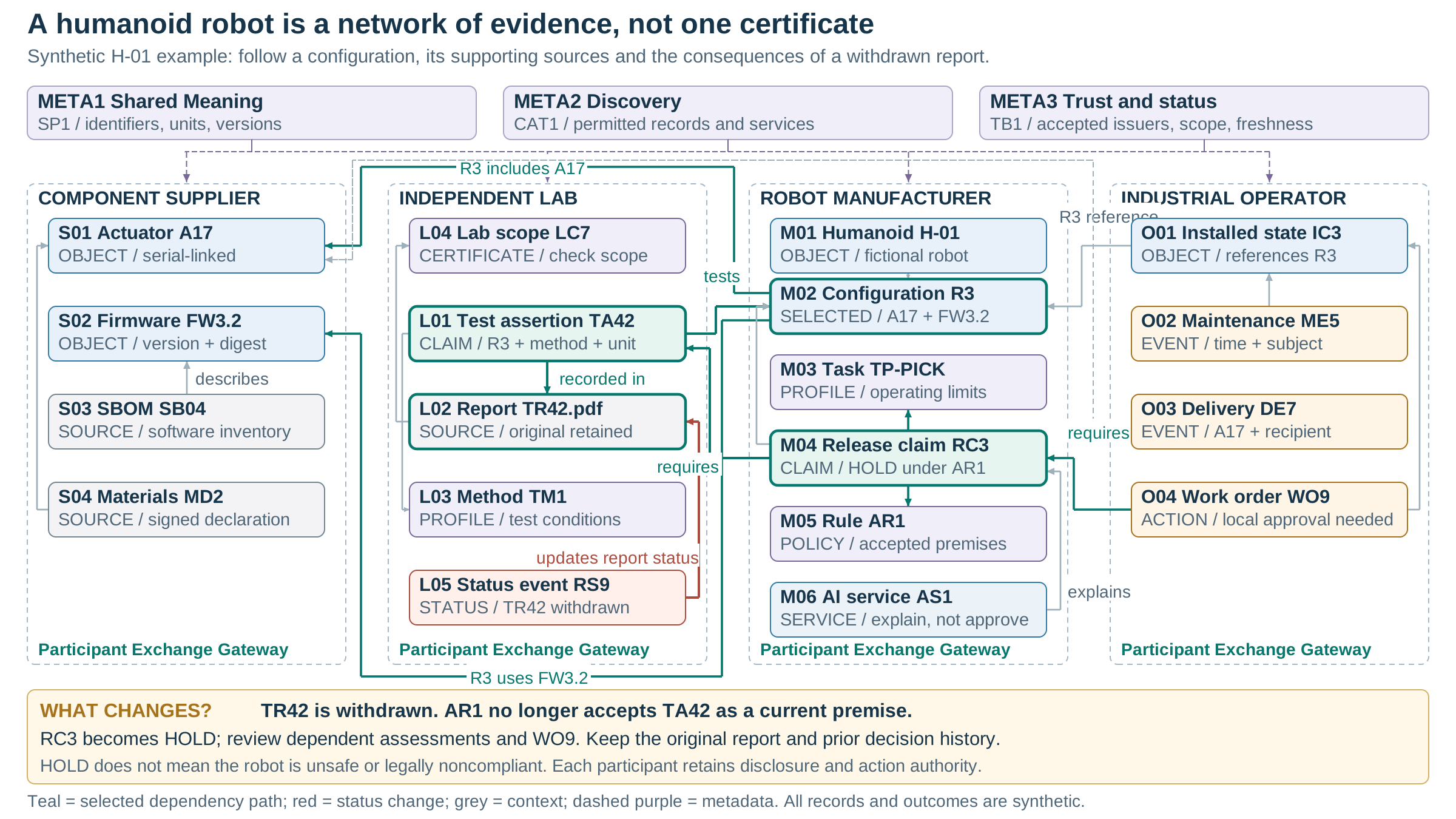
Academic Figure 6, PDF page 23 · Executive Brief Figure 3, PDF page 8
SVG PDF PNG
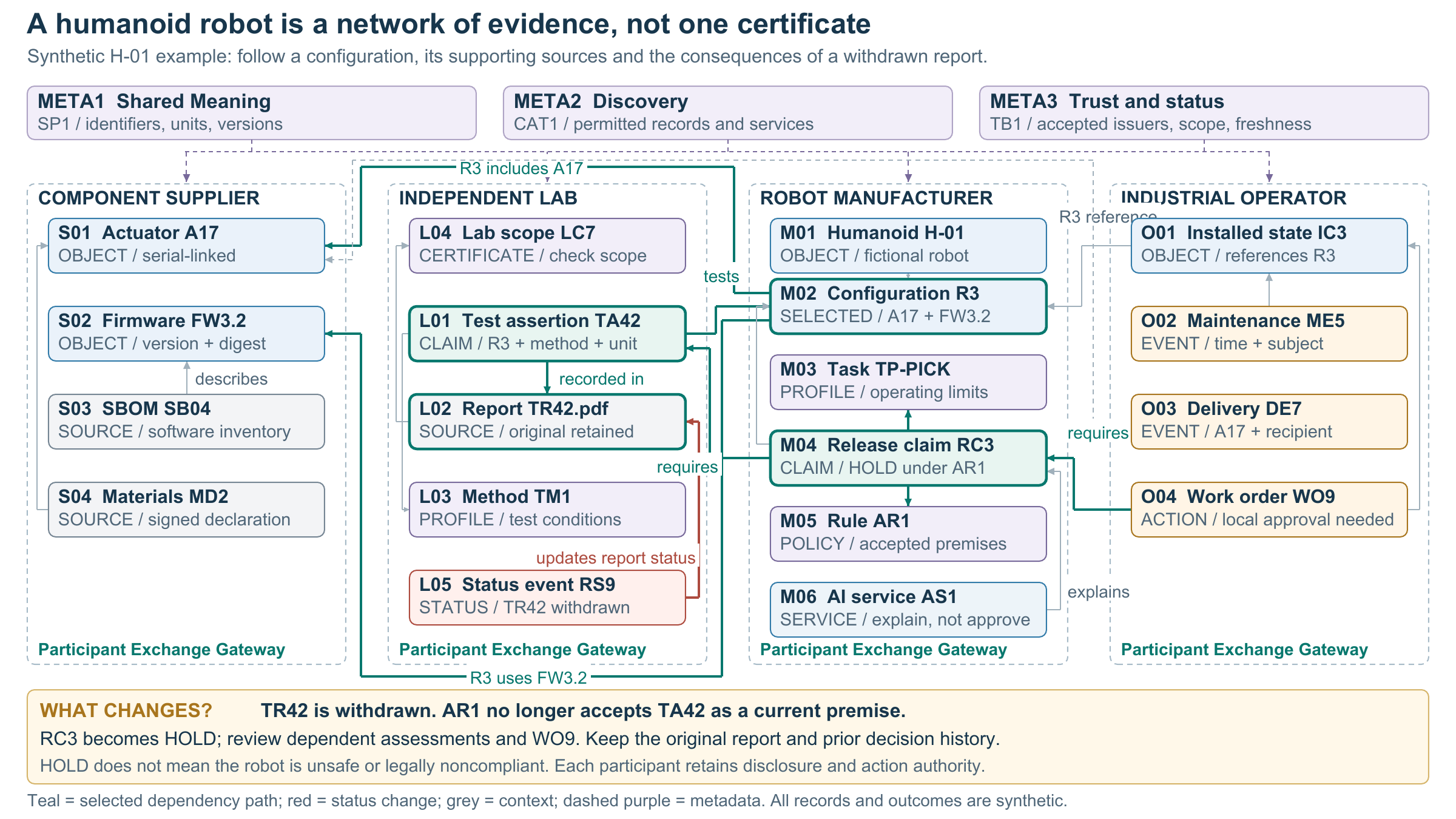
Download the authoritative graph model (JSON, 0.1.0). All four participants connect to Shared Meaning (META1), Discovery (META2) and Trust/status (META3). Cross-boundary relationships are logical references, not unrestricted data flows. The teaching dependency projection is separate from the 20 typed relationships; it does not prove causation or legal invalidation.
All 22 fictional records and their evidence conditions
S01 · Actuator A17 · Component supplier
- type
- entity
- claim
- Physical component, serial A17. Claims must identify the component and version actually installed.
- limit
- Asset identity; not a safety certificate.
- source_kind
- synthetic teaching record
- version
- 0.1
- signature
- Not cryptographically checked in this demonstration
- access
- Pre-disclosed example; a real query requires task-scoped authorization
- status
- Illustrative
- owner
- Component supplier
S02 · Firmware FW3.2 · Component supplier
- type
- entity
- claim
- Versioned software installed on actuator A17. An update requires a fresh assessment of which evidence still applies.
- limit
- Version identity; no automatic transfer of a previous test result.
- source_kind
- synthetic teaching record
- version
- 0.1
- signature
- Not cryptographically checked in this demonstration
- access
- Pre-disclosed example; a real query requires task-scoped authorization
- status
- Illustrative
- owner
- Component supplier
S03 · Software inventory SB04 · Component supplier
- type
- document
- claim
- Machine-readable software bill of materials for FW3.2, including dependency identifiers and versions.
- limit
- Inventory completeness and vulnerability relevance still require checks.
- source_kind
- synthetic teaching record
- version
- 0.1
- signature
- Not cryptographically checked in this demonstration
- access
- Pre-disclosed example; a real query requires task-scoped authorization
- status
- Illustrative
- owner
- Component supplier
S04 · Material declaration MD2 · Component supplier
- type
- document
- claim
- Supplier assertion about the identified component or batch, retained with its source and issuer.
- limit
- A signed claim is attributable, not automatically true.
- source_kind
- synthetic teaching record
- version
- 0.1
- signature
- Not cryptographically checked in this demonstration
- access
- Pre-disclosed example; a real query requires task-scoped authorization
- status
- Illustrative
- owner
- Component supplier
L01 · Test-result assertion TA42 · Independent laboratory
- type
- assertion
- claim
- The tested configuration met the selected criterion under method TM1 and task conditions TP-PICK. This is a fictional, bounded result.
- limit
- Subject, method, conditions and current admissibility must match.
- source_kind
- synthetic teaching record
- version
- 0.1
- signature
- Not cryptographically checked in this demonstration
- access
- Pre-disclosed example; a real query requires task-scoped authorization
- status
- Illustrative
- owner
- Independent laboratory
L02 · Original test report TR42 · Independent laboratory
- type
- document
- claim
- Original fictional PDF from which TA42 was extracted. Its source identity and history remain available after withdrawal.
- limit
- Demonstration only; no real report or signature is supplied.
- source_kind
- synthetic teaching record
- version
- 0.1
- signature
- Not cryptographically checked in this demonstration
- access
- Pre-disclosed example; a real query requires task-scoped authorization
- status
- Illustrative
- owner
- Independent laboratory
L03 · Test-method profile TM1 · Independent laboratory
- type
- policy
- claim
- Defines measurement units, test procedure, operating conditions and acceptance criterion for the example.
- limit
- A method profile is not accreditation or product certification.
- source_kind
- synthetic teaching record
- version
- 0.1
- signature
- Not cryptographically checked in this demonstration
- access
- Pre-disclosed example; a real query requires task-scoped authorization
- status
- Illustrative
- owner
- Independent laboratory
L04 · Laboratory scope certificate LC7 · Independent laboratory
- type
- certificate
- claim
- Illustrative credential identifying a laboratory and the scope for which the verifier accepts its evidence.
- limit
- Certificate authenticity, scope, expiry and issuer acceptance are separate checks.
- source_kind
- synthetic teaching record
- version
- 0.1
- signature
- Not cryptographically checked in this demonstration
- access
- Pre-disclosed example; a real query requires task-scoped authorization
- status
- Illustrative
- owner
- Independent laboratory
L05 · Report-status event RS9 · Independent laboratory
- type
- event
- claim
- In the withdrawn branch, a later event withdraws TR42 from current reliance. The available branch is an alternative scenario before that withdrawal; it does not erase the historical report.
- limit
- The receiving participant must obtain current status within its declared freshness bound. No safety verdict follows from withdrawal alone.
- source_kind
- synthetic teaching record
- version
- 0.1
- signature
- Not cryptographically checked in this demonstration
- access
- Pre-disclosed example; a real query requires task-scoped authorization
- status
- Illustrative
- owner
- Independent laboratory
M01 · Humanoid robot H-01 · Robot manufacturer
- type
- entity
- claim
- Fictional industrial humanoid used to explain evidence reuse. Its intended task is non-medical material handling.
- limit
- No real manufacturer, product performance or endorsement is implied.
- source_kind
- synthetic teaching record
- version
- 0.1
- signature
- Not cryptographically checked in this demonstration
- access
- Pre-disclosed example; a real query requires task-scoped authorization
- status
- Illustrative
- owner
- Robot manufacturer
M02 · Robot configuration R3 · Robot manufacturer
- type
- entity
- claim
- The specific robot, actuator, firmware and task configuration being assessed.
- limit
- A graph connection does not transfer a certificate to a new configuration.
- source_kind
- synthetic teaching record
- version
- 0.1
- signature
- Not cryptographically checked in this demonstration
- access
- Pre-disclosed example; a real query requires task-scoped authorization
- status
- Illustrative
- owner
- Robot manufacturer
M03 · Task and operating conditions TP-PICK · Robot manufacturer
- type
- policy
- claim
- A bounded industrial picking task with specified workspace, payload, speed and supervision. Values are deliberately unspecified.
- limit
- New intended uses or operating conditions require applicability review.
- source_kind
- synthetic teaching record
- version
- 0.1
- signature
- Not cryptographically checked in this demonstration
- access
- Pre-disclosed example; a real query requires task-scoped authorization
- status
- Illustrative
- owner
- Robot manufacturer
M04 · Bounded release claim RC3 · Robot manufacturer
- type
- assertion
- claim
- A proposed assurance claim for the selected configuration and task, supported by explicit accepted premises.
- limit
- This is neither a universal compliance certificate nor permission to operate.
- source_kind
- synthetic teaching record
- version
- 0.1
- signature
- Not cryptographically checked in this demonstration
- access
- Pre-disclosed example; a real query requires task-scoped authorization
- status
- Illustrative
- owner
- Robot manufacturer
M05 · Manufacturer approval rule AR1 · Robot manufacturer
- type
- policy
- claim
- The example rule requires a current, applicable test result. Withdrawal of its only accepted report produces HOLD pending reassessment.
- limit
- Author-created teaching rule; not a claim about a legal approval procedure.
- source_kind
- synthetic teaching record
- version
- 0.1
- signature
- Not cryptographically checked in this demonstration
- access
- Pre-disclosed example; a real query requires task-scoped authorization
- status
- Illustrative
- owner
- Robot manufacturer
M06 · AI evidence-assistant service AS1 · Robot manufacturer
- type
- entity
- claim
- A versioned virtual service that can retrieve permitted evidence, follow links and prepare source-linked explanations.
- limit
- The visualization runs deterministic rules; no live AI model or action authority is attached.
- source_kind
- synthetic teaching record
- version
- 0.1
- signature
- Not cryptographically checked in this demonstration
- access
- Pre-disclosed example; a real query requires task-scoped authorization
- status
- Illustrative
- owner
- Robot manufacturer
O01 · Installed configuration IC3 · Industrial operator
- type
- entity
- claim
- The operator records which physical robot and software configuration are actually installed.
- limit
- Installation identity and operational context must match the assessed configuration.
- source_kind
- synthetic teaching record
- version
- 0.1
- signature
- Not cryptographically checked in this demonstration
- access
- Pre-disclosed example; a real query requires task-scoped authorization
- status
- Illustrative
- owner
- Industrial operator
O02 · Maintenance event ME5 · Industrial operator
- type
- event
- claim
- A lifecycle event records work on the installed configuration and may trigger targeted reassessment.
- limit
- An event can invalidate assumptions without invalidating every certificate.
- source_kind
- synthetic teaching record
- version
- 0.1
- signature
- Not cryptographically checked in this demonstration
- access
- Pre-disclosed example; a real query requires task-scoped authorization
- status
- Illustrative
- owner
- Industrial operator
O03 · Supply-chain delivery event DE7 · Industrial operator
- type
- event
- claim
- Receipt of the identified component connects its supplier provenance to the operator lifecycle.
- limit
- Custody, origin, export classification and permitted end use remain distinct questions.
- source_kind
- synthetic teaching record
- version
- 0.1
- signature
- Not cryptographically checked in this demonstration
- access
- Pre-disclosed example; a real query requires task-scoped authorization
- status
- Illustrative
- owner
- Industrial operator
O04 · Work order WO9 · Industrial operator
- type
- document
- claim
- A request to use the installed robot for the specified task. It needs local authorization as well as accepted evidence.
- limit
- The graph cannot grant legal or operational authority by itself.
- source_kind
- synthetic teaching record
- version
- 0.1
- signature
- Not cryptographically checked in this demonstration
- access
- Pre-disclosed example; a real query requires task-scoped authorization
- status
- Illustrative
- owner
- Industrial operator
META1 · Shared semantic profile SP1 · Multiple independently governed metadata services
- type
- policy
- claim
- Versioned industry definitions, identifiers, units and mappings make assertions interpretable across participants.
- limit
- Open standards need maintained profiles, mappings and conformance tests.
- source_kind
- synthetic teaching record
- version
- 0.1
- signature
- Not cryptographically checked in this demonstration
- access
- Pre-disclosed example; a real query requires task-scoped authorization
- status
- Illustrative
- owner
- Multiple independently governed metadata services
META2 · Permitted evidence catalogue CAT1 · Multiple independently governed metadata services
- type
- document
- claim
- Authorized discovery of relevant evidence and services. Restricted existence and metadata must also be protected.
- limit
- The visible demo contains only pre-disclosed fictional metadata.
- source_kind
- synthetic teaching record
- version
- 0.1
- signature
- Not cryptographically checked in this demonstration
- access
- Pre-disclosed example; a real query requires task-scoped authorization
- status
- Illustrative
- owner
- Multiple independently governed metadata services
META3 · Issuer, scope and status bundle TB1 · Multiple independently governed metadata services
- type
- certificate
- claim
- Accepted issuer references, credential scopes and current status information support local verification.
- limit
- Signatures, authority, freshness, applicability and permission are independent dimensions.
- source_kind
- synthetic teaching record
- version
- 0.1
- signature
- Not cryptographically checked in this demonstration
- access
- Pre-disclosed example; a real query requires task-scoped authorization
- status
- Illustrative
- owner
- Multiple independently governed metadata services
All 20 typed relationships
| Source record | Relationship | Target record |
|---|---|---|
| M01 | has configuration | M02 |
| M02 | includes | S01 |
| M02 | uses | S02 |
| S03 | describes | S02 |
| S04 | concerns | S01 |
| L01 | tests | M02 |
| L01 | recorded in | L02 |
| L01 | used method | L03 |
| L02 | issued under | L04 |
| L05 | updates status of | L02 |
| M04 | assesses | M02 |
| M04 | for task | M03 |
| M04 | applies | M05 |
| M04 | requires | L01 |
| M06 | explains | M04 |
| O01 | instantiates | M02 |
| O02 | concerns | O01 |
| O03 | delivers | S01 |
| O04 | requests use of | O01 |
| O04 | requires | M04 |
Seven separate assessment lenses and scope limits
ESPR / DPP
Can product identity, materials and lifecycle claims be traced? ESPR DPP duties depend on applicable product measures and dates; a humanoid does not automatically require an ESPR DPP.
Functional safety
Does accepted evidence support this configuration in this task? Functional safety is a discipline and assurance task. A single test result does not establish system safety.
EU AI Act
What is the AI function, intended use and applicable assurance route? Classification, duty holder and sectoral route require assessment; a robot or AI assistant is not automatically high-risk.
MDR · medical branch
Would a medical intended purpose change the required evidence? The base case is non-medical. A medical variant would require its own classification, clinical evidence and conformity route; these are not supplied here.
Machinery Regulation
Which risk assessment, technical documentation and conformity route apply? Check the placing-on-market date and applicable machinery regime. The figure does not grant conformity or CE marking.
Cyber Resilience Act
Which software, vulnerabilities, support duties and incidents matter? Determine product scope, exclusions and staged duties. An SBOM is useful evidence, not a complete CRA assurance case.
Export controls
What classification, destination, end user and end use must be checked? No automatic licence requirement follows from the word robot. List entries, catch-all provisions and other relevant restrictions need case-specific review.
Fast-track modernisation for AI-first workloads
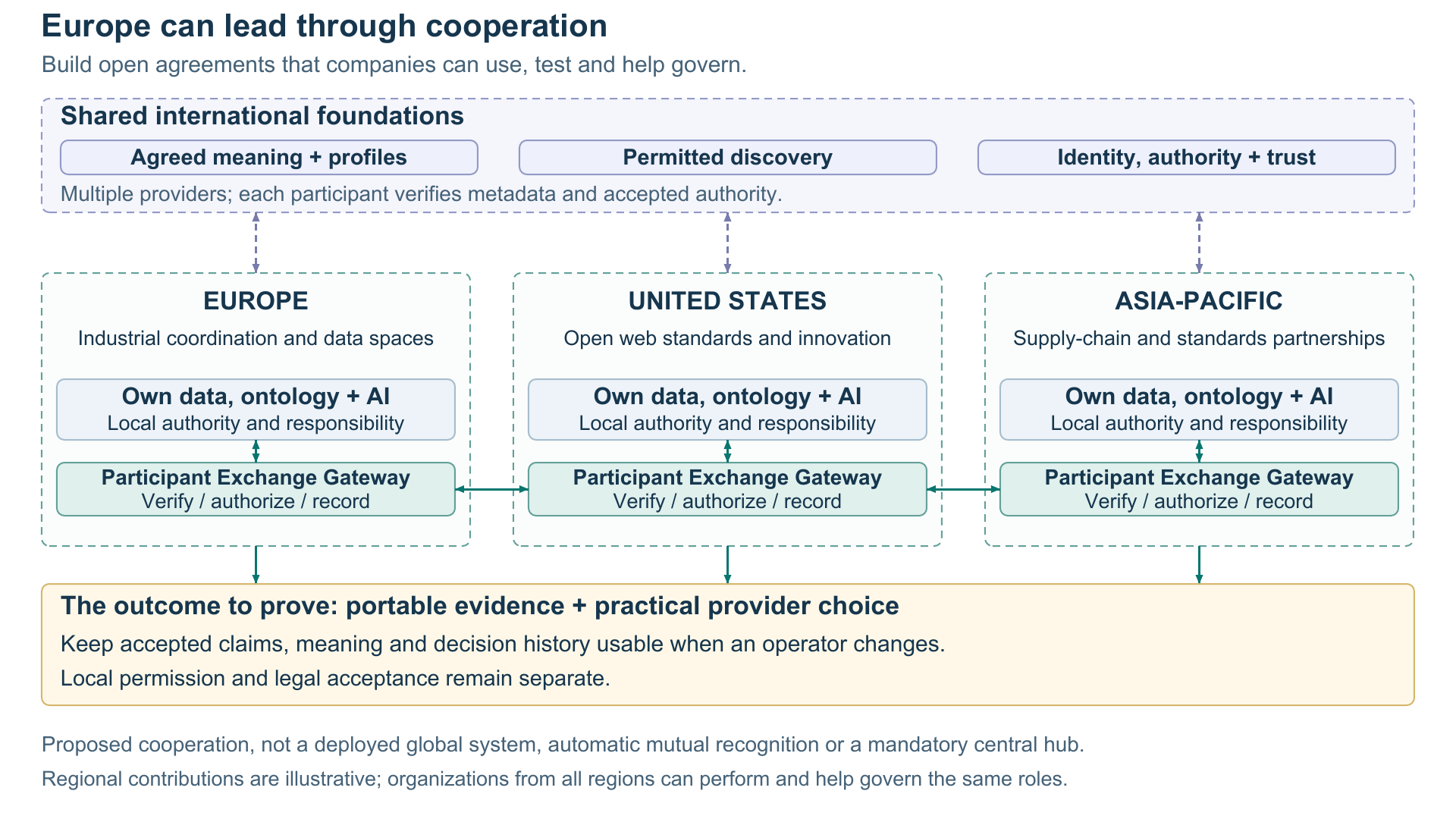
Europe’s dataspace work is a foundation for coordination and experimentation. It is not evidence that current implementations already satisfy IPCEI-AI or frontier-AI throughput, latency and volume requirements. The goal is fast-track modernisation without relaxing access control, verifiability or participant authority. Retain components that pass defined tests.
The meta-platform argument is participant-controlled cooperation across platforms. It does not imply a proven exponential network-value law, guaranteed GDP uplift or automatic efficiency gains from decentralization. Shared vocabulary, discovery or trust operators can themselves become concentration points; credible substitution and continuity need testing.
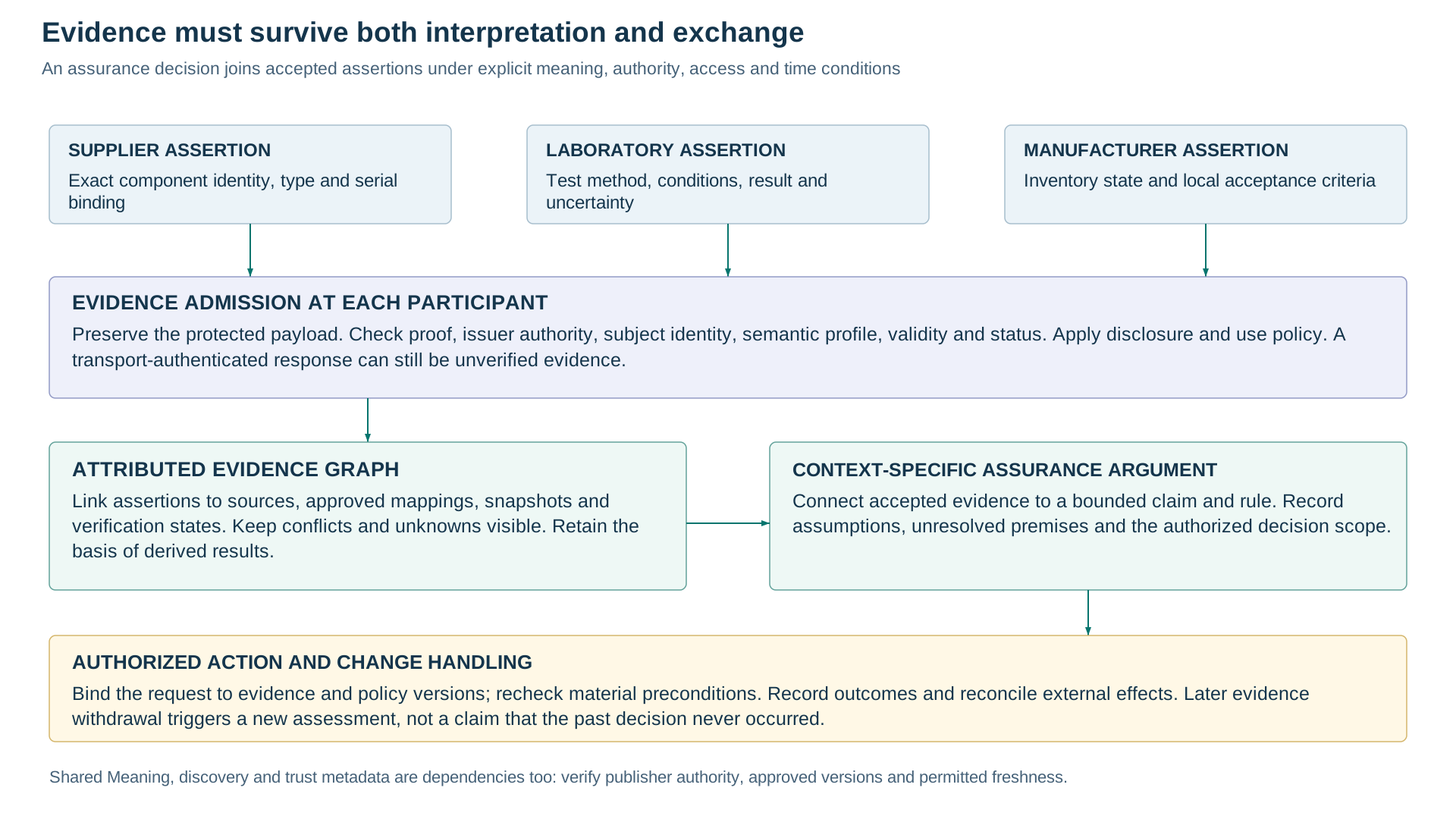
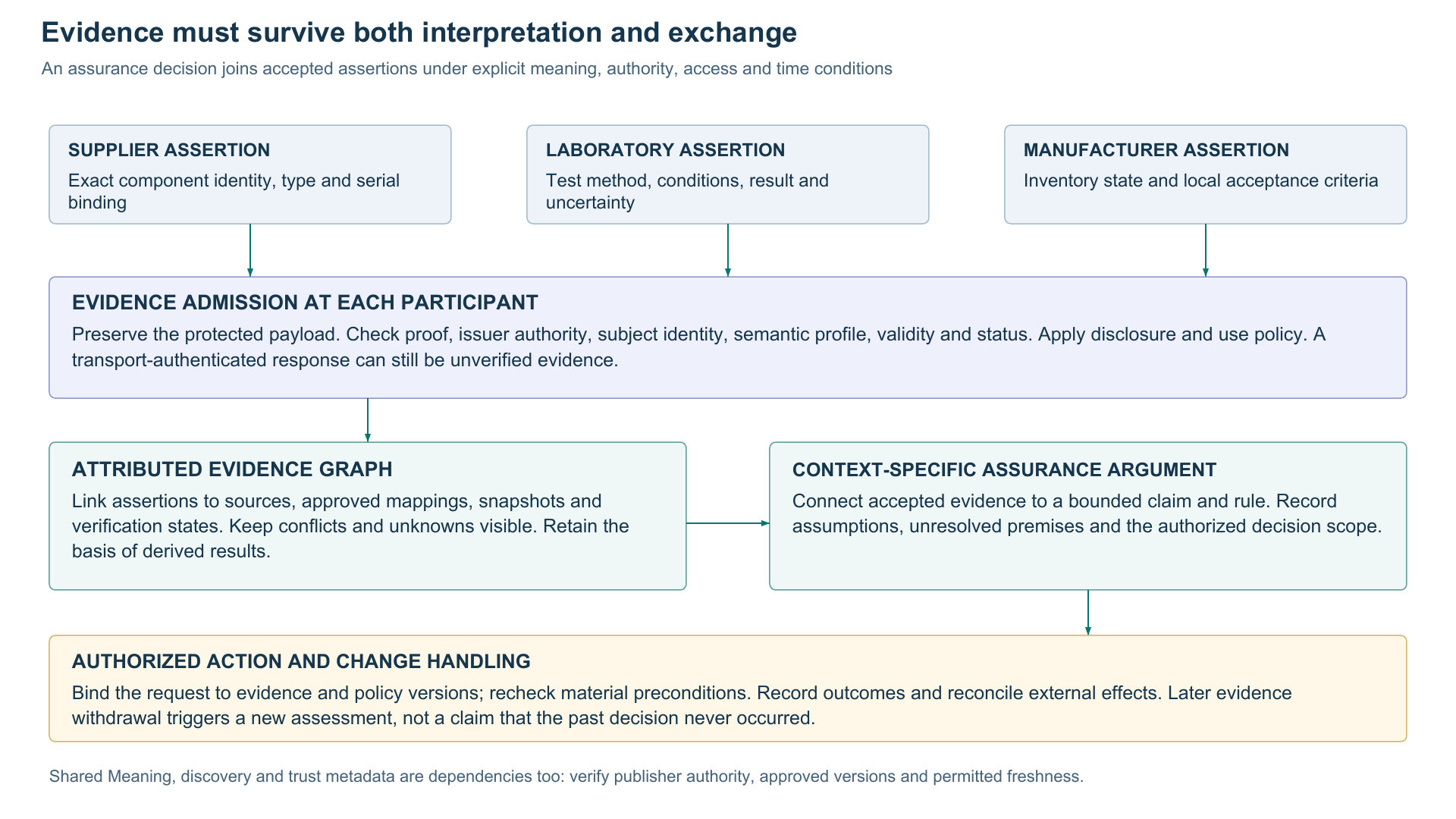
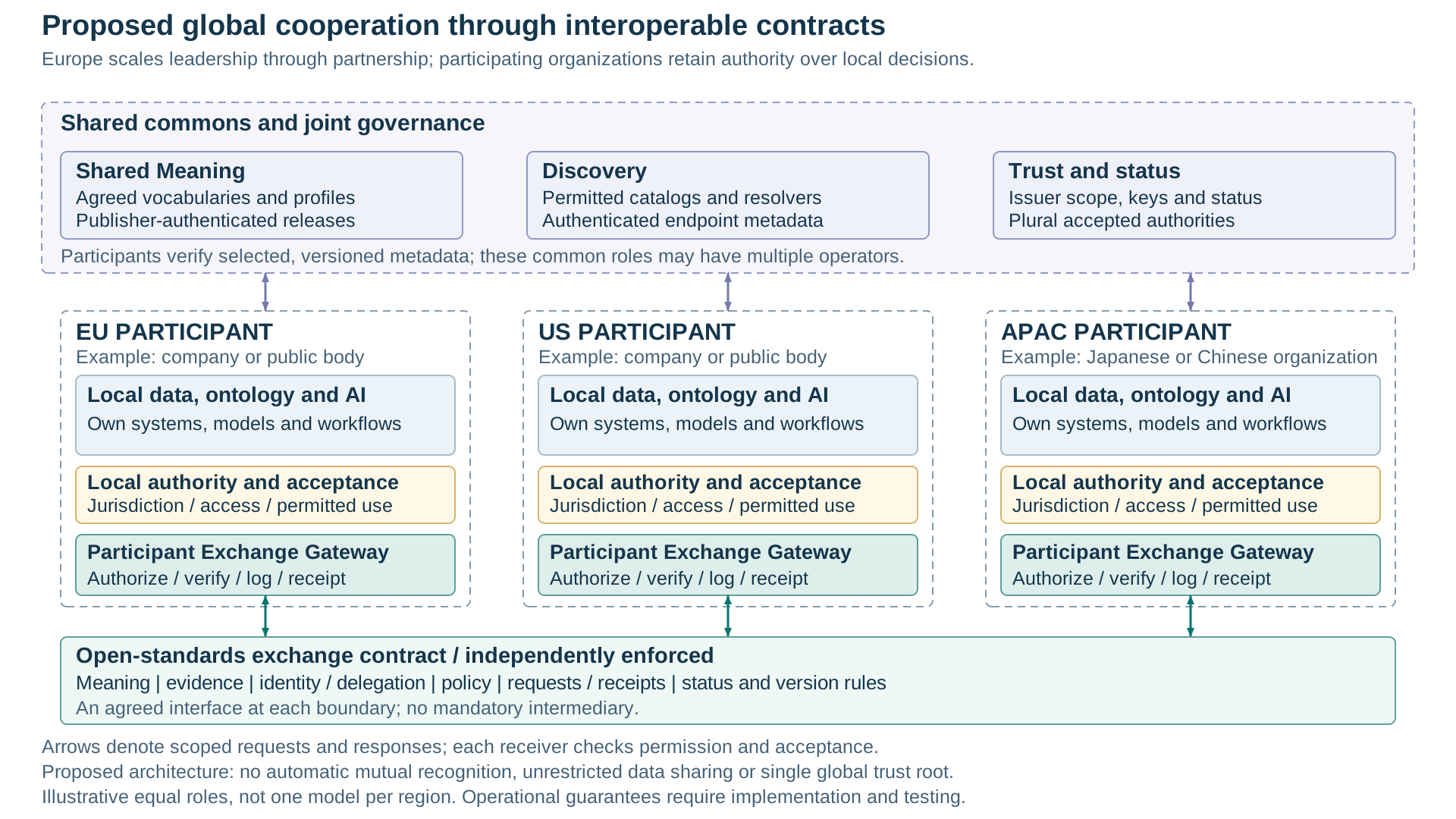
A Participant Exchange Gateway manages permitted exchanges. A dataspace connector built with Eclipse Dataspace Components is one implementation option for its exchange functions, complemented by identity, evidence verification and action authorization. Shared Meaning provides semantic and vocabulary-hub functions. These are logical shared roles, potentially with several providers. Every participant connects to Shared Meaning, Discovery and Trust/status.
ODRL is a policy-expression standard used in dataspace implementations, and EDC provides a reference implementation of policy evaluation. Neither ODRL nor a connector alone is a universal, complete enforcement or legal-recognition mechanism. Shared vocabularies, catalogues, resolvers and trust metadata also need authenticated publication, integrity checks, scoped access and explicit freshness bounds. Cached or ledger-backed information does not remove freshness or accepted-authority decisions.
Europe as a global convener
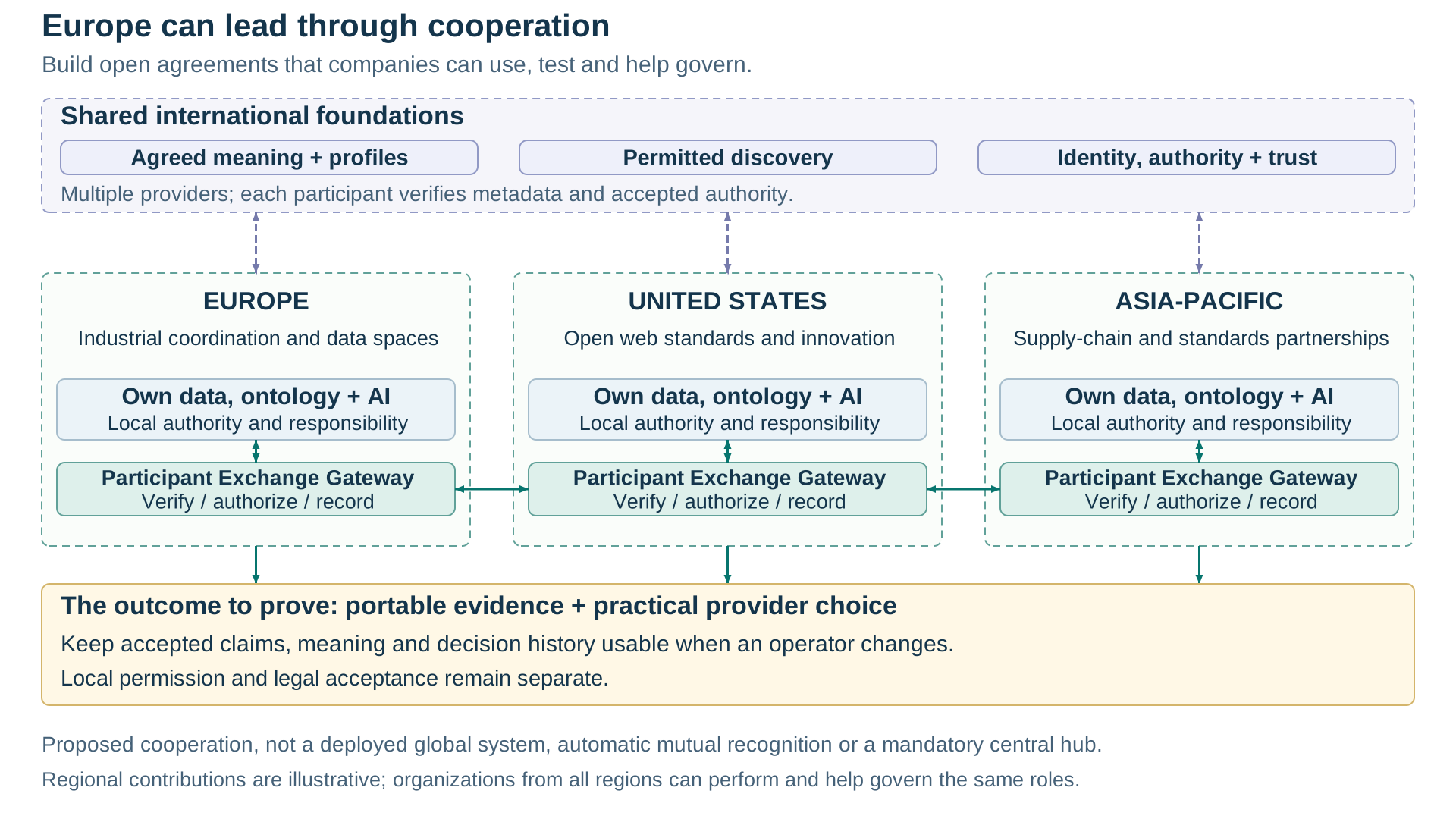
Europe can turn its experience in industrial dataspaces into a globally collaborative offer. The next step is shared implementation profiles, joint testing and accountable recognition arrangements with international partners. W3C work, UNECE traceability initiatives, US innovation and Asia-Pacific programmes provide relevant cooperation channels. Technical interoperability, accepted issuer authority and legal recognition are separate achievements; a technical connection does not establish all three.
Figure library: 12 originals, 14 paper placements
All 12 figures are available as SVG, vector PDF and PNG. The downloads include descriptive and licensing metadata; the artwork is unchanged. The two robot figures appear in both papers and have one public copy each. Open a full-size diagram to inspect small labels.
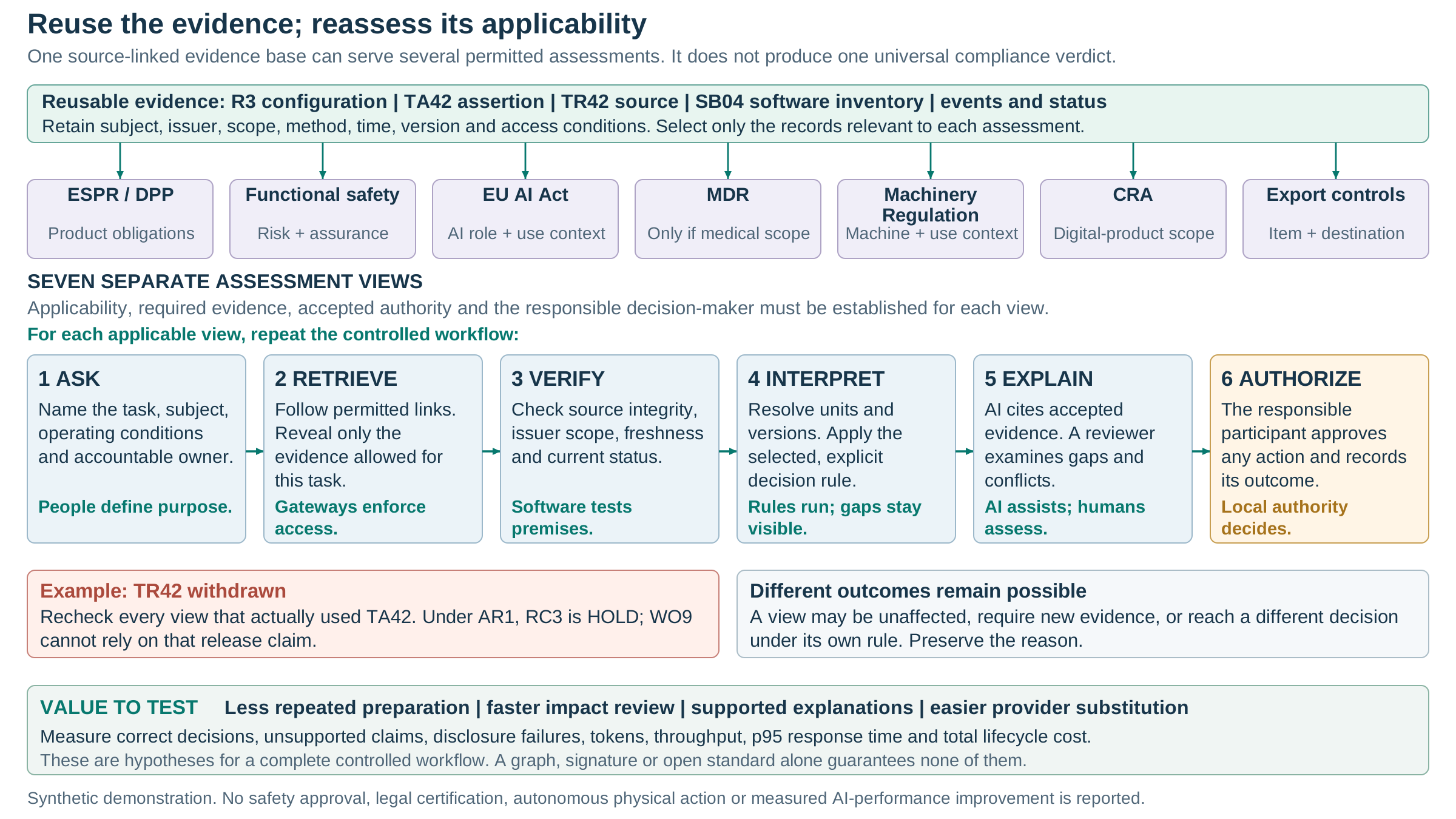
Academic Figure 7, PDF page 25 · Executive Brief Figure 4, PDF page 10
SVG PDF PNG
Academic Figure 1, PDF page 10
SVG PDF PNG
Academic Figure 2, PDF page 12
SVG PDF PNG
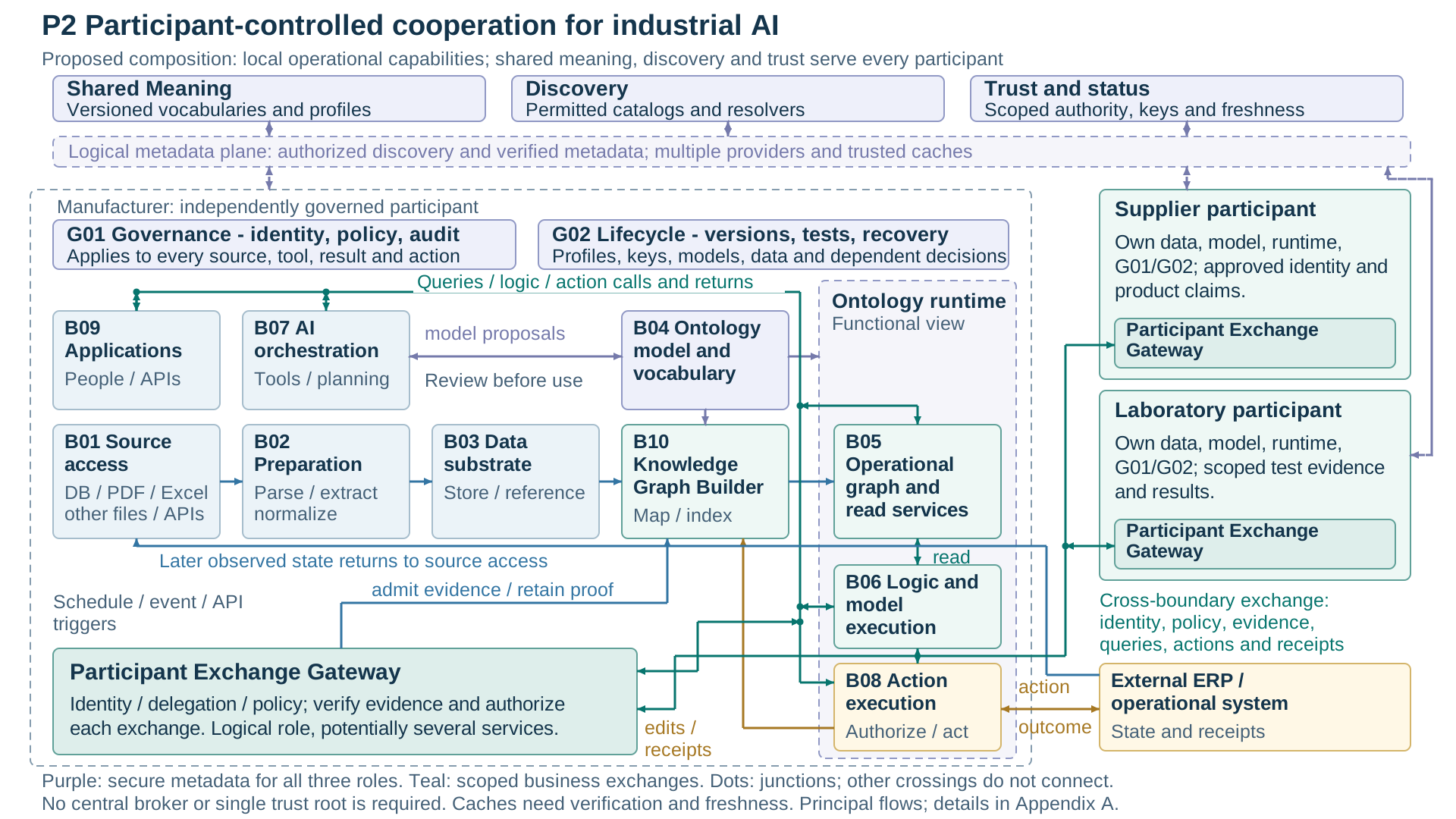
Academic Figure 3, PDF page 14
SVG PDF PNG
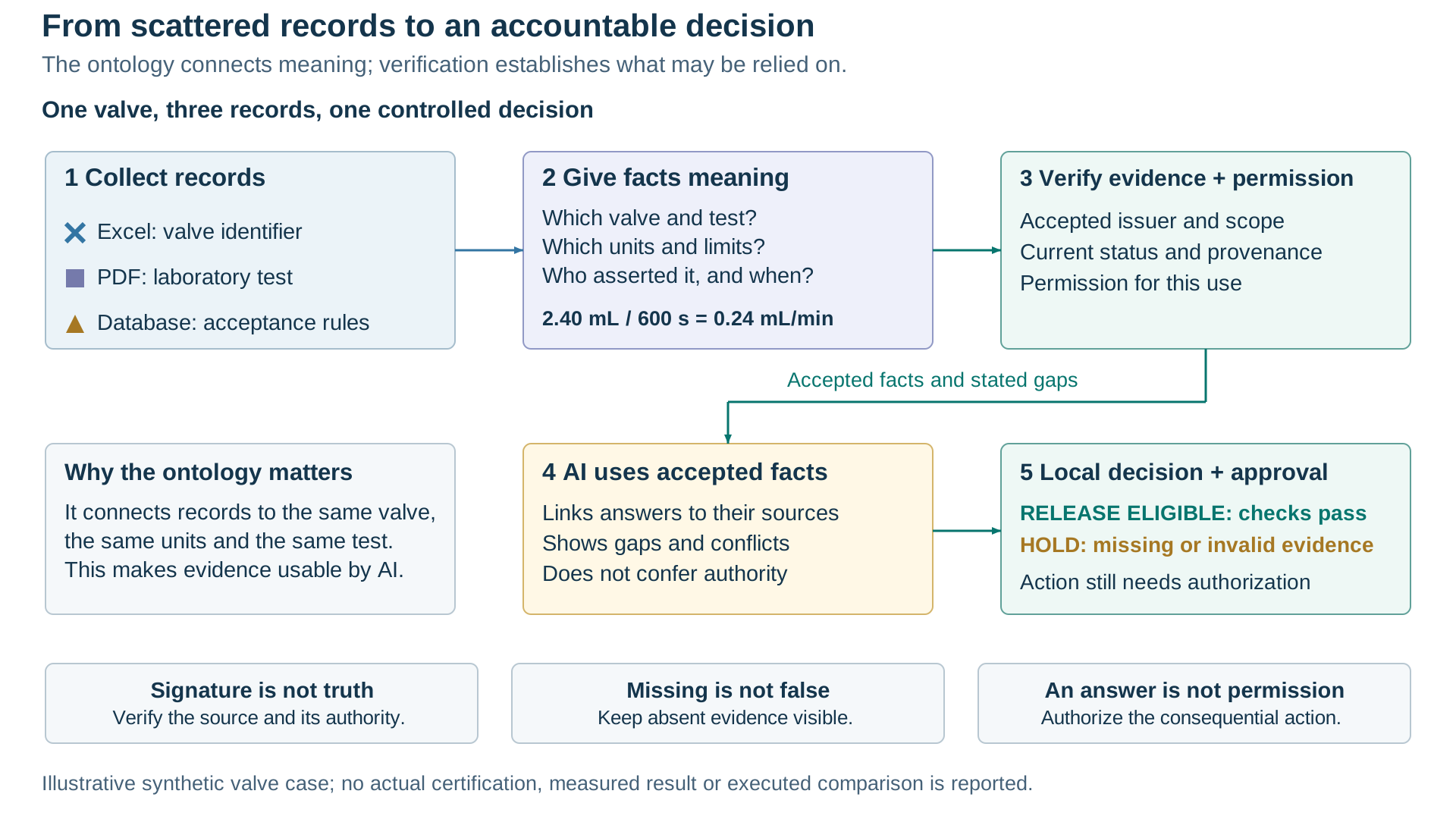
Executive Brief Figure 2, PDF page 6
SVG PDF PNG
Academic Figure 5, PDF page 21
SVG PDF PNG
Academic Figure 4, PDF page 18
SVG PDF PNG
Academic Figure 8, PDF page 33
SVG PDF PNG
Executive Brief Figure 5, PDF page 14
SVG PDF PNG
Academic Figure 9, PDF page 41
SVG PDF PNG
Build a bounded first-mover experiment
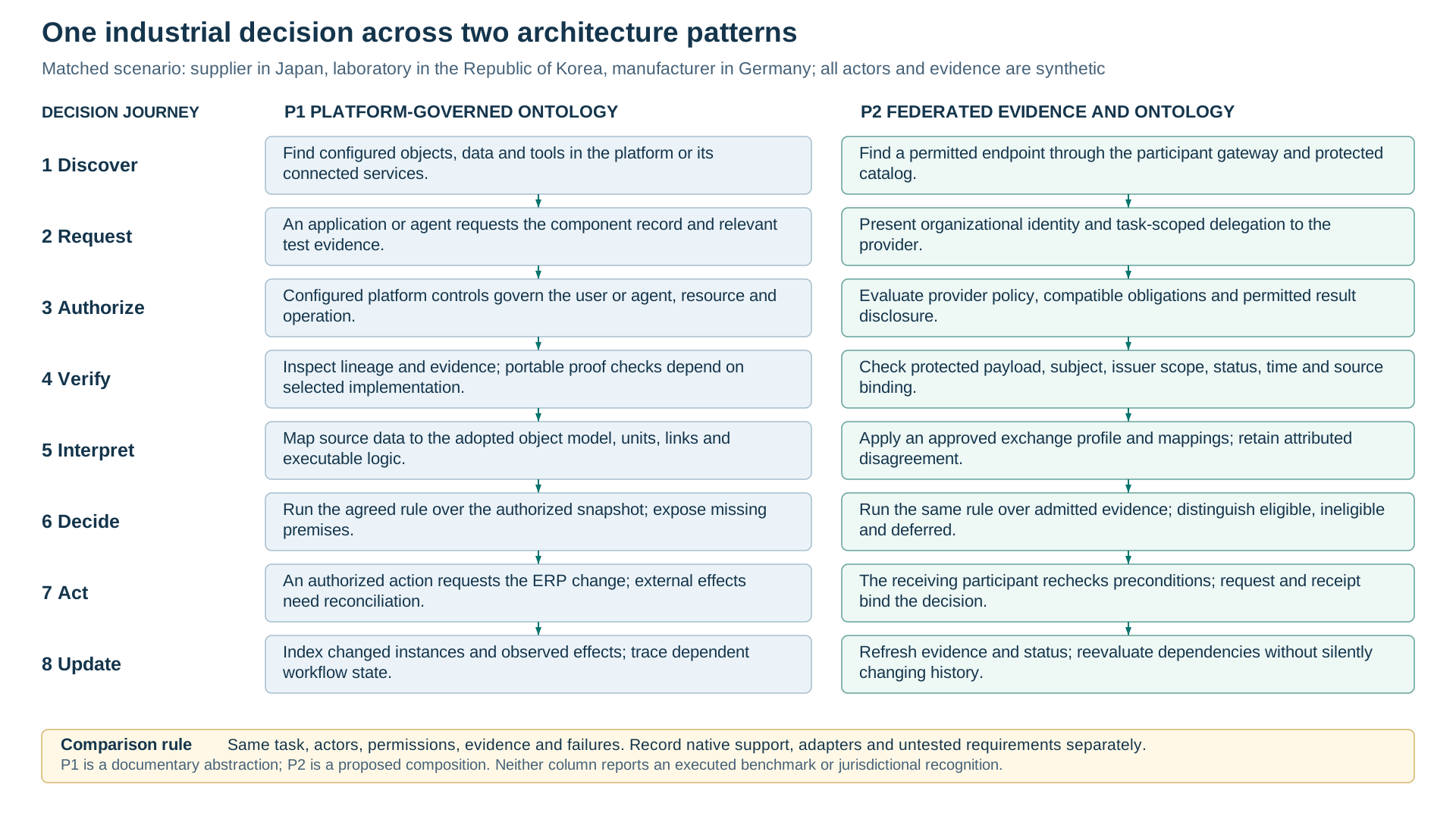
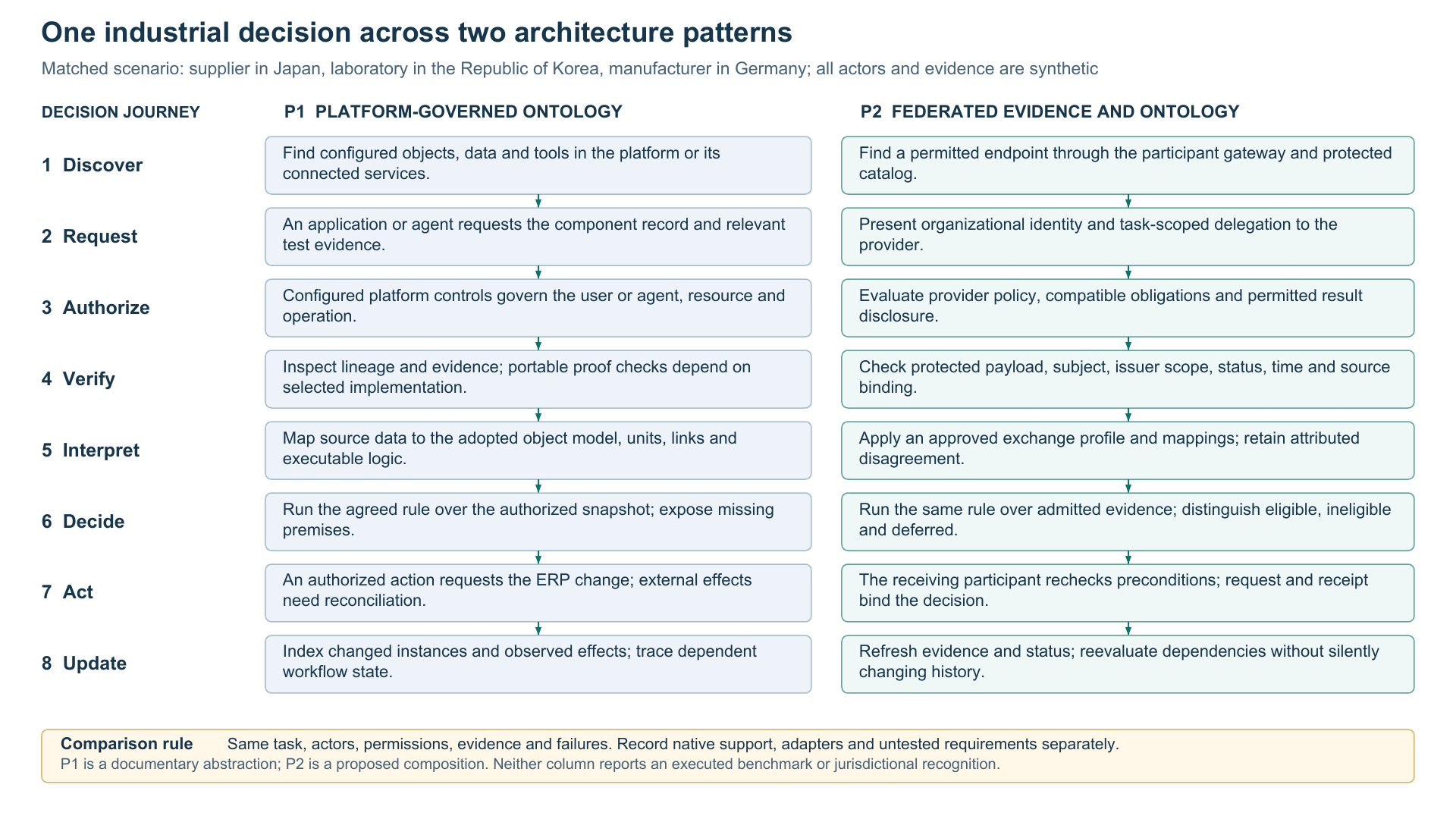
Start with a decision that crosses real organizational boundaries: accepting a component, reviewing a changed test report or assembling a release dossier. Agree the relevant identifiers, vocabulary, evidence requirements and responsibilities. Keep each participant’s source processing and action authority local. Exchange only what the task permits. Then test the complete workflow, including missing permission, stale evidence, conflicting claims and service failure.
Measure correctness and unsupported claims, end-to-end response time, tokens and total cost, evidence freshness, recovery and provider substitution. Include the cost imposed on suppliers and laboratories. Demonstrate that a replaceable provider can change without silently losing meaning, authority, evidence history or required behavior. These tests should guide fast-track dataspace modernisation and procurement.
Build the first interoperable evidence workflow with us. We invite manufacturers, suppliers, laboratories, platform providers, standards communities and public-sector partners to agree one useful decision, a shared vocabulary and an open test protocol. Bring a real use case and help demonstrate cooperation across providers. Collaborative leadership matters because no single company can establish an ecosystem’s meaning, trust and operating rules alone.
Discuss a first-mover collaboration →
What is established—and what remains to test?
- Documentary findings: Palantir documents operational ontology and multi-organization ecosystems. European dataspaces, policy initiatives and standards provide distinct foundations.
- Proposed architecture: P2 composes independently governed implementations with shared meaning, discovery, trust and local action authority.
- Untested outcomes: No integrated production federation, authenticated Palantir comparison, signature verification or comparative performance benchmark was executed. Correctness, freshness, resilience, cost, latency and provider substitution must be demonstrated together.
Editorial review does not mean external journal peer review or acceptance. The v1.0 releases are version-only releases from academic 0.6 and executive 0.5; no new experiments were added. The graph remains the separate fictional 0.1.0 release.
Sources, methods and research boundaries
The papers combine targeted primary-source review, platform economics, comparative architectural synthesis and a proposed matched industrial experiment. Research cutoff: 1 November 2026. This is not a systematic review of every enterprise AI platform. The unchanged PDFs contain the complete, separate bibliographies (101 academic and 30 executive references).
- Palantir: Ontology system — operational architecture; academic reference 1.
- Palantir: multi-organization ecosystems — documents multi-organization support.
- Decentralized Identity as a Meta-platform — cooperation argument; academic reference 7. The paper’s research used the complete Markdown version; equivalence to this linked final PDF was not established.
- European Commission: Common European Data Spaces — programme context, not evidence that P2 is deployed.
- EU International Digital Strategy, official document — digital diplomacy context, academic reference 5.
- Eclipse Dataspace Components: adopters and policy engine — gateway implementation context and policy evaluation.
- W3C ODRL Information Model 2.2, Verifiable Credentials Data Model 2.0 and DPP/Business Wallet Task Force — standards and task-force work have distinct maturity and status.
- UNTP specification and governance — traceability cooperation context, not universal recognition.

Open research
License and citation
This collection of both version 1.0 papers, original figures, research-page content and fictional teaching data is licensed by its named author under the Creative Commons Attribution 4.0 International License (CC BY 4.0), except for the third-party material identified below. Reuse must credit every named author, link to this canonical version and the license, and indicate whether changes were made.
Third-party rights: Referenced third-party material retains its own terms. © 2026 Dr. Carsten Stöcker, Spherity GmbH.
A European Answer to Palantir
Stöcker, C. (2026). A European Answer to Palantir: A globally collaborative counter model for industrial AI (Version 1.0). Spherity GmbH. https://spherity.github.io/spherity-research/European_Industrial_AI_Executive_Brief_v1.0.pdf
A Global Cooperation Model for Sovereign Industrial AI
Stöcker, C. (2026). A Global Cooperation Model for Sovereign Industrial AI: European dataspaces and open standards for verifiable evidence across platforms (Version 1.0). Spherity GmbH. https://spherity.github.io/spherity-research/Industrial_AI_Academic_Paper_v1.0.pdf
Direct answers
Questions this research answers
What is Europe’s answer to Palantir?
This research proposes industrial cooperation across independently governed platforms, using shared semantics, access control and verifiable evidence. Europe’s dataspace experience can help convene that effort globally. It is a design and modernization agenda, not the announcement of a completed European substitute.
Does Palantir only work inside one company?
No. Palantir documents multi-organization ecosystems. The comparison concerns platform-centred integration versus cooperation across independently governed implementations. It does not assert a universal closed-world semantics or a single-company limit.
Why does the ontology matter for AI?
An ontology makes relevant concepts and relationships explicit. A graph can connect a specific component, configuration, report and decision rule so software and people can inspect the evidence. The result can improve grounding and repeatability, provided the mappings, sources and controls are maintained.
Do knowledge graphs eliminate hallucinations or always make AI faster?
No. They can reduce irrelevant context and help check support for claims. Incorrect links, weak sources or unsupported model explanations remain possible. Measure the complete workflow, including graph construction, retrieval and verification costs.
Does open-world semantics mean open access to company data?
No. Open-world semantics treats knowledge as potentially incomplete. Access control decides who may discover or use particular records, relationships and results. A shared vocabulary does not grant permission to read the data that use it.
Are today’s dataspaces already ready for AI-first infrastructure?
That is not established by this research. Current components need workload-specific tests for throughput, latency, volume, evidence freshness and authorization. The papers argue for fast-track modernisation that meets performance and trust requirements together.
What does the robot graph demonstrate?
It shows how fictional evidence can support a configured product and how a withdrawn report can trigger reassessment of dependent decisions. It does not verify signatures, certify a robot or decide whether a regulation applies.
Can one graph automate compliance with every regulation?
Selected evidence can be reused across assessments, but each has its own applicability, authority, evidence and decision criteria. The demonstration separates seven assessment lenses and does not produce a universal compliance approval.
How can companies participate?
Bring a bounded cross-company decision, the relevant participants and a willingness to agree vocabulary, evidence rules and open tests. Spherity invites first movers to test useful cooperation and provider substitution against measurable outcomes.